Showing posts with label consciousness shadow-speaking. Show all posts

Thursday, September 25, 2025

Consciousness Shadow-Speaking Is Only a Fraction of Materialism's Complexity Coverup

 Let us imagine someone showed you some cards on a table in his backyard, some cards that had been arranged into something that looked like a house of cards. Suppose the person tried to persuade you that no one had purposefully arranged the cards into such a house-like structure, and that the structure had appeared because of purely random, accidental effects (such as say, friction or random wind gusts). The more complex such a house of cards was, the less likely you would be to believe such an explanation.

If the person showed you a “house of cards” consisting of only one card leaning against another card to make an upside-down “V” shape, you might easily be willing to believe the person's theory of accidental construction. But suppose the person showed you a “house of cards” consisting of twenty cards. You then would be vastly less likely to believe the person's theory of accidental construction. If the person showed you a “house of cards” consisting of 50 cards, like the one below, you would never accept any theory that such an intricate and hard-to-achieve arrangement had occurred by chance.


Speaking more generally, I can evoke a general rule: what I can call the first rule of accidental construction.

The first rule of accidental constructionthe credibility of any claim that an impressively organized final result was accidentally achieved is inversely proportional to the number of parts that had to be well-arranged to achieve such a result, and the amount of organization needed to achieve such a result.

Because of this general rule, the rule that the more functionally organized something is the less likely it arose accidentally, there is a very important relation between the degree of organization and complexity in biological organisms and the credibility of Darwin's theory of natural biological origins. The relation is that the credibility of Darwin's theory of natural biological origins is inversely proportional to the degree of organization and functional complexity in biological organisms. The more organized and functionally complex that biological organisms are, the less likely that they might have appeared because of any accidental process.

Biological organisms have enormously high levels of organization. We know how to put together piece by piece aircraft carriers equipped with all their jets, but there is no team of scientists that could ever put together from scratch a living human body, by a molecule by molecule arrangement of parts.  The human body has a more impressive degree of organization and complexity than any machines humans have ever manufactured. So the advocates of Darwinism have a tough situation. If they realistically depict organisms such as humans as being as functionally complex and hierarchically organized as they are, all attempts to sell Darwinism will be undermined. So the asvocates of Darwinism routinely attempt to portray organisms and their parts as being vastly less complex than they are.

Again and again (particularly when speaking to the general public), mainstream biologists will give us kind of kindergarten sketches of biological life, in which organisms or their parts are depicted as being enormously simpler than they are. They use a series of tricks by which people may be fooled into thinking that organisms and their parts are a hundred times simpler or a thousand times simpler or a million times simpler than they are.

To perform such a concealment, biologists very often engage in what I call shrink-speaking, which is misleadingly describing something as if it were vastly simpler than it is.  A person who describes the United States of America as "just a bunch of buildings" is engaging in shrink-speaking, as does a scientist who refers to you as "a bunch of chemical compounds." The same shrink-speaking would occur if someone described the volumes of a public library as "just some ink marks on paper."

Below are some of the tricks that are used as part of this gigantic complexity concealment. The tricks are most commonly used when professors are writing books for the general public or articles designed to be read mainly by the general public. Conversely, inside scientific papers rarely read by the public, professors often discuss the vast amount of organization and functional complexity of living things. 

Trick #1: The Frequent Mention of “Building Blocks of Life”

Scientists and science writers have long claimed that “building blocks of life” were produced by certain experiments, although the claims made along these lines are very erroneous and misleading. More baloney has been written about the Miller-Urey experiment (an experiment claimed to have produced “building blocks of life”) than almost any other scientific topic.

Without reviewing the huge number of misstatements that have been made about origin-of-life research, we can merely consider how utterly misleading is the very phase “building blocks of life.” The very term suggests that the simplest life would be something very simple. When we think of what is made from building blocks, we can think of something as simple as a wall or a simple house made of cinder blocks or bricks. But all cells are incomparably more complex than a simple house.

The building components of cells are organelles, which make up even the simplest prokaryotic cells. The building components of organelles are proteins and protein complexes, and the building components of proteins are mere amino acids. Whenever anyone describes an amino acid or a nucleobase as a “building block of life.” that person is misrepresenting the complexity of life. An amino acid is merely a building component of a building component (a protein) of a building component  (an organelle) of a cell.

Trick #2: Misleading Cell Diagrams

A staple of biological instruction materials is a diagram showing the contents of a cell. Such diagrams are usually profoundly misleading, because they make it look like a cell is hundreds or thousands of times simpler than it actually is.

Specifically:

  • A cell diagram will typically depict a cell as having only a few mitochondria, but cells typically have many thousands of mitochondria, as many as a million.
  • A cell diagram will typically depict a cell as having only a few lysosomes, but cells typically have hundreds of lysosomes.
  • A cell diagram will typically depict a cell as having only a few ribosomes, but a cell may have up to 10 million ribosomes.
  • A cell diagram will typically depict one or a few stacks of a Golgi appartus, each with only a few cisternae, but a cell will typically have between 10 and 20 stacks, each having as many as 60 cisternae.
  • Cell diagrams create in the mind the idea of a cell as a static thing, when actual cells are centers of continuous activity, like some active factory or a building that is undergoing continous construction and remodeling. 
misleading cell diagram

Trick #3: Claiming that a Human Could Be Specified by a Mere “Blueprint” or “Recipe,” and Claiming DNA Has Such a Thing

The idea that DNA is a blueprint or recipe for making a human being is a claim that is both false and profoundly misleading, giving people a totally incorrect idea about the complexity of human being. It is false that DNA has any such thing as a recipe or blueprint for making a human. DNA contains only low-level chemical information such as information about the amino acids that make up proteins. DNA does not contain high-level structural information. DNA does not specify the overall body plan of a human, does not specify how to make any organ system or organ of a human, and does not even specify how to make any of the 200 types of cells in the human body. See this post for the statements of 18 science authorities telling you that DNA is not a blueprint or a recipe for making organisms.

Besides giving us an utterly false idea about the contents of DNA, claims such as “DNA is a blueprint for making humans” or “DNA is a recipe for making humans” create false ideas about the complexity of human beings. A blueprint is a large sheet of paper for doing a relatively simple construction job. A recipe is a single page for doing a relatively simple food preparation job. So whenever we hear people say something “DNA is a blueprint for making a human” or “DNA is a recipe for making a human,” we think that the construction of a human is a relatively simple affair. In reality, a human body is many thousands or millions of times too complex to be constructed from any blueprint or recipe.

If you were to give an analogy that would properly convey how complex would be the instructions needed for building a human, you might refer to something like a “a long bookshelf filled with many volumes of construction blueprints" or a “long bookshelf filled with recipe books.” But even such analogies would poorly describe the instructions for making a human, as they would be give you the idea of a human being as something merely static, rather than something that is internally dynamic to the highest degree.

Trick #4: Trying to Conceal the Complexities of Human Minds, by Claiming that Human Minds Are Like Animal Minds

Humans are enormously complex not only in their physical bodies, but in their minds. The human mind is its own separate ocean of mental complexity apart from the ocean of physical complexity that is the human body. Darwinists have always had the greatest difficulty in accounting for the subtleties and complexities of human minds and human behavior. Very much of our mental activity seems like something inexplicable under any theory of natural selection. Much of what our minds do (such as mathematical ability, artistic creativity and philosophical reasoning) is of no survival value, and cannot be explained under any reasoning of survival-of-the-fittest or natural selection.

Darwinists have usually dealt with this problem by taking an approach of claiming that mentally humans are like animals. Such a claim is a gigantic example of complexity concealment, a case of trying to cover-up the complexities of the human mind, by sweeping them under the rug. Darwin committed this error most egregiously in a passage of The Descent of Man in which he made the extremely absurd claim that " there is no fundamental difference between man and the higher mammals in their mental faculties." 

Trick #5: Using the Shadow-Speaking Term "Consciousness" To Refer to Human Mentality

A very common trick of modern scientists is to refer to the human mind (an extremely multifaceted and complex reality) by the minimalist term "consciousness,"  which would be a suitable term for describing the mind of an insect. A dictionary defines consciousness as being awake and aware of your surroundings. But human mentality is something vastly more complex and multifaceted than that. So using the term "consciousness" for human mentality is an example of shadow-speaking, language that makes something look like a mere shadow of what it is. 

While the term "problem of consciousness" is often used, what we actually have is not some mere "problem of consciousness" but an extremely large “problem of explaining human mental capabilities and human mental experiences” that is vastly larger than merely explaining consciousness. The problem includes all the following difficulties and many others:
  1. the problem of explaining how humans are able to have abstract ideas;
  2. the problem of explaining how humans are able to store learned information, despite the lack of any detailed theory as to how learned knowledge could ever be translated into neural states or synapse states;
  3. the problem of explaining how humans are able to reliably remember things for more than 50 years, despite extremely rapid protein turnover in synapses, which should prevent brain-based storage of memories for any period of time longer than a few weeks;
  4. the problem of how humans are able to instantly retrieve little accessed information, despite the lack of anything like an addressing system or an indexing system in the brain;
  5. the problem of how humans are able to produce great works of creativity and imagination;
  6. the problem of how humans are able to be conscious at all;
  7. the problem of why humans have such a large variety of paranormal psychic experiences and capabilities such as ESP capabilities that have been well-established by laboratory tests, and near-death experiences that are very common, often occurring when brain activity has shut down;
  8. the problem of how humans have such diverse skills and experiences as mathematical reasoning, moral insight, philosophical reasoning, and refined emotional and spiritual experiences;
  9. the problem of self-hood and personal identity, why it is that we always continue to have the experience of being the same person, rather than just experiencing a bundle of miscellaneous sensations;
  10. the problem of intention and will, how is it that a mind can will particular physical outcomes.
It is therefore an example of a complexity cover-up and concealment for someone to refer to the human mind as merely "consciousness" or to speak as if there is some mere "problem of consciousness" when there is the vastly larger problem of explaining human minds that are so much more than mere consciousness.  Calling a human mind "consciousness" (a good term for describing the mind of a mouse) is like calling a city a bunch of bricks and lumber. 

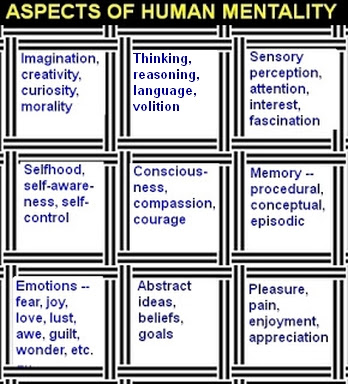
aspects of human mentality
Our minds are so much more than just "consciousness"

The diagram helps show the stupidity of the approach taken by many of today's thinkers, an approach in which the thinker tries to make his explanation task a million times easier by the trick of describing a mere "problem of consciousness" that needs to be solved.   The human mind and its capabilities and experiences is a reality a million times more than mere "consciousness."  It is an absurd problem misstatement to describe the problem of explaining human minds as a mere problem of explaining consciousness.  The person who makes that mistake is committing a blunder as bad as the person who tries to reduce the problem of explaining the arising of human bodies to a mere "problem of solidity origination." 

complexity of human minds

Trick #6: Trying to Conceal the Complexities of Human Minds, by Denying the Evidence for Psi and Paranormal Abilities

As you can see by reading the 200+ posts here, we have two hundred years of very good observational and experimental evidence for paranormal human abilities such as clairvoyance and ESP, very much of it published in the writings of distinguished scientists and physicians. But the existence of such abilities is senselessly denied by very many of our professors. Denying the reality of psi is essentially a cover-up, a case of sweeping under the rug complexities of the human mind that you would prefer not to deal with it, for the sake of depicting human minds as being much simpler than they are.  

Trick #7: Failing to Describe the Complexity of Typical Protein Molecules or Larger Protein Molecules

When biologists and writers on biology describe protein molecules, they typically tell us that protein molecules have "many" amino acids. But almost never are we given a statement that informs about how complex protein molecules are.  It is very easy to do such a thing. 

The first way to do such a thing is by simply mentioning that the average human protein molecule has about 370 amino acids, and that very many types of human protein molecules consist of thousands of specially arranged amino acids.  Another way to do this by an analogy. If we compare an amino acid to a letter, we can say that the average protein has the information complexity of a well-written paragraph, and that the larger protein molecules have the information complexity of a well-written page of text.  

But we almost never are told such facts. Nine times out of ten a reader will simply be vaguely told that there are "many" amino acids in a a protein. The complexity of protein molecules are almost always hidden from readers, who may go away with the very incorrect idea that a protein molecule consists of only 10 or 20 amino acids. 

Trick #8: Failing to Discuss the Sensitivity of Protein Molecules

There are two ways to get an understanding of how organized and fine-tuned protein molecules are. The first is to learn how many parts they have (typically several hundred amino acid parts). The second is to learn how sensitive such molecules are to small changes, how easy it is to break the functionality of a protein by changing some of its amino acids. Some important papers have been written shedding light on how the functionality of protein molecules tends to be destroyed when only a small percentage of the molecule is changed. One such paper is the paper here, estimating that making a random change in a single amino acid of a protein (most of which have hundreds of amino acids) will have a 34% chance of leading to a protein's "functional inactivation."  Such papers tell us the very important truth that protein molecules are very sensitive to small changes, which means that they are exceptionally fine-tuned and functionally organized. But we almost never hear our professors discuss this extremely relevant truth. 

Trick #9: Failing to Tell Us Protein Molecules Are Very Often Functional Only As a Part of Protein Complexes Involving Multiple Proteins

Protein complexes occur when a protein is not functional unless it combines with one or more other proteins, which act like a team to create a particular effect or do a particular job.  When writing for the general public, our biology authorities conveniently mention as infrequently as they can the extremely relevant fact that a significant fraction of proteins are nonfunctional unless acting as team members inside a protein complex, a fact that makes Darwinian explanations of human biochemistry seem exponentially more improbable.  An example is a recent paper estimating the likelihood of photosynthesis on other planets,  which very misleadingly refers to photosynthesis as being something with "overall simplicity," conveniently failing to mention that photosynthesis requires at least four different protein complexes, making it something that can only be achieved by extremely organized functional arrangements of matter, incredibly unlikely to ever appear by chance of Darwinian processes. 

Trick #10: Not Telling Us How Many Protein Molecules Are in a Typical Cell

How many protein molecules are in a typical cell? I doubt whether one high-school graduate in 10 could correctly answer this question within a factor of 100. Biology's concealment aces are good about hiding this important information from us.  The answer (about 40 million) almost never appears in print.  We do sometimes hear mention of the fact that the human body contains more than 20,000 different types of protein molecules (each a separate complex invention), but not nearly as often as we should. 

Trick #11: Misleading "Cell Types" Diagrams Suggesting There Are Only a Few Cell Types

How many different cell types are there in the human body? Our biologists frequently publish "cell types" diagrams listing only a few types of cells. Such charts cause people to think there are maybe 5 or 10 types of cells in the human body.  The actual number of cell types in the human body is something like 200. When did we ever see a diagram suggesting this reality?

Trick #12: Describing Human Bodies As If They Were Static Things, Ignoring the Vast Internal Dynamism of Organisms and Cells

Inside the human body and each of its cells there are a thousand simultaneous choreographies of activity.  The physical structure of a cell is as complex as the physical structure of a factory, and the internal activity inside a cell is as complex as all of the many types of worker activities going on inside a large factory. Such a very important reality is almost never discussed by our professors when writing for the public. Such people love to describe cells as "building blocks," as if they were static things like bricks or cinder blocks.  

Trick #13: Failing to Describe the Hierarchical Organization of Human Bodies

The organization of organisms is extremely hierarchical.  Subatomic particles are organized into atoms, which are organized into relatively simple molecules such as amino acids, which are organized into complex molecules such as proteins, which are organized into more complex units such as protein complexes and cell structures called organelles, which are organized into cells, which are organized into tissues, which are organized into organs, which are organized into organ systems, which (along with skeletal systems) are organized into organisms.  You will virtually never read a sentence like the previous one in something written by a professor, and we may wonder that this is because a sentence like that one makes too clear the extremely hierarchical organization of organisms, something many of our biologists rather seem to want us not to know about. 

Trick #14: Making It Sound As If Particular Organs Accomplish What Actually Requires Organ Systems and Fine-Tuned Biochemistry

In discussions involving biological origins, our professors often speak as if an eye will give you vision or a heart will give you blood circulation, or a stomach will give you food digestion.  But nobody sees just by eyes; they see by means of extremely complicated vision systems that require eyes, optic nerves, parts of the brain involved in vision, and very complex protein molecules.  And hearts are useless unless they are working with extremely complex cardiovascular systems that include lungs, veins, arteries, capillaries and very complex biochemistry.  And nobody digests food simply through a stomach, but through an extremely complicated digestive system consisting of many physical parts and very complex biochemistry. Our professors do an extremely poor job of explaining that things get done in organisms only when there are extremely complex systems consisting of many diverse parts working like a team to accomplish a particular effect. 

Trick #15: Making Scarce Mention of the Countless Different Types of Incredibly Fine-Tuned Biochemistry Needed for Organismic Function

Everywhere biological functionality requires exquisitely fine-tuned biochemistry. But we rarely hear about that in the articles and books of professors written for the general public.  An example of such fine-tuned biochemistry is the biochemistry involved in vision, which a biochemistry textbook describes like this:
  1. Light-absorption converts 11-cis retinal to all-trans-retinal, activating rhodopsin.
  2. Activated rhodopsin catalyzes replacement of GDP by GTP on transducin (T), which then disassociates into Ta-GTP and Tby.
  3. Ta-GTP activates cGMP phosphodiesterase (PDE) by binding and removing its inhibitory subunit (I).
  4. Active PDE reduces [cGMP] to below the level needed to keep cation channels open.
  5. Cation channels close, preventing influx of Na+ and Ca2+; membrane is hyperpolarized. This signal passes to the brain.
  6. Continued efflux of Ca2+ through the Na+-Ca2+ exchanger reduces cytosolic [Ca2+].
  7. Reduction of [CA2+] activates guanylyl cyclase (CG) and inhibits PDE; [cGMP] rises toward “dark” level, reopening cation channels and returning Vm to prestimulus level.
  8. Rhodopsin kinase (RK) phosphorylates “bleached” rhodopsin; low [Ca2+] and recoverin (Recov) stimulate this reaction. Arrestin (Arr) binds phosphorylated carboxyl terminus, reactivating rhodopsin.
  9. Slowly, arrestin dissociates, rhodopsin is dephosphorylated, and all-trans-retinal is replaced with 11-cis-retinal. Rhodopsin is ready for another phototransduction cycle.
We hear no mention of such requirements in typical discussions of the origin of vision, nor do we hear a discussion of how vision requires certain protein molecules consisting of hundreds of parts arranged in just the right way.  Instead, our professors often speak as if vision could have kind of got started if something very simple existed.  Such insinuations are absurdly false. 

Such biochemical requirements are all over the place in biology. In general, any physical function of a body requires a vast amount of enormously complicated biochemistry which has to be just right. But you would hardly know such a thing from reading a typical article or book written by a professor.  The mountainous fine-tuned biochemistry complexity of every physical operation of living things is rarely mentioned, just as if our professors were trying to portray organisms as a thousand times simpler and less organized than they are.  

Darwinism seems to be of very little value in explaining such biochemistry. For example, the thirtieth edition of Harper's Illustrated Biochemistry is an 800-page textbook describing cells, genes, enzymes, proteins, metabolism, hormones, and biochemistry in the greatest detail, with abundant illustrations. The book makes no mention of Darwin, no mention of natural selection, and only a single mention of evolution, on a page talking only about whether evolution had anything to do with limited lifespans.

In papers and textbooks professors may accurately describe the complexities of humans, but so often in books and articles for the public such professors use sentences that can be compared to crude cartoon sketches.   Human minds have oceanic depths of complexity, and human bodies have oceanic depths of organization. But very often it is as if reductionist shrink-speaking professors describe such oceanic realities as if they were crummy little puddles. 

oversimplification by scientists

Monday, December 2, 2024

The Problem of Explaining Human Minds Is a Million Times Larger Than a Mere "Problem of Conscious Experience"

 There is a branch of physical science that has great relevance to the philosophy of mind: neuroscience. What has been learned about brains has very much relevance to questions such as whether the brain is the source of the human mind and whether the brain could be a storage place of human memories. The science of psychology also has great relevance to the philosophy of mind. But other sciences have much less relevance to the philosophy of mind.  The science of physics has no great direct relevance to the philosophy of mind, although it does have an indirect relevance I will mention near the end of this post. 

Because of a lack of any direct relevance of physics to the philosophy of mind, we should not tend to be overly impressed when physicists write on questions in the philosophy of mind, particularly when they sound like  dilettantes making rather brief trips into topics of oceanic depth that they have not deeply studied. A recent example of such a thing may be found in the paper "The mind-brain relationship and the perspective of meaning" by physicist Ranjan Mukhopadhyay.

Ranjan goes wrong in his first sentence by stating that the two chief problems are "how subjective conscious experience can arise from physical neurological processes and how conscious mental states can causally act upon the physical world."  We have here the same mistake that scientists so often make: the mistake of asking "how causes y" when you don't know if causes y. We do not actually know that human mental activity arises from physical neurological processes, and there are very many reasons (discussed in the posts of this blog) for thinking that the human brain cannot be the source of the mind. It is always a huge mistake to assume that causes y without adequate warrant and to then limit your investigation into "how x causes y" rather than deeply diving into the question "is it true that x causes y?"  Nature never told us that brains cause minds.  When I retrieve an apple from a table, my senses give me two reasons for believing that my hand was involved in such a retrieval: the sight of my hand touching the apple, and the feel of my fingers touching the apple. But if I retrieve from my memories a memory of my youth, my body does nothing whatsoever to hint that my brain was the cause of such a retrieval. 

On page 2 of the paper we have a quote that shows how wrong Ranjan has gone. He states this:

" The brain consists of an intricate network of neurons that communicate with each other via a combination of electrical and chemical signals (Bear et al., 2006). It appears reasonable to assume that the brain is carrying out computations in the sense of processing information from the surroundings, the information being transmitted, for example, in the form of electrical impulses, processing this information, and sending out instructions about how the body should react to the environmental cues. Given the immense complexity of the brain, maybe it’s not surprising that we do not understand the details of how the brain accomplishes this. The true puzzle is how conscious experience fits into this picture. What rules govern how the brain will interpret certain patterns of neural firings as pain, or pleasure, or sorrow, or joy? How can we explain our sensations in physical terms, given that we do not even understand how to represent such subjective mental states in physical or mathematical ways?"

We have here the very great error of making a gigantic philosophical and scientific conclusion (that we act in some way because our brain is "sending out instructions about how the body should react to the environmental cues"),  a conclusion not reached by some reasoning process and pondering of evidence, but merely by making an assumption. No, it does not "appear reasonable to assume" that the brain is doing any such thing, particularly given a complete lack of any understanding of how a brain could ever make a decision on how someone should act.  Computers produce computation by virtue of such inventions as an operating system (e.g. Windows or UNIX), and things such  as application software. The brain has no such things, and has no unit comparable to a CPU (one that sequentially processes logical instructions). So it does not at all "appear reasonable to assume" that the brain is doing computations that lead it to "sending out instructions about how the body should react to the environmental cues." We also have in the statement above the very big nonsense of trying to speak as if there is only one puzzle in the philosophy of mind, by making the claim that  "the true puzzle is how conscious experience fits into this picture."  The philosophy of mind is filled with very many deep puzzles.

brain is not a computer
See here for why brains are not like computers. 

The problem is that humans have a huge variety of mental experiences and mental capabilities, normal and anomalous; and "the brain caused it" explanations fail all over the place. We don't have any credible neural explanations for how humans think, imagine, believe, learn, form memories and instantly recall.  Ranjan gives us a lame excuse for the failures to produce credible neural explanations for such things, saying, "Given the immense complexity of the brain, maybe it’s not surprising that we do not understand the details of how the brain accomplishes this."  If brains were responsible for things such as the creation of memories and the retrieval of learned information, there would be evidence of such a thing all over the place in the brain; but such evidence has not been found.  Saying "the brain is very complex" is a lame excuse for such an observational failure. The truth is that we haven't found "how the brain accomplishes this" (despite very many billions in funding for high-tech neuroscience research) because the brain does not accomplish any such thing. 

Ranjan sounds like he hasn't done his homework in studying human mental phenomena (a topic of oceanic depth) and that he hasn't done his homework by making a very deep study of the human brain and whether it actually has the characteristics we would expect it to have if it was the source of the human mind and the storage place of human memories that can last for 60 years and can be instantly recalled.  On page 5 he claims that a deep analysis of quantum mechanics is important in dealing with these issues. It sounds like someone who hasn't done the studies he should have done trying to compensate by appealing to some esoteric topic that he does know well. It's kind of like someone who hasn't learned how to fly a plane claiming while trying to fly a plane that he does know well how to ride a motorcycle, and this will be sufficient.  

Quantum mechanics has no very big relevance to topics of the philosophy of mind. I could list 100 books you should read before writing a book about the nature of the mind, and a book on quantum mechanics would not be one of those books. 

Ranjan then spends several pages discussing quantum mechanics (not very clearly), and uses his discussion as some justification for some claim that there is some "underlying proto-consciousness" that might help to explain minds. We seem to get nothing of much value in the next pages, which wander around a large variety of topics, failing to offer much of anything in the way of insights or credible ideas. But then the author in his conclusion makes this triumphal proclamation: "In this paper, I have developed a framework which can successfully unsnarl the knot and provide a convenient starting-point for developing a systematic theory of the mind and consciousness, thus converting a seemingly unsolvable philosophical mystery to a problem that can then be addressed using the methods of neurobiology, psychology, and cognitive neuroscience." No, it sounds more like author has just said a few things about quantum mechanics and "proto-consciousness," and fooled himself into thinking this was some great insight. 

Ranjan errs in claiming that his idea is a top-down theory of consciousness.  You have a top-down theory of the human mind when you postulate a human mind being produced by something greater than a human mind, and a bottom-up theory when you postulate a human mind being produced by something less than a human mind. The "proto-consciousness" Ranjan imagines is something less than a human mind, so his theory is a bottom-up theory. 

Alas, our physicist sounds like a dabbler and a dilettante making a quickie sojourn into the philosophy of mind, a topic far beyond his expertise. He shows no signs of having very deeply studied either brains or minds, and makes some statements sounding like he has not done either. Brains plus some vague quantum-mechanics-flavored "proto-consciousness" do not explain human minds, which have such a rich variety of characteristics and capabilities beyond any neural explanation. The topic of minds and human mental experiences is a topic of oceanic depth, and we should not expect much from those who just briefly wade around in such an ocean.

Part of the problem seems to be that in this paper and another similar paper Ranjan (like many others) seems to have fallen "hook, line and sinker" for the "one big thing left" myth promulgated by philosopher David Chalmers.  Chalmers has long taught the extremely misconceived idea that the problems in the philosophy of mind are all easy problems, except for one big problem he calls "the hard problem of consciousness," a problem of explaining subjective awareness.  Chalmers arguments for this idea have always been fallacious. He has repeatedly argued that the other problems in the philosophy of mind are easy because we can conceive of brain observations that might solve them. Chalmers failed to study all the reasons why what we have already observed rules out the brain as the explanation for quite a few mental things other than consciousness: things such as rapid thinking, life long memories and instant knowledge recall. You can imagine someone observing someone on some other planet, observing a brain very different from our brains, a brain that had indexes, addresses, a unit for writing memories, a unit for reading memories, blazing fast and low-noise transmission pathways, a vastly complicated encoding system for translating experiences and learned knowledge into brain states, and also a stable system for storing memories for 60 years.  A person observing such features might then be able to say, "I know how people on this planet use brains to recall instantly and accurately things they learned 60 years ago."  The problem is that neuroscientists have already exhaustively studied the brain, and they have found none of the features just mentioned.  So it's a huge fallacy to talk about hypothetical observations that could be made that might solve problems of explaining phenomena such as instant memory retrieval, blazing fast arithmetic calculation, and life-long memories, when we already can be confident that such observations will not ever occur in regard to human brains,  because the imagined units and components and tendencies would have been discovered long ago if they existed in the human brain. 

It is a gigantic fallacy to think there is merely some "problem of consciousness" when there is a billion  times bigger "problem of explaining human minds and human mental phenomena" that is almost infinitely more complicated.  Once you realize this, you may realize that imagining some quantum "proto-consciousness" does very little to solve the explanatory problems in the philosophy of mind, which are huge and "all over the place."  

consciousness babbling

The trick of posing a mere "problem of consciousness" is a ridiculous ruse. A human being is not merely "some consciousness." A human being is an enormously complex reality, and the mental reality is as complex as the physical reality.  You dehumanize and degrade human beings when you refer to their minds as mere "consciousness." The problem of human mentality is the problem of credibly explaining the thirty or forty most interesting types of human mental experiences, human mental characteristics and human mental capabilities.  Instead of just being  "some consciousness," human beings are minds that have a vast variety of mental capabilities and mental experiences such as these:

  • imagination
  • self-hood
  • abstract idea creation
  • appreciation
  • memory formation
  • moral thinking and moral behavior
  • instantaneous memory recall
  • instantaneous creation of permanent new memories
  • memory persistence for as long as 50 years or more
  • emotions
  • desire
  • speaking in a language
  • understanding spoken language
  • creativity
  • insight
  • beliefs
  • pleasure
  • pain
  • reading ability
  • writing ability
  • mental illness of many different types
  • ordinary awareness of surroundings
  • visual perception
  • recognition
  • planning ability
  • auditory perception
  • attention
  • fascination and interest
  • the correct recall of large bodies of sequential information (such as when someone playing Hamlet recalls all his lines correctly)
  • eyes-closed visualization
  • extrasensory perception (ESP)
  • dreaming
  • pattern recognition
  • social abilities
  • spirituality
  • philosophical reasoning
  • mathematical ability
  • volition
  • trance phenomena
  • exceptional memory such as hyperthymesia
  • extraordinary calculation abilities such as in autistic savants
  • out-of-body experiences
  • apparition sightings 

It is always a silly, stupid trick when someone tries to reduce so complex a reality to try and make it sound like the faintest shadow of what it is, by speaking as if there is a mere "problem of consciousness," and talking as if humans are just "some consciousness" that needs to be explained.  Such a shabby, pathetic trick (which can be called consciousness shadow-speaking) is as silly as ignoring the vast complexity of the organization of the human body, and speaking as if explaining the origin of human bodies is just a task of explaining how there might occur "some carbon concentrations."  The person attempting so pathetic a trick is acting as silly as a person who stands at the seashore, fills a glass with seawater, and says, "Oceans are easy to explain -- they're just water."  Just as the ocean includes trillions of deep, baffling complexities such as all of the organization and biochemistry of sea creatures -- something infinitely more complex than mere water -- the human mind and human mental experiences involve trillions of complexities, and such a reality is something almost infinitely more complex than mere "consciousness."  The reductionist who engages in consciousness shadow-speaking is someone engaging in a trick as misleading as someone who says, "Mathematics is real simple -- it's just counting." 

consciousness misspeaking

The vast majority of people who try to reduce the mountain-sized problem of explaining human minds and human mental experiences in all their variety into the mouse-sized problem of explaining some mere dry abstraction of "consciousness"  are people who were too lazy to deeply study minds and brains, and who used this stupid trick of shadow-speaking to try to make their explanation job a million times easier.  People who lack credible explanations for very complex realities (whether physical or mental) love to use shabby word tricks in which they try to make the complex realities sound a million times simpler than they are. 

The dialog below illustrates the stupidity of trying to explain human minds by describing a human mind as mere "consciousness" and then trying to create a "theory of consciousness" that applies to everything conscious. 

James: John, I've made great progress in explaining how the human body arises during a mother's pregnancy.

John: Great, tell me about it.

James: I call my explanation a “theory of solidity.”

John: A theory of solidity?

James: Yes, because that's the essential nature of human bodies, that they are solid. So my theory attempts to explain how solidity arises.

John: I think you've gone in the wrong direction, and made a big mistake.

James: Why?

John: Because a human body is something gigantically greater than mere “solidity.” A human body is a state of vast hierarchical organization, with a oceanic level of functional complexity. For example, in our bodies are 20,000 different protein inventions, most very special arrangements of many thousands of atoms. And we have 200 types of cells, each so complex they are compared to factories. You would do nothing to explain so impressive a reality of physical organization by merely explaining “solidity.” Your body is something gigantically more than mere “solidity.”


James: John, I've made great progress in explaining how the human mind arises.

John: Great, tell me about it.


James: I call my explanation a “theory of consciousness.”

John: A theory of consciousness?

James: Yes, because that's the essential nature of human minds, that they are conscious. So my theory attempts to explain how consciousness arises.

John: I think you've gone in the wrong direction, and made a big mistake.

James: Why?


John: Because a human mind is something gigantically greater than mere “consciousness.” You and I are not merely “some consciousness.” We are thinking, believing, seeing, reading, hearing, loving imagining minds with insight, emotions, viewpoints, and a great variety of mental powers such as instant learning ability, the ability to hold memories for decades, and the ability to instantly recall knowledge when only hearing a word or seeing a face. Human minds and human mental experiences are a reality of oceanic depth, so much more than mere “consciousness.”

The same complaints I make above about Ranjan's sojourn into the philosophy of mind apply with equal force against a recent  article by cosmologist/physicist Ethan Siegel, one entitled "Can the known particles and interactions explain consciousness?" As far as I can guess from many years of  reading his articles that are too-frequently promoted by Google News, Siegel seems to have never lifted a finger to seriously study minds, brains or human mental experiences. So he spends almost all of his article telling us about what he does know about (physics), without doing anything to explain how what he is discussing has any relation to explaining minds. We hear nothing that is of any value in explaining how particles or physical interactions could give rise to human minds. We get what sounds like a "laziest effort" sojourn into the philosophy of mind. We get the silly claim, "We should, therefore, be able to take these fundamental constituents of matter — quarks, gluons, and electrons — and assemble them in various ways to explain everything that we encounter in everyday life."  Humans are no more capable of creating a living and thinking human adult body by assembling subatomic particles than fish are capable of building aircraft carriers; and every human body is a state of organization greater than any object humans have constructed. 

Consider the human body. The human body is a fantastically complex arrangement of matter. The very many types of complex molecules and cells in the human body contain various different elements, including hydrogen, oxygen, carbon, nitrogen, phosphorus, calcium and iron. Now suppose someone were to try to analyze a human body by only analyzing the hydrogen in it, the simplest element in it. That would be folly. A body having molecules made of multiple different types of elements cannot be meaningfully or wisely analyzed by restricting yourself to an analysis of the simplest element in that body. Anyone trying to analyze a human body by some restricted "hydrogen analysis" has gone hopelessly astray.  Similarly, human minds and human mental experiences consist of a very great number of things rather than some mere primitive of "consciousness."  The person who tries to analyze human minds and human mental experiences by mainly analyzing what he calls "consciousness" is typically someone who has made as big a mistake as someone trying to analyze human bodies by mainly analyzing hydrogen in human bodies. No real insight can be gained by analyzing some very complex reality so that you center your analysis on the simplest thing or simplest aspect of that reality. People  who try to analyze minds by "consciousness analysis" are people as blundering as someone who might try to analyze a human body mainly by "hydrogen analysis."

The person trying to simplify the problem of explaining human minds and human mental experiences by shrinking the problem a million-fold to become a mere problem of explaining some dry abstraction of "consciousness" is like some metaphysician who tries to simply the problem of explaining the universe a million-fold by reinventing the problem as a mere dry "problem of existence" rather than a problem of explaining a universe like the one we have. 

Physics does have an indirect relevance to the philosophy of mind, although it is something entirely different from what Ranjan has discussed. The fundamental constants of physics are enormously fine-tuned in a way that makes possible the existence of life, as I discuss hereherehere and here. We would not expect such fine tuning to exist in any of 1,000,000,000,000,000,000 random universes. The fine-tuning of the universe's fundamental  constants and the fine-tuning of the universe's laws strongly suggest that our universe was produced by some enormous mind of vast power. Realizing how fine-tuned our universe is, and also studying biology which provides evidence of fine-tuning everywhere, it becomes more plausible to believe that our minds have as their source not brains but some transcendent mind vastly greatly than our own minds. 

fine-tuning in nature

Below we see some of the pillars of an advanced philosophy of mind and biology. The fine-tuning of the universe's physical laws and fundamental constants is one of the pillars of such a philosophy. For a discussion of how these things all fit together to be pillars of a single well-justified and evidence-based philosophy of mind and biology, read my long post here

advanced philosophy of mind and biology

Monday, January 16, 2023

The Two Huge Mistakes Involved in Typical Talk of a "Hard Problem of Consciousness"

There are many discussions that talk about a “hard problem of consciousness,” and such discussions tend to involve two huge mistakes. The first mistake is in trying to shrink the gigantic problem of explaining human mentality into a relatively tiny problem of explaining consciousness. 

The visual below may help show what I mean. We see in the grid various diverse aspects of human mentality. There is the problem of  how humans got all these diverse mental aspects and capabilities. As shown in the grid, consciousness is merely a tiny part of human mentality. The grid below is actually a simplification, for it does not even mention many unusual aspects of human mentality that are studied by parapsychologists. 

facets of human mentality

The problem of human mentality is the problem of credibly explaining the thirty or forty most interesting types of human mental experiences, human mental characteristics and human mental capabilities. These include things such as these:

  • imagination
  • self-hood
  • abstract idea creation
  • appreciation
  • memory formation
  • moral thinking and moral behavior
  • instantaneous memory recall
  • instantaneous creation of permanent new memories
  • memory persistence for as long as 50 years or more
  • emotions
  • speaking in a language
  • understanding spoken language
  • creativity
  • insight
  • beliefs
  • pleasure
  • pain
  • reading ability
  • writing ability
  • ordinary awareness of surroundings
  • visual perception
  • recognition
  • auditory perception
  • attention
  • fascination and interest
  • the correct recall of large bodies of sequential information (such as when someone playing Hamlet recalls all his lines correctly)
  • eyes-closed visualization
  • extrasensory perception (ESP)
  • dreaming
  • volition
  • out-of-body experiences
  • apparition sightings 

Reductionist theorists love it when people do not raise the big problem of explaining human mentality but instead raise a much tinier problem of the problem of consciousness. Then such theorists can attempt to offer some little neural explanation and then say, “You see, the brain can explain consciousness.” Whenever such theorists attempt to do that, we should always point out that the problem of explaining human mentality is very many times larger and harder than a mere problem of consciousness.

When such theorists write their articles, they love to reference philosopher David Chalmers, a thinker who coined the phrase "hard problem of consciousness." One of the earliest uses by Chalmers of such a phrase was in a December 1995 Scientific American article by Chalmers. A careful look at the article reveals a great deal going wrong. 

In the article (entitled "The Puzzle of Conscious Experience")  Chalmers makes a very misguided and poorly conceived distinction between what he calls "easy problems of consciousness" and what he calls a "hard problem of consciousness."  Chalmers wrote this:

"The easy problems of consciousness include the following: How can a human subject discriminate sensory stimuli and react to them appropriately? How does the brain integrate information from many different sources and use this information to control behavior? How is it that subjects can verbalize their internal states? Although all these questions are associated with consciousness, they all concern the objective mechanisms of the cognitive system. Consequently, we have every reason to expect that continued work in cognitive psychology and neuroscience will answer them."

This was triumphalist hogwash. We do not know that brains "integrate information from many different sources and use this information to control behavior."  We simply know that humans integrate integrate information from many different sources.  There is no understanding of how a brain could control behavior, no credible theories of how a brain could store learned information, and zero reason to expect that "continued work in cognitive psychology and neuroscience" would lead to some understanding of how neurons could control behavior. The idea of identifying a "hard problem of consciousness" and calling the other problems of explaining minds "easy problems" was  very misguided, a blundering bifurcation.  Nature gave us no warrant for dividing up philosophy of mind problems into one "hard" problem and a bunch of other "easy" problems.  

There are many dozens or hundreds of very hard problems involving the explanation of human minds and human mental experiences. The attempt by Chalmers to insinuate that there was only one hard problem of explaining the mind (what he called a "hard problem of consciousness") was folly.  This is the kind of error that would tend to come from either (1) someone was not a very serious critical scholar of neuroscience and its very many shortfalls, unfounded claims and poor research practices, or (2) someone who was not a very serious and thorough scholar of psychical research and the more hard-to-explain mental phenomena such as paranormal phenomena. 

Just as ill-conceived was how Chalmers defined what he called "the hard problem of consciousness." In his 1995 Scientific American article he defined his so-called "hard problem of consciousness" like this: "The hard problem, in contrast, is the question of how physical processes in the brain give rise to subjective experience."  Because we do not know that any physical processes in the brain give rise to subjective experience, and have very strong reasons for doubting that any such processes exist, it was an error to be posing such a question framed in such a way. It is a big mistake to ask questions that assume some claim that has not been proven, and that there are very good reasons for doubting. 

By 1995 there already existed the strongest reasons for doubting that "physical processes in the brain give rise to subjective experience." One major reason was the complete failure of anyone to explain how subjective experience (something mental) could ever be caused by something merely physical. Another major reason very well documented by 1995 was the existence of human mental experience in persons whose brain was shut down after cardiac arrest.  During near-death experiences people can have extremely vivid subjective experience while their brains have temporarily shut down because their hearts have stopped.  Many cases of that happening had been well documented by 1995. 

In his 1995 article Chalmers makes the poor reasoning below:

"I am not denying that consciousness arises from the brain. We know, for example, that the subjective experience of vision is closely linked to processes in the visual cortex. It is the link itself that perplexes, however. Remarkably, subjective experience seems to emerge from a physical process. But we have no idea how or why this is." 

Some kind of relation between the visual cortex and the "subjective experience of vision" does nothing to establish that "consciousness arises from the brain." Similarly, some kind of link between your eyeglasses and "the subjective experience of vision" does nothing to show that your eyeglasses produce consciousness. Chalmers confesses here that we "have no idea how or why this is" that subjective experience could arise from a brain, but he failed to realize the very obvious implication of such thing: that such a failure should cause us to doubt the dogma that subjective experience does arise from the brain.

What we are left with is a quotation above that sounds as silly as someone saying, "I do not doubt that extraterrestrials are manipulating the US stock market, but I don't know how or why they are doing it."  If you don't know how or why X, then you should typically doubt that you actually know X. 

Later in the same article Chalmers tells us this:

"Thus, a complete theory will have two components: physical laws, telling us about the behavior of physical systems from the infinitesimal to the cosmological, and what we might call psychophysical laws, telling us how some of those systems are associated with conscious experience. These two components will constitute a true theory of everything."

People who say things like this make me wince. Physicists sound very silly every time they talk about a "theory of everything," and philosophers sound every bit as silly when they use that term. The two things mentioned leave out almost everything to be explained in biology, astronomy, cosmology, history, sociology, chemistry and a dozen other major topics, as well as 98% of what needs to be explained to explain the human mind and its experiences (a topic of oceanic depth). Serious and very thorough scholars of the human mind and human mental experiences don't tend to talk in such a way, because they tend to be humbled by the very large variety of utterly baffling phenomena they encounter in their studies. 

At the link here (obtained from a Google Scholar search of Chalmers name) you can read a 1995 book by Chalmers entitled "The Conscious Mind: In Search of a Theory of Conscious Experience." In the second paragraph of this 391-page book, we have an unwise "we're almost finished" kind of claim that "we do not have many detailed theories of cognition, to be sure, but there are few problems of principle; the details cannot be too far off."  This is enormously false. Neuroscientists have not got much of anywhere in explaining any of the main mysteries of the mind, which are very many.  

Reading this book, I fail to get a strong impression of Chalmers being a very serious and thorough scholar of either the human brain or neuroscience (although he uses the term "brain" nearly 200 times). The fact that in the book he only refers to synapses two times (not saying anything  substantive about them) and proteins one time may indicate that when he wrote the book he had failed to do his homework very vigorously, by thoroughly studying the human brain and neuroscientist claims about it and its components, and the physical limitations and shortfalls of the human brain. In the book Chalmers also seems to show no familiarity with psychical research (research into paranormal phenomena), something that should be studied very carefully before anyone should be writing about questions of mind or consciousness. We get no mention of dendrites, no substantive mention of protein molecules, no mention of LTP or long-term potentiation, no mention of claims of engrams. We have on page 37 a false reference to "the fact that all living things are made of DNA." Physically, we are made of cells, and DNA is only one of countless components in cells. 

We get in the book statements sounding like Chalmers has bought "hook, line and sinker" some of the most groundless boasts and ill-founded dogmas of modern scientists. He repeatedly refers to a groundless tenet that there is some "causal closure of the physical," that everything physical (such as human actions) can be explained by something else physical. Such a claim is a groundless dogma.  On page 110 he seems to endorse such a dogma, making the incorrect claim that science tells us that "for every physical event, there is a physical sufficient cause." The claim that every physical event must have a physical cause is no more logically compelling than the claim that every Danish pastry must come from a Danish cook. What Chalmers advocates seems to be a "wolf in sheep's clothing" affair that he calls a dualism, but later reveals to be a "naturalistic dualism." It seems like basically something not much different from materialism.  He claims that not everything is physical, but the way he presents such an idea, it seems there is no practical difference between what he is imagining and materialism, but merely a descriptive difference.  

The reasoning that he gives for his position is some unconvincing reasoning based largely on some armchair argument involving "philosophical zombies." In the book Chalmers uses the word "zombies" 43 times. A "philosophical zombie" is some hypothetical entity having no conscious experience but acting just like a human. Arguments based on the possibility of "philosophical zombies" are misguided and fallacious. There is no reason to think that beings could act just like humans if such beings were not conscious. 

To get some insight into the human mind, you should study in the greatest detail all of the varieties of human experiences, all of the strange things humans have reported seeing and experiencing, and all of the mental capabilities humans have seemed to have. A scholar of the mind should study and write about thousands or many hundreds of specific human beings and the specific capabilities and experiences they have had. Very little will be accomplished by avoiding specifics, and engaging in endless dry abstract philosophical talk about "consciousness," just as very little will be accomplished by a philosopher engaging in endless dry abstract philosophical talk about "existence." In Chalmers' book "The Conscious Mind" he uses the term "consciousness" 1,362 times, but seems to make very few  references to specific humans and their specific experiences.   

There are three main ways to start making some progress in the philosophy of mind: 
(1) The first way is to do a thorough study of the human brain and its components, and the physical shortfalls of the human brain and its components, as well as a thorough critical study of neuroscience and the shortfalls and defective speech customs of current neuoscientists, including a study of their poor experimental practices and their frequent use of unproven dogmatic claims. Such a study should include an exhaustive inquiry into enigmatic case histories of neuroscience, and also a deep sociological study correctly categorizing neuroscientists as members of a modern belief community resembling an organized religion. Always be asking, "What kind of physical characteristics would a brain need to have if it were the source of our minds and the storage place of memories, and does the brain actually have such characteristics?" The person doing such a study will be likely to strongly suspect that "brains make minds" explanatory boasts of neuroscientists are mainly unfounded dogmas or belief community speech customs, rather than claims well-established by observations. 
(2) The second way to start making some progress in the philosophy of mind is to make a very thorough study of the two hundred years of well-documented evidence for psychical phenomena and paranormal phenomena, which are of utmost relevance to topics in the philosophy of mind. This requires a very deep study of the specific experiences which particular humans have had. 
(3) The third way to start making some progress in the philosophy of mind is to very deeply study biology, the vast order and organization of biological systems,  the very many examples of cosmic fine-tuning that help make possible biological systems, and particularly the unsolved problem of the origin of the individual human body, something not explained by DNA, which does not specify anatomy, and does not specify the structure of any cell. A person properly studying such a topic will eventually learn that biologists currently have no credible explanation for the progression from a speck-sized zygote to the vast organization of a human body. Such a failure is of the utmost relevance to the question of how there arises a human mind. If we need a top-down explanation for the origin of human bodies (as we do), that suggests we also need a top-down explanation for the origin of human minds, an explanation different from the bottom-up explanation of mere neural activity. 

In his 1995 book Chalmers seemed to show few signs of having properly studied any of these topics to any great extent. He seemed to sound in that book rather like someone who hadn't properly studied brains and their components and their very many physical shortfalls and limitations, and hadn't properly studied the rich diversity of human mental experiences. His reasoning seems to be mainly armchair reasoning rather than the type of observation-based reasoning that should be the core of someone arguing about minds. This, alas, is what philosophers tend to do. Ignoring hundreds of extremely relevant observations that are of the utmost relevance to philosophical topics, observations requiring deep scholarly study, philosophers spend endless time discussing the armchair arguments of other philosophers. 

Searching for Chalmers' work on Google Scholar, I find a draft of a book by him called Constructing the World, which talks endlessly about the mind, but fails to even use the words "neuron" or "neural" or "brain." This reinforces my impression of someone without much interest in diving very deeply into the low-level details of brains and neuroscience. 

Chalmers wrote very much on mind-related problems during the 25  years following his 1995 Scientific American article. But in a 2018 paper, he sounded rather like he hadn't learned much about the shortfalls of neuroscience, the extreme overconfidence of neuroscientists, the physical limitations and shortfalls of the human brain, and the vast complexities of the human mind and human mental experience, a topic of oceanic depth. In a 2018 paper by Chalmers entitled "The Meta-Problem of Consciousness," we read this very erroneous statement: 

"The hard problem of explaining phenomenal consciousness is one of the most puzzling in all of science and philosophy, and at the present time there are no solutions that command any sort of consensus. The hard problem contrasts with the easy problems of explaining various objective behavioural or cognitive functions such as learning, memory, perceptual integration, and verbal report. The easy problems are easy because we have a standard paradigm for explaining them." 

What an erroneous statement that is at the end. Problems don't become easy because you have some simplistic "this explains everything" paradigm such as "it's all caused by neurons." When you have bad explanations for things, explanations that do not hold water, you have not made very hard problems "easy." And neuroscientists have nothing but bad explanations for "learning, memory, perceptual integration, and verbal report," explanations that do not hold water, for reasons discussed at great length in the posts on this blog. Part of the problem is that the brain bears no resemblance to a device for instantly storing memories, retaining learned information for decades, and allowing the instant retrieval of such information. From our work with computers, humans know the kind of characteristics that such a device would have; and the human brain has no such characteristics (as discussed here and here). 

A position stated so often by Chalmers is one that makes no sense. It is the position that we can believe explaining things like learning and memory are "easy problems," because the neuroscientists claim some progress in understanding them, but that we must regard explaining consciousness as a "hard problem" because no progress has been made in solving it. But the neuroscientists have made just as many boasts about explaining consciousness as they have about explaining memory. So if our neuroscientists are not credible in their claims about having an explanation for consciousness, why should we think that they are credible about having an explanation for learning and memory? A very careful and impartial study of the claims of neuroscientists about having a neural explanation for learning and memory will reveal that they are as groundless as their claims of having an explanation for consciousness. 

On page 5 of the document here, Chalmers states this:

"It is widely agreed that experience arises from a physical basis,
but we have no good explanation of why and how it so arises. 
Why should physical processing give rise to a rich inner life
at all? It seems objectively unreasonable that it should, and yet 
it does." 

How very erroneous, to believe in something "objectively unreasonable," without having any "how" or "why," apparently because "it is widely agreed." Much better to get some idea of the mind that does not require you to believe in things "objectively unreasonable," no matter how much such an idea may defy the prevailing speech customs in academia. 

I cannot claim to have well-studied Chalmers writings other than the few documents I have referred to, so who knows, maybe elsewhere there is some much better insight to be found in his writings, or much better scholarship on some of the topics I have mentioned. Indeed, a 2021 paper by him suggests he may be gaining some better insight. Some of the quotes I have made above may refer to one or more positions that Chalmers no longer holds.  

To summarize, there are two gigantic mistakes involved in typical talk of a "hard problem of consciousness" when such talk cites Chalmers:
(1) Is it a huge mistake to be claiming that a problem of explaining consciousness is a "hard problem," and that the other problems of explaining human minds are "easy problems." Most of the other problems involved in explaining human minds are just as hard as the problem of explaining consciousness. If you think otherwise, you have probably failed to properly study the many physical shortfalls of the brain, and you have probably accepted without adequate critical scrutiny some unfounded explanatory boasts of neuroscientists that are not supported by robust evidence.  
(2) Is it a huge mistake to be posing a "hard problem of consciousness" as a problem of "how does the brain give rise to consciousness?" We do not know that the brain does give rise to consciousness, and have very strong reasons (discussed in the posts of this site) for disbelieving that the main aspects of human mentality (such as consciousness and memory) can be explained as being caused by brains. 

Reading the countless repetitions in writings by others of Chalmers' very faulty claim of a single "hard problem of consciousness," I sometimes ask myself: why do people keep repeating reasoning so erroneous? I think the answer is that in such a claim we have a "the job is almost finished" legend, and people just love "the job is almost finished" legends, just as they love "light at the end of the tunnel" stories. We find a comparable "the job is almost finished" legend in the groundless boast that Darwinism has explained all biological origins except the origin of life. A more careful study may cause you to realize that such a boast is triumphalist baloney, and that neither the origin of any biologically innovative species nor the origin of any human body is plausibly explained by Darwinist theory (for reasons discussed here, here, here,  here and here).