Showing posts with label ESP. Show all posts

Friday, September 19, 2025

Parapsychologists Should Not Imitate Bad Research Habits of Neuroscientists

 In this post I will criticize an experiment attempting to show the existence of a mind-over-matter effect. My criticism does not at all arise from any disbelief in the existence of psi phenomena such as telepathy and ESP. I have written many posts presenting the evidence for ESP and clairvoyance, which you can read by reading the series of posts here and here, and continuing to press Older Posts at the bottom right. Later in this post I will give a bullet list linking to some of the best evidence for paranormal psi effects. I regard the evidence for ESP (telepathy) and clairvoyance as being very good. 

The experiment I refer to is described in the paper "Enhanced mind-matter interactions following rTMS induced frontal lobe inhibition" which you can read here. The authors start out by giving some speculative reasons for thinking that the brain may suppress or inhibit paranormal powers of humans. My concern that the authors have gone astray begins when I read the passage below:

"Based on our findings in the two individuals with damage to their frontal lobes, we adopted a new approach to help determine whether the left medial middle frontal region of brain acts [as] a filter to inhibit psi. This was the use of repetitive transcranial magnetic stimulation (rTMS) to induce reversible brain lesions in the left medial middle frontal region in healthy participants."

Inducing "reversible brain lesions?" That sounds like dangerous fiddling that might go wrong and cause permanent damage to the brain.  On this blog I have strongly criticized neuroscience experiments that may endanger human subjects, in the series of posts you can read here  and here. I must be consistent here, and criticize just as strongly parapsychologists using similar techniques. There are very many entirely safe ways to test whether humans have paranormal psychical abilities, and I describe one of them later in this post. So I don't understand why anyone would feel justified in zapping someone's brain in an attempt to provide evidence for such abilities.  There's no need for such high-tech gimmickry. Abilities such as mind-over-matter and telepathy can be tested in simple ways that do not have any reliance on technology.  I would strongly criticize any conventional neuroscience experiment that claimed to be inducing "reversible brain legions."  I must just as strongly attack this experiment for doing such fiddling. 

The paper describing the experiment tells us about some experimental setup in which people were asked to change the output of a random number generator generating numbers of  0 and 1, by looking at a computer screen showing an arrow, and willing the arrow to move in a particular direction. The idea was that if there were a lot more 0 numbers than 1 numbers, an arrow on the middle of a screen would move towards one end of the screen; and  if there were a lot more 1 numbers than 0 numbers, an arrow on the middle of a screen would move towards another end of the screen. 

We have some paragraphs describing the way the data was analyzed, and the results.  Here the paper fails to follow a golden rule for parapsychology experiments.  That rule is: keep things as simple as possible, so that readers will well-understand any impressive results achieved, and so that readers will have a minimum tendency to suspect that some statistical sleight-of-hand is occurring. The importance of this rule cannot be over-emphasized.  Skeptics and materialist scientists start out by being skeptical of claims of paranormal abilities.  The more complex your experimental setup and data analysis, the easier it will be for them to ignore or belittle your results. 

There is a golden rule of  computer programming, the rule of KISS, which stands for Keep It Simple, Stupid.  People doing parapsychology experiments should follow the same rule. The more complex the experimental setup, the easier it will be for skeptics to suggest that some kind of "smoke and mirrors" was going on. 

The authors of the paper "Enhanced mind-matter interactions following rTMS induced frontal lobe inhibition" have violated this rule. They give us some paragraphs of statistical gobbledygook about their results, and fail to communicate an impressive result in any way that even 10% of their readers will be able to understand. I myself am unable to understand any result in the paper providing impressive evidence of a mind over matter effect. If there is any such result, the authors have failed to effectively describe it in a way the general public can understand. 

The authors state this:

"As predicted by our a priori hypothesis, we demonstrated that healthy participants with reversible rTMS induced lesions targeting the left medial middle frontal brain region showed larger right intention effects on a mind-matter interaction task compared to healthy participants without rTMS induced lesions. This significant effect was found only after we applied a post hoc weighting procedure aligned with our overarching hypothesis."

It sounds like the raw results of their experiment failed to show a significant effect, but that by "calling an audible" after gathering data to try to "save the day" by introducing some unplanned statistical trick, the authors were able to claim a significant result.  This sounds like the kind of sleazy maneuver that neuroscientists so often use to try to gin up a result showing "statistical significance."   Instead of acting like badly behaving neuroscientists, our authors should have used pre-registration (also called the use of a registered report). The authors should have published a very exact plan on how data would be gathered and analyzed, before gathering any data. They then should have stuck to such a plan.  If this resulted in a non-significant effect or null result, they should have called that result a non-significant effect or null result. 

Parapsychologists should not be aping the bad habits of neuroscientists, whether it be zapping brains in a potentially dangerous way, or following "keep torturing the data until it confesses" tactics.  Parapsychologists should be following experimental best practices. 

The experimental evidence for telepathy (also called extra-sensory perception or ESP) is very good. We have almost two hundred years of compelling evidence for the phenomenon of clairvoyance, a type of extrasensory perception occurring when a person is asked to describe something he cannot see and does not know about. It is not correct that serious study of this topic began about 1882 with the founding of the Society for Psychical Research in England, as often claimed. Serious rigorous investigation of the topic of clairvoyance dates back as far as 1825, with the 1825-1831 report of the Royal Academy of Medicine finding in favor of clairvoyance. Serious scholarly investigation of clairvoyance occurred many times between 1825 and 1882.  Such investigations often involved subjects who were hypnotized, with many investigators reporting clairvoyance from hypnotized subjects or subjects who were in a trance.  Experimental investigation of telepathy occurred abundantly in the twentieth century, with many university investigators such as Joseph Rhine of Duke University reporting spectacular successes. 

You can read up about some of the evidence for such things by reading some of my posts and free online books below:

There is a simple way for you to test this subject yourself, by doing quick tests with your friends and family members. I will now describe a quick and simple way of doing such tests that I have  found to be highly successful, as I report in another post here. I have no idea whether you will get similar success yourself, but I would not be surprised if you do. Below are some suggestions:

(1) Test ideally using family members or close friends.  I don't actually have any data showing that tests of this type are more likely to be successful using family members or close friends, but I can simply report that I have had much success testing with family members.

(2) Ask the family member or friend to guess some unusual thing that you have seen with your eyes or seen in a dream.  Announce this simply as a guessing game, rather than some ESP or telepathy test. For example, you might say something like, "I saw something unusual today -- I'll give you four guesses to guess what it was."  Or you might say, "I dreamed of something I rarely dream of -- I'll give you four guesses to guess what it was." 

(3) Do not give any clues about your guess target, or give only a very weak clue. Your ESP test will be trying to find some case of a guess matching a guess target, with such a thing being extremely improbable.  You will undermine such an attempt if you give any good clue, such as "I'm thinking of an animal" or "I'm thinking of something in our house." If you give a clue, give only a very weak one such as "I saw something unusual on my walk today, can you guess what it was," or "I had a dream about something I rarely dream of, can you guess what it was." 

(4) Be sure to suggest that the person try three or four guesses rather than a single guess. I have noticed a strong "warm up" effect when occasionally trying tests like this. I have noticed that the first guess someone makes usually fails, but that the second or third guess is often correct or close to the answer. For example, not long ago I said to one of my daughters, "You'll never guess what I saw down the street." I gave no clues, but asked her to guess. After a wrong guess of an orange cat, her second guess was "a raccoon," which is just what I saw. No one in our family had seen such a thing on our street before. Later in the day I asked her what I saw in a weird dream I recently had, mentioning only that it involved something odd in our front yard. After a wrong first guess of a snowman, she asked, "Was it a wild animal?" I said yes. Then she asked, "Was it an elephant?" I said yes.

(5) After the person makes the first guess, suggest that the person take 10 seconds before making each of the next guesses. Throughout the entire guessing session, you should be trying hard to visualize the thing you are asking the person to guess. Slowing the process down by suggesting 10 seconds between guesses may increase the chances of your thought traveling to the subject you are testing. 

(6) Only test using a guess target that is some simple thing that you can clearly visualize in your mind.  Do not test using a guess target of some complicated scene involving multiple actions or interacting objects.  For example, don't ask someone to guess some scene you saw that involved someone dropping his coffee and spilling it on his feet. Use a guess target of some single object or a single animal or a single human. Testing with types of animals seems to work well. If the test object or animal has a strong color or some characteristic action, all the better. Do not test using some extremely common sights such as your family dog. Success with such a test will not be very impressive. It's better to use a rarer sight, maybe something you see as rarely as a donkey or a racoon. 

(7) Answer only yes or no questions, counting each question as one of the three or four allowed guesses.  You can include a single "You're getting warm" answer instead of a "no" answer, but no more than one.  

(8) Very soon after the test, write down the results, recording all guesses and questions, and any responses you made such as "yes" or "no."  With testing like this, the last thing you want to rely on is a memory of some event happening weeks ago.  Write down the results of your test, positive or negative, within a few minutes of an hour of making the test. 

(9) Do a single test (allowing three or four guesses) only about once every week or two weeks. There may be a significant fatigue factor in such tests. A person who does well on such a test may not continue to do well if you keep testing him on the same day. To avoid such fatigue and to avoid annoying people with too many tests, it is good to just suggest a casual test as described above, once every week or two weeks. Keep a long-term record of all tests of this type you have done, recording failures as well as successes. 

(10) It's best not to announce the test as an ESP test or as a telepathy test, but to describe it as a quick guessing game or a test of chance. Our materialist professors have senselessly succeeded in creating very much unreasonable prejudice and bias against psychic realities that are well-established. So the mere act of announcing an ESP test may cause your subject to raise mental barriers that may prevent any successful result. To avoid that, it is best to describe your test as a quick guessing game or a test of chance.  

(11) It's best to choose a guess target that you personally saw either in reality or in a dream.  The more personal connection you have with the guess target, the better. Something that you personally saw recently (either in reality or a dream) may work better than something you merely chose randomly. The more your recent sensory experience of the guess target, the better it is. Choosing a guess target of something you both saw and touched may work better than something you merely saw. The more you have thought about the guess target, the better. It's better that the object have one or two colors than many colors, and the brighter the color is, the better. 

(12) Be cautious in publicly reporting successful results.  I would wait until you get three or four good successful tests before reporting anything about such tests on anything like social media. Also, avoid reporting your results as evidence of anything, unless you have something very impressive to report. Social media has a horde of skeptics ready to attack you if you claim evidence for ESP based on slim results. A good rejoinder to such attacks is if you can say, "I'm not claiming anything, I'm just reporting what happened.

ESP test

Above we see some guess targets that were successfully guessed after only a few guesses, in trials in which the guesser was not told that the item was an animal or anything living.  There were about nine trials, with one or two other trials being unsuccessful, and one being a partial success.  The guess targets were only in my mind, and I compiled the visual above only after these items were guessed correctly. 

Tests that you do of this type will be unlikely to ever constitute any substantial contribution to the literature of parapsychology, unless you follow a very formal approach with an eye towards making such a contribution. But such tests may have the effect of helping you to realize or suspect extremely important truths about yourself and other human beings that you might never have realized. A person might read a dozen times about experiments suggesting something, but the truth of that thing may never sink in until that person has some first-hand experience with the thing.  

Whether ESP or telepathy can occur is something of very high philosophical importance. There is a reason why materialists show a very dogmatic refusal to seriously study the evidence for telepathy. It is that if telepathy can occur, the core assumptions of materialism must be false. Telepathy could never occur between brains, but might be possible between souls. So any personal evidence you may get of the reality of telepathy can be a very important clue aiding you in your philosophical journey towards better understanding what humans are, and what kind of universe we live in. 

Using a binomial probability calculator it is possible to very roughly estimate the probability of getting success in a series of about nine tests like the one above. To use such a calculator, you have to have an estimate of the chance of success per trial. With tests like those I have suggested, it is hard to exactly estimate such a thing, because you are choosing a guess target that could be any of 100,000 different things.  One reasonable approach would be to assume 100,000 different guess possibilities. The chance of a successful guess in only four guesses can be calculated like this, giving a result of only .00004.

probability calculation

The screen above is using the StatTrek binomial probability calculator, which doesn't seem to work whenever the probability is much less than a million. A similar calculator is the Wolfram Alpha binomial probability calculator, which will work with very low probabilities. I used that calculator with the data described in my post here. The situation described in that post was:

  • Each correct guess had a probability no greater than about 1 in 10,000, as I never mentioned the category of what was to be guessed, but always merely asked a relative to guess after saying  something like "I saw something today, try and guess what it was" or "I dreamed of something today, try to guess what it was."
  • Counting all questions asked (which were all "yes or no" questions) as a guess, there were in about nine guessing trials involving nine targets a total of about 37 guesses. 
  • Six times the guess target was correctly guessed within a few guesses, and one time the answer was wrong but close (with a final guess of a red bicycle rather than a red double-decker bus, both being red vehicles).  
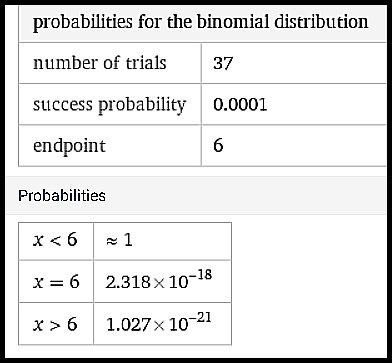
Counting the close guess as a failed attempt, I entered this data into the Wolfram Alpha binomial probability calculator, getting these results (with this calculator the "number of successes" is referred to as the "endpoint"):

ESP test result

Having a probability of less than about 1 in .00000000000000001, it would be very unlikely for anyone to ever get a result as successful by mere chance, even if every person on planet Earth were to try such a set of trials. You can use the same 
Wolfram Alpha binomial probability calculator to get a rough estimate of the likelihood of results you get. 

I mention using a binomial probability calculator above, but just ignore such a thing if you find it confusing, because the use of such a calculator is just some optional "icing on the cake" that can be used after a successful series of tests. The point of the tests I suggest here is not to end up with some particular probability number, but mainly to end up with an impression in your mind of whether you were able to get substantive evidence that telepathy or mind reading is occurring. Such an impression may be a valuable clue that tends to point you in the right direction in developing a sound worldview. Some compelling personal experience with telepathy may save you from a lifetime of holding the widely taught but unfounded and untenable dogma that you are merely a brain or merely the result of some chemical activity in a brain.  Getting such experience, you may embark on further studies leading you in the right direction. Keep in mind that a negative test never disproves telepathy, just as failing to jump a one-meter hurdle does nothing to show that people can never jump one-meter hurdles. 

In the academic literature of ESP testing, we often read about the use of Zener cards, cards in which there are five abstract symbols. While using such cards has the advantage of allowing precise estimates of probability,  there is no particular reason to think that better results will be obtained when using such cards. To the contrary, it may be that impressive results are much less likely to be obtained using such cards, and that ESP tests work better when living or tangible guess targets are used such as a living animal or a tangible object. 

A very important point I must reiterate is that when trying tests such as I have suggested, it is crucial to allow for a second, third and fourth guess, with at least ten seconds between guesses (during which the person thinking of the guess target tries to visualize the guess target).  In my testing the correct guesses tend to come on the second, third or fourth try. 

The results mentioned above are not by any means the best result I have got in a personal ESP test. The beginning of my very interesting post "Spookiest Observations: A Deluxe Narrative" describes a much more impressive result I got long ago, in a different type of test than the type of test described above.  

Monday, October 14, 2024

Old Newspaper Stories Relevant to Whether Brains Make Minds

The Chronicling America web site allows you to make a full-text search of many decades of American newspapers. Below are some interesting clips from old newspaper articles, all having some relevance to whether the human brain makes the human mind. 

Below is a clip from an 1899 newspaper article, one suggesting there is no relation between brain size and intelligence:

brain size and intelligence

You can read the article here:


Here is a news story from 1912:

man with half a brain

You can read the news story here:


The news story below tells us that a man who lost part of his brain "larger than a teacup"  is "nearly as well as before," with the weird detail that doctor's put part of a calf's brain in his head. 

weird brain story

You can read the story here:

https://chroniclingamerica.loc.gov/lccn/sn86092151/1899-06-16/ed-1/seq-1/

Below is a clip from an old newspaper story, one ending with a statement "more than half his brain was destroyed, and yet he retained his mental faculties in full force till he died":


The newspaper story can be read here:

https://chroniclingamerica.loc.gov/lccn/sn84020422/1876-03-01/ed-1/seq-4/

The newspaper account below discusses some topics relevant to whether brains make minds:


good minds with damaged brains

You can read the story using the link below:


The following is part of a news article that appeared in 1936:


You can read the full article here:

https://chroniclingamerica.loc.gov/lccn/sn83045462/1936-09-11/ed-1/seq-30/

According to the Guinness Book of World Records article here, the largest human brain ever recorded was a brain of 2850 grams (about 100 ounces), which belonged not to some genius, but to a man with "intellectual difficulties." 

Below is a news story from 1904, telling of a man whose "intellectual capacity was not effected in the slightest" despite a very serious brain injury:

little damage from brain injury
You can read the story here:


Here is a similar story of a man who shot himself through the head in an attempt to kill himself, but still survived so well that he "talks rationally":

brain injury with mind preservation

You can read the story here:

https://chroniclingamerica.loc.gov/lccn/sn85038489/1912-04-30/ed-1/seq-1/

I've saved the best for last. It is an account to be found on page 603 of the September 17, 1936 edition of the periodical Light, and deals with the widely noted phenomenon called terminal lucidity:

terminal lucidity

You can read the account using the link below:


Monday, October 7, 2024

In 1941 the Editors of Scientific American Confessed That Telepathy Was Proven

In 1941 the publication Scientific American announced that it was going to offer a $15,000 prize for proof of the paranormal. The announcement can be read on the page here.  Ending with a byline of "The Editors," the announcement started out with a misrepresentation which stated this:

"In JANUARY, 1923, Scientific American inaugurated an exhaustive two-year exploration of the subject of psychic phenomena, both in Europe and in America, in an endeavor to discover a basic, scientific truth upon which the wide-spread belief in spiritism might be solidly founded. Those efforts were fruitless in that no objective spiritistic manifestation of physical character, in the form of a psychic photograph or otherwise, was produced which bore sufficient authority to warrant approval by the co-operating committee, or which was not capable of duplication or explanation by Houdini, then the world’s most noted conjurer, and a member of that committee."

The statement is not an accurate summary of either the investigation that went on or the findings of the investigation that Scientific American reported in November 1924 on the page that can be read here. The page is below:

Marjory Crandon investigation

On the page we read conclusions of members of a five-man Scientific American committee that investigated reports of paranormal events in the seances of Margery Crandon (we are told the fifth member was unavailable for comment).  First we read William Franklin Prince state inconclusively that the experiments "have not scientifically and conclusively proved the exercise of supernormal powers."  Next we read the conclusion by Hereward Carrington that "I have arrived at the definite conclusion that genuine supernormal (physical) phenomena frequently occur at her seances."  His statement is below:

Scientific American investigation of paranormal

The third member of the committee (Comstock) said "my conclusion therefore is that rigid proof has not yet been been furnished, but that the case at present is interesting, and should be investigated further."  The fourth member (the magician Harry Houdini) said he thought it was all fakery, which was consistent with the bitter hostility he expressed towards all mediums for so many years. 

So clearly the statement of the editors of Scientific American in their April 1941 edition was a deceit. Instead of it being that "no objective spiritistic manifestation of physical character, in the form of a psychic photograph or otherwise, was produced which bore sufficient authority to warrant approval by the co-operating committee" it was the case that one of the four members of that committee stated that "I have arrived at the definite conclusion that genuine supernormal (physical) phenomena frequently occur at her seances."  Scientific American deceived its readers by misrepresenting the findings of its own committee, making it sound like the committee had delivered a negative verdict, when one of its four members had declared "I have arrived at the definite conclusion that genuine supernormal (physical) phenomena frequently occur at her seances." 

Moreover, the Scientific American article lied when it said "in JANUARY, 1923, Scientific American inaugurated an exhaustive two-year exploration of the subject of psychic phenomena." No such "exhaustive" investigation was carried out. Some of the main psychic phenomena that had been reported by this time were telepathy, mysterious raps and a phenomenon called "direct voice" (described here)  in which mysterious voices would be heard in seances. But in a 1943 interview describing the 1923-1924 investigation and also something it did in early 1940's, the publisher of Scientific American (Orson D. Munn) had stated this:

"We were not after just plain spirit messages. Table rappings. mental telepathy. and the ordinary oral messages have not been included in either of our investigations. We want specific evidence in physical form that the spirits do converse or try to converse with the living." 

Get the picture? So if an investigator went to a medium, and the medium started telling accounts of the investigator's experiences with his dead grandmother, experiences known only to the investigator, that would be ignored by the investigator. And if the investigator heard a mysterious voice sounding just like the voice of his dead grandmother, telling secrets only she knew, that would be ignored. And if the investigator went to a seance where mysterious raps were heard as the alphabet was recited, with the raps spelling out a message describing facts about the investigator only the investigator and a deceased person would have known, that would be ignored by the investigator, on the grounds that the investigators were looking for "specific evidence in physical form." But what sense did it make to claim that mysterious raps on a table was not  "specific evidence in physical form"?  No sense at all. Raps on a table are a physical effect.  

On the same page of the April 1941 Scientific American, we had a box describing an offer of the magazine to pay $15,000 for proof of the paranormal. Here is part of that box:

Scientific American and telepathy

Note well item 6 in the list of conditions. We read, "Since experiments by Dunninger and others have proved telepathy to an acceptable degree, demonstrations of this nature are not eligible for the award."  That is a confession that the reality of telepathy had been proven. At the time this was written, the person who had done the most to prove telepathy was Duke University professor Joseph Rhine (whose laboratory experiments are discussed here), and other researchers such as Professor Riess (whose enormously convincing experiment is discussed here). Later r
esearcher Louisa Rhine documented very many cases of telepathy outside of laboratory settings, in her book Hidden Channels of the Mind, which may be read here. Sally Rhine Feather documented very many other cases of telepathy outside of laboratory settings, in her book The Gift: ESP, the Extraordinary Experiences of Ordinary People, which can be read here.

So why in so many decades after the 1940's have Scientific American writers and Scientific American editors deceived us by claiming that there is no good evidence for ESP? Nothing happened to warrant such a change. To the contrary,  experiments after 1941 using the Ganzfeld protocol provided extremely well-replicated evidence for the reality of ESP. A paper on the Cornell Physics Paper server gives this summary of the telepathy evidence from the ganzfeld experiments run in recent decades, in which the success rate expected by chance is 25%:

"From 1974 to 2018, the combined ganzfeld database contained 117 studies. Of those, studies using targets sets with 4 possible targets included 3,885 test sessions, resulting in 1,188 hits, corresponding to a 30.6% hit rate. With chance at 25%, this excess hit rate is 8.1 sigma above chance expectation (p = 5.6 × 10⁻¹⁶). Analysis of these studies showed that similar effect sizes were reported by independent labs, that the results were not affected by variations in experimental quality, and that selective reporting biases could not explain away the results. The Bayes Factors (BF) associated with the last 108 more recently published ganzfeld telepathy studies was 18.8 million in favor of H1 (i.e., evidence favoring telepathy). Given that BF > 100 is considered 'decisive' evidence, this outcome far exceeds the 'exceptional evidence' said to be required of exceptional claims.[48,49] By comparison, in particle physics experiments effects resulting in 5 or more sigma are considered experimental 'discoveries.' ”

The probability of 1 in 5.6 × 10⁻¹⁶  cited is a likelihood of less than 1 in a quadrillion. 

The only explanation for the telepathy denialism of Scientific American in recent decades is that the reality of telepathy is strong evidence against a cherished belief of the writers at that publication: the belief that the brain makes the mind.  Within the framework of prevailing neuroscience dogmas, all such results are inexplicable.  Since the results are largely remote results produced by people separated by sizable distance, they cannot be explained by any speculative theory that the brain can act as a radio transmitter and radio receiver (a theory not supported by any neuroscience studies).  And such a radio transmitter theory makes no sense. Your head does not have any  antenna that might pick up radio signals being sent by someone else's brain, and brains don't emit anything like radio signals. 

The 1941 money offer of Scientific American was pretty much a farce. There was the arrogant requirement that only phenomena performed in front of some Scientific American committee would be considered. There was the statement sounding as if unlimited number of successful retests might be asked for, under any conditions whatsoever that some Scientific American committee might request. Then there was the statement that no matter what was observed, Scientific American might or might not publish the results.  Hardly any sensible person would agree to such conditions.  They would tend to think that no matter what phenomena was produced, that the committee would just keep asking for retests under ever-more troublesome conditions, until getting something it would call a failure. 

In 1924 the news story below appeared:

Scientific American award to psychic

During the past 60 years, Scientific American has followed a "head in the sand" approach toward spooky psychical phenomena, a "lazy as it gets" approach that has been basically "ignore it and hope it goes away." In the rare cases in recent decades when Scientific American writers say anything about the topic of ESP and telepathy, they tend to sound just as if they never seriously studied such a topic; and they say things on the topic that are false and contrary to the magazine's 1941 confession of the reality of telepathy. The visual below illustrates the kind of treatment such very  important and very-well established phenomena get from the guys at Scientific American. 

scientific censorship

Wednesday, January 17, 2024

Cox's Cases Were Better Explained as Evidence Brains Don't Make Minds

 Edward W. Cox was a 19th-century writer who wrote the book "The mechanism of man: an answer to the question, what am I? A popular introduction to mental physiology and psychology."  The title page lists Cox as "SERJEANT-AT-LAW, PRESIDENT OF THE PSYCHOLOGICAL SOCIETY OF GREAT BRITAIN." Confusingly, we find the same figure listed in some of the parapsychology literature of the time under the name of Serjeant Cox rather than Edward W. Cox. 

On page 293 of the June 17, 1875 edition of The Spiritualist, we have an example of Cox drawing the wrong conclusions from some important evidence. In that edition he writes an article entitled "The Duality of the Mind."  He writes this, referring to different hemispheres of the brain:

"A multitude of undisputed facts prove that one brain can be destroyed, or its action paralysed, and yet the other brain preserve its power and perform all the mental functions. As already stated, this result may be witnessed in cases of paralysis. One-half the body has lost sensation by reason of disease in one brain only; the other side of the body continues in full possession of its powers of sensation and action, because the other brain is uninjured. Dr. Wigan tells us of a boy who, climbing a tree, fell on a sharp edge of iron, which sliced off a large portion of the skull and brain on one side of his head; 4 oz. of his brain were thus lost. His mental faculties remained uninjured until his death from hemorrhage many days afterwards. In another case, one hemisphere of the brain was wholly destroyed by disease, but the man conversed rationally. Dr. Conolly records the case of a man of family, one side of whose brain was found on examination to have been annihilated by an abscess, and in its place was 'a yawning chasm.'  His mental faculties were apparently quite perfect to the moment of death. Dr. James Johnson reported another case of a man who preserved his mental faculties, although, on a post mortem, it was found that one hemisphere of the brain had been reduced to a thin membrane, the whole solid contents of one-half of the cranium having absolutely disappeared. A similar case is recorded by Cruveilhier, of complete atrophy of the left side of the brain without apparent injury to the intellectual powers, proving conclusively that the functions of the mind were performed wholly by the right side of the brain. These are but a few of a multitude of cases reported by medical observers, and they are adduced here merely as illustrations of the evidence upon which the great physiologists named have based their contention that each brain is a complete machine, capable of performing alone the work of mind."

These are all very interesting cases,  but they do not prove what Cox claims they prove. Instead of being evidence that each hemisphere of the brain can by itself produce the mind, such cases help to show that the brain is not the source of the mind.  One reason is that according to Cox's reasoning, a human would consist of two minds rather than one, since humans have two brain hemispheres. 

On the next page Cox states his full reasoning, which takes him to an untenable position:

"The propositions sought to be maintained in this paper are : —

 1. That the brain is constituted of two hemispheres. 

2. That the brain is the mechanism by which mental operations are conducted. 

3. That one hemisphere of the brain may be injured or destroyed without seriously impairing the operations of the other hemisphere. 

4. That in such cases the mental operations also proceed without serious impediment. 

5. That therefore each hemisphere of the brain is a complete and perfect mental machine, capable of performing alone most, if not all, mental operations. 

6. That therefore we have two minds. 

7. That this is proved abundantly by recorded cases of persons who have exercised the ordinary mental faculties when one brain has been destroyed."

This was very bad reasoning. Humans do not have two minds, but a single unified mind. The ability of the human mind to survive with little apparent damage after the destruction of most or all of a hemisphere is not evidence that backs up the claim that the brain is the source of the mind. Such an ability is instead evidence that the human brain is not the source of the human mind. Any line of reasoning that leads you to the conclusion that humans have two minds is one that must be an error. And Cox's reasoning was very much in error. 

The cases that Cox cites above are very similar to many other cases that I cite in my posts below:

Cases of High Mental Function Despite Large Brain Damage

More Evidence of High Mental Function Despite Large Brain Damage

Some People Our Neuroscientists Don't Want You to Know About

Preservation of Mind and Memories After Removal of Half a Brain

Brain Dogmas Versus Case Histories That Refute Them

Cox's theory of "two brains and two minds" has been effectively debunked by the rare cases in which the fibers connecting the hemispheres of the brain have been severed. Such operations are called split brain operations. The result is a single mind, not two. Claims that split-brain operations result in two minds are some of the most outrageous lies of materialists, who tell many dozens of types of lies (as documented here). Split brain operations actually leave people with a single unified mind. 

Cox seemed to have had  a great tendency to try to make observations fit his theories, which often involved awkward cases of trying to hammer round pegs into square holes. Cox's 1872 book Spiritualism Answered by Science was a book that appeared the year after the Dialectical Society's 1871 report summarized here; and Cox was one of the investigators involved in that report which found resoundingly in favor of various types of dramatic paranormal phenomena.  Probably some people bought Cox's book hoping to read someone discredit reports of the paranormal that may have irritated them.  If someone bought the book hoping to see a wholesale debunking of the paranormal, they must have been sorely disappointed. Before  long the book's pages start telling us that some of the main types of paranormal phenomena are well-established observational facts.  On page 20 the author states this:

"Not only is the evidence by which the phenomena of Psychic Force are established stronger than any upon which the criminal courts daily convict and punish even with death ; it is at least equal to the evidence upon which most of the other sciences are founded. The experiments with Psychic Force are in all respects as perfect and trustworthy as those exhibited by Professor Tyndall at the Royal Institution. They are as plain to the eye, as palpable to the touch, as audible to the ear, as any witnessed in that famous lecture room. If the senses can deceive in the one, so are they equally liable to be deceived in the other, and the argument of imposture would be found equally applicable to both."

On page 29 the author describes being part of a group of investigators testing the hypothesis (suggested by Michael Faraday) that table turning (also called table tipping) was merely the result of involuntary muscular effort by the hands, and decisively debunking such a hypothesis:

"Such was the reasonable argument that led us to look to involuntary muscular action as the explanation of the motions and sounds that were continually being made. To ascertain if this hypothesis was correct, we devised a series of tests that should place the matter beyond all possible doubt. First, all hands were laid upon the table ; then one hand only of each person ; then the table was touched by the tips only of all the fingers ; then by the fingers of one hand alone ; then with one finger only. Still the motions and sounds continued with but slightly diminished force. If our theory of involuntary pressure was correct, the force should have diminished in precise proportion to the lessened points of contact. Moreover, it did not explain the fact, continually before our eyes, of the table being raised several inches from the floor on one side only, the muscular action of the fingers upon that side of the table being antagonistic and not contributory to such a motion ! We continued our experiments with lessened faith in our foregone conclusion. First, one person withdrew from all contact ; then a second, and a third, until one finger of one person only touched the table. Nevertheless it moved, the sounds continued to come from it, and a frequent motion was the lifting up of the table at the side on which the finger was pressing down, if exercising any pressure whatever. I should state that at all of these test experiments the tables employed were the large and heavy dining tables, some nine feet and some twelve feet long, with six legs, in common daily use in the dining-room of members of the committee, standing upon Turkey carpets, therefore not easily slid and difficult to move by the arm. 

We next tried a more decisive test. All hands were joined and held over the table at the height of three inches from it, no part of any hand touching it, the room being well lighted with gas and all eyes keeping careful watch over the lifted hands. The sounds were heard and the motions produced as before. It was suggested that possibly the feet might be at work ; so two of the members seated themselves under the table to observe. The motions and sounds continued, but not a foot stirred. Then all the persons present stood, so that no foot could touch the table unseen. Still it moved. Lastly we devised a test that conclusively settled the question as to the possible agency of muscular action, conscious or unconscious. It was contrived thus : All present turned the backs of their chairs to the table, and kneeling upon the chairs, placed their arms upon the backs of the chairs, their hands being extended above the table, but without possibility of contact with it. The chairs were first placed six inches from the table, with which, as the reader will readily understand, neither foot nor hand, nor any part of the person, of any of those present could possibly come into contact unseen. In this position the table moved eight inches over the carpet and tilted several times. The chairs were then withdrawn further from the table, on each trial to an increased distance, and with the same results. At the distance of two feet from it the motions were continued, with but slightly diminished power....These experiments of motion without contact were repeated many times at different meetings in different houses, and with the same results. Thus was our third and last explanatory conjecture, which we had eagerly accepted on the authority of Faraday, completely demolished by the facts, and we were compelled reluctantly to the conclusion that there is a Force apparently proceeding from the human organisation by which motion is produced in heavy substances without the employment of any muscular force, and without contact or material connection of any kind between such substances and the body of any person present."

Reports such as the one above will seem shocking only to those who have failed to study the extremely abundant evidence for paranormal phenomena in the 19th century, including very frequent reports by very many distinguished witnesses that untouched tables had levitated or moved around inexplicably. A good starting point if you want to look into such matters is my 13-part "Spookiest Years" series (you can reach Part 11 and links to the first 10 parts here). 

On pages 39-40 Cox reports a paranormal phenomenon of the mysterious alteration in the weight of tables (something similar to what was reported by Sir William Crookes in very careful observations):

"Alterations in the weight of tables and other furniture have been frequently exhibited. Bidding the table to be light, a finger lifted it ; the next moment, bidding it to be heavy, the entire force of the body was required to raise it from the floor. It was, however, suggested by myself and others who were engaged in the scientific investigation of the phenomena of Psychic Force, that possibly this change in the weight of the subject of the Force might be merely in our own sensations, and not an actual change in the gravity of the wood or the operation of any pressure upon it. To test this, a weighing machine was constructed with a hook to fix to the table, the index accurately marking the weight of whatever was attached to it. Applying this machine to the table and other bodies, we found that the change was really in them, and not sensational merely, as we had suspected. This simple experiment was tried so often, and with, so many precautions, as to establish it beyond doubt. The weights varied at every trial, but all proved the reality of the Force that was operating. One instance will suffice. Weighed by the machine, the normal weight of a table, raised from the floor 18 in. on one side, was 8 lb. ; desired to be light, the index fell to 5 lb. ; desired to be heavy, it advanced to eighty-two pounds ; and these changes were instantaneous and repeated many times."

On page 45 Cox begins to speculate about the nature of the mysterious force he has observed, what he has called a Psychic Force.  Cox's speculations on this matter are not very believable.  He seems determined not to go all the way towards admitting the existence of a mysterious supernatural force from some external agency beyond living humans. He tried to inhabit some halfway house between materialism and the supernatural. 

Cox tries to suggest that the effects he has observed can be explained as some natural but poorly understood force coming from human beings, not from beyond them. He imagines a kind of unconscious telekinesis or subconscious psychokinesis "mind over matter" coming from psychics or mediums or even ordinary people. 

On page 49 Cox states his theory:

"There is a Force proceeding from, or directly associated with, the human organisation, which, in certain persons and under certain conditions, can cause motion in heavy bodies, and produce audible and palpable pounds in such bodies, without muscular contact or any material connection between any person present and the heavy body so moved or on which the sounds are produced. This Force appears to be frequently directed by some intelligence. For the reasons presently to be specified, we conclude that this Force is generated in certain persons of peculiar nervous organisation in sufficient power to operate beyond bodily contact." 

Since the nineteenth century we have learned much about the organization of human bodies. We have learned that human bodies are vastly more organized than any one in the nineteenth century had imagined. But nothing we have learned about the stratospheric levels of organization in human bodies supports the idea that the human organization could result in some power to mysteriously manipulate matter outside of the human body.  It could be that the human soul has some ability to manipulate matter outside of the body, through something like telekinesis or psychokinesis. But nothing we have learned about the physical body can explain such an effect it if exists. 

One problem with such a theory of subconscious telekinesis is that it can explain only a fraction of reports of paranormal phenomena, only physical effects. Such a theory of subconscious telekinesis cannot explain reports of inexplicable mental effects. Subconscious telekinesis cannot explain the very many well-documented accounts in the nineteenth century of dramatic clairvoyance of hypnotized subjects. Subconscious telekinesis cannot explain cases such as that of the medium Leonora Piper, who (while in trance) stated a great deal of correct information relating to deceased people who should have been unknown to her.  

But we can at least credit Cox for being better than the average neuroscientist of today, in the sense that he reluctantly acknowledged evidence for paranormal phenomena that he preferred not to believe in. Conversely, today's typical neuroscientist goes all "head buried in the sand" when encountering any of countless abundant observational reports of paranormal phenomena beyond any neural explanation. Today's typical neuroscientist shows zero evidence of having seriously studied the evidence for such phenomena, and just follows a witless policy of "deny, deny, deny" whenever such evidence is mentioned.  

types of paranormal phenomena
Types of paranormal phenomena discussed here

The insight of Edward W. Cox may have grown after the publication of the "we have two minds" statement quoted above. On page 136 of the March 23, 1877 edition of The Spiritualist, Cox states this:

"The paper contributed to the Psychological Society by Mr. Croll almost demonstrates as a fact in nature and science that the universe is not wholly material—probably the material part being the least part of it. It proves scientifically that spirit—by which I mean nothing more than nonmolecular being, affirming nothing whatever what that being is—underlies, surrounds, possibly permeates, all molecular matter—that the forms of life and being arc not determined by chance nor by the fortuitous combination of atoms, but are moulded by forces that are not the blind physical forces, but some power with a plan, which determines organic structure and perhaps all mundane structure; that matter, which is the proper study of the chemists, is not, as the materialists would have it, the all in all, but that there is behind the world of matter, and probably underlying it a cosmos of spirit—a universe of soul, whose investigation is the proper province of psychology. While the materialists are usefully toiling to learn the laws of those physical forces that mechanically move the dead unconscious matter which alone they recognise, we psychologists are not less usefully employed in exploring the facts and phenomena of living conscious being, the forces by which it is moved, and that yet greater force which determines the direction of all the forces of nature, and builds up that world of organic and inorganic matter which the materialists are analysing. We thank them for this good work. We cordially recognise the great service physical science is doing. We complain only that physicists will not be content with labouring in their own province, leaving psychology to psychologists, but, without seeing or knowing, they venture to pass judgment upon another branch of science of which they confess themselves wholly ignorant. Psychologists justly complain...that they [materialists] refuse to hear any evidence or any argument that goes to prove its. existence—that they insist upon pronouncing a verdict upon that which they have never seen, nor tried, nor studied..."

Sadly the situation Cox described persists to this day, with physicists and neuroscientists who have never properly studied human minds and human mental experiences (a topic of oceanic depth) issuing pronouncements about the nature of mind, which is rather like someone who never paid attention in physics class and shunned reading about physics issuing dogmatic proclamations about the nature of the subatomic world. 

On page 266 of the June 4, 1875 edition of The Spiritualist, Cox describes a state of extraordinary memory, what sounds like a case of photographic or eidetic memory. Cox describes himself as having a similar memory. Cox states this:

"The Rev. Henry Christmas, formerly of Sion College, possessed an extraordinary memory. I have seen him read a page of Greek or Latin opened at random, close the book and repeat the whole of the page verbatim, beginning with the broken sentence in the first line. He knew by heart the entire of many volumes of poems. He could repeat the whole of Horace from memory : one perusal usually sufficed. He informed me that this marvellous memory of his was a memory not of sound but of sight. He did not recall the words, but the page on which they had been printed when he learned them, and in his mind’s eye he saw that page and read from it. I suspect such a form of memory to be not uncommon. It is possessed by myself. When I desire to repeat anything learned by rote I am compelled to recall to my mind the book and the page of the book from which I learned it. I see in my mental vision the very misprints, creases, and spots upon the paper, and I mentally read it from the ideal representation of the book. This is plainly memory for objects of sight, not for language."

Such cases strengthen the case against the idea of a brain storage of memories, as they give us facts of exceptional human memory that make all claims of brains storing memories seem more implausible. The more exceptional human memory performance is, the less credible are claims that human memory can be explained by something with the many physical shortfalls of the brain. 

Sunday, June 4, 2023

Some People Our Neuroscientists Don't Want You to Know About

In this post I will discuss some subjects with dramatic case histories that tell you very important things about the human brain and the human mind. Neuroscientists fail to mention these subjects with such important case histories. So we can assume that today's neuroscientists don't want you to know about such cases, because the cases contradict the dogmas that neuroscientists like to teach, such as the dogma that your brain makes your mind, the dogma that your brain stores your memories, and the dogma that there cannot be mysterious psychic powers inexplicable through any type of brain activity. 

  • Dandy's patients: The case of Dandy's patients are reported in the American Journal of Psychology, Vol. 46, No. 3 (Jul., 1934), pages 500-503. We read this: "Dandy has completely removed the right cerebral hemisphere from eight patients. He has performed total extirpations of one or more lobes much oftener... There are tabulated below certain generalizations on the effects of removing the right hemisphere.... The operation was the complete extirpation of the right frontal, temporal, parietal, and occipital lobes peripheral to the corpus striatum. The weight of the tissue re moved varies, with the pathological conditions involved, from 250 to 584 grm [grams].Coherent conversation began within twenty-four hours after operation, and in one case on the afternoon of the same day. Later examinations showed no observable mental changes. The patients were perfectly oriented in respect of time, place, and person; their memory was unimpaired for immediate and remote events; conversation was always coherent; ability to read, write, compute, and learn new material was unaltered. Current events were followed with normal interest. There were no personality changes apparent; the patients were emotionally stable, without fears, delusions, hallucinations, expansive ideas or obsessions, and with a good sense of humor; they joked frequently. They showed a natural interest in their condition and future. They cooperated intelligently at all times throughout post-operative care and subsequent testing of function." How could the memory of patients be "unimpaired for immediate and remote events" if memories are stored in brains?
  • Patient P. G. Described in the 1966 paper "Long-term changes in intellect and behaviour after hemispherectomy," Patient   P.G. had an IQ of 128 before the right half of his brain was removed. After the right half of his brain was removed, he scored 142 on the same IQ test, improving his score by 14 points. The paper tells us that this man with half a brain “obtained a university diploma after operation” and “has a responsible administrative position with a local authority.” If your brain makes your mind, how could taking out half of someone's brain cause their IQ to increase by 14 points, with an end result so far above average?
  • Patient D. W. Described in the 1966 paper "Long-term changes in intellect and behaviour after hemispherectomy," Patient D.W.  had an IQ of 97 before the left half of his brain was removed. After the left half of his brain was removed, he scored 100 on the same IQ test, improving his score by 3 points.
  • The French civil servant. The case is discussed here in a Reuters story entitled “Man lives normal life with abnormal brain.” Inside a normal brain are tiny structures called lateral ventricles that hold brain fluid. In this man's case, the ventricles had swollen up like balloons, until they filled almost all of the man's brain. When the 44-year-old man was a child, doctor's had noticed the swelling, and had tried to treat it. Apparently the swelling had progressed since childhood. The man was left with what the Reuters story calls “little more than a sheet of actual brain tissue.”  But this same man, with almost no functioning brain, had been working as a French civil servant, and had his IQ tested to be 75, higher than that of a mentally retarded person. The Reuters story says: “A man with an unusually tiny brain managed to live an entirely normal life despite his condition, caused by a fluid buildup in his skull.” The case was written up in the British medical journal The Lancet in a paper entitled “Brain of a white-collar worker.” It is as if the authors tried to make these facts be noticed by as few as possible, by giving their story the dullest title they could. 
  • Christina Santhouse. In an article in the New Yorker magazine, we are told of a Christina Santhouse who had the right half of her brain surgically removed: “When I met her, she had taken her S.A.T.s and just finished high school, coming in seventy-sixth in a class of two hundred and twenty-five.”
  • Beth Usher. Beth was mentioned in an article in the LA Times, which stated this: "How is it that 8-year-old Beth Usher of Storrs, Conn., can lose her left hemisphere, yet retain her large repertoire of knock-knock jokes? Beth’s memories survived not just the loss of brain tissue, but also the 32 days that she spent in a coma, the result of some brain stem swelling that occurred in response to the trauma of surgery. Shortly after Beth regained consciousness, her father began quizzing her about people and places from her past. Brian Usher didn’t get very far. 'Dad,' Beth interrupted, with a trace of impatience. 'I remember everything.'" Of course, there's a very easy answer to the question asked: the answer that memories are not actually stored in the human brain. 
  • Borgstein and Grootendorst's 7-Year-Old. In 2002 in The Lancet these two published a paper "Half a Brain." They reported this on the child who had the left half of her brain surgically removed: "Though the dominant hemisphere was removed, with its language centres and the motor control for the left side of her body, the child is fully bilingual in Turkish and Dutch, while even her hemiplegia has partially recovered and is only noticeable by a slight spasticity of her left arm and leg. She leads an otherwise normal life."
  • The Johns Hopkins 58 hemispherectomy patients. In a scientific paper ("Why Would You Remove Half a Brain? The Outcome of 58 Children After Hemispherectomy −−The Johns Hopkins Experience: 1968 to 1996") we read about surgeons at Johns Hopkins Medical School who performed fifty-eight hemispherectomy operations on children over a thirty-year period. At least eleven had the left half of the brain removed; and more had the right half removed. The paper states this: 
    "Despite removal of one hemisphere [i.e. one half of the brain], the intellect of all but one of the children seems either unchanged or improved....It is tempting to speculate, that the continuous electrical activity of these severely dysfunctional hemispheres interferes with the function of the other, more normal hemisphere. This might explain why motor function improves after hemispherectomy and why language recovers after removal of the dysfunctional left hemisphere, but does not seem to fully transfer before surgery. Perhaps it also partially explains intellectual improvement in these children after removal of half of the cortex. We are awed by the apparent retention of memory after removal of half of the brain, either half, and by the retention of the child’s personality and sense of humor."  An appropriate response to such observations would be not mere awe, but the questioning or discarding of belief dogmas such as the dogma that brains store memories (which cannot be found by microscopically inspecting brain tissue). 
  • Kim Peek.  Kim Peek suffered from a lack of a corpus callosum, the bundle of fibers that connect the two hemispheres of the brain. Instead of this resulting in two minds in a single body (as we would expect from the "brains make minds" dogma), the result was a single mind and personality with an exceptional memory and astonishing calculation abilities. A newspaper report said Peek could accurately tell the contents of 12,000 books he had read, and the wikipedia article on him says he could "remember almost everything he had read." He could quickly tell strangers which day of the week they were born when they merely told him their birthdays. 
  • Martel's boy. In a scientific paper ("Discrepancy Between Cerebral Structure and Cognitive Functioning") we read of a case of a boy who was "mentally unimpaired" until death (despite progressive loss of the senses), and who was found in an autopsy to have almost no brain. We read this: "Martel (1823) described a boy who died at the age of 10. During the first years of his life, he seemed healthy, but eventually, his health deteriorated considerably. He had severe headaches, gradually lost all his senses except hearing, developed fits, and became confined to his bed, but he nevertheless seemed mentally unimpaired until his death. His head appeared enlarged, and upon autopsy, apart from 'residues of meninges,' 'no trace of a brain' was found inside the skull (Martel, 1823, p. 20)." 
  • John Lorber's patients. Lorber was a physician who had patients who lost the great majority of their brain due to a disease that replaces brain tissue with a watery fluid. Lorber was astounded to find that many of the patients had above-average intelligence, including a patient that had almost no brain but still had an IQ of 144. His patients are discussed here. 
  • Masdeu's 44-year old. In the paper "Ventricular Wall Granulations and Draining of Cerebrospinal Fluid in Chronic Giant Hydrocephalus," Joseph C. Masdeu MD and others report a case of a 44-year-old woman with a huge fluid-filled hole in her brain, one that seemed to have replaced most of the tissue in her brain (judging from the photos in the paper). The paper reports the woman had an IQ of 98, worked as an administrator for a government agency, and could speak seven languages. 
  • The 72-year-old woman with "asymptomatic hydrocephalus."  The woman's case is reported in the paper "Asymptomatic Hydrocephalus" which you can read here. We see brain scan photos showing the brain of a woman whose brain tissue was almost entirely replaced by watery fluid. But the woman is described as "asymptomatic," a word meaning "without symptoms."  We read this: "The patient lived independently...Her developmental history was unremarkable; she had finished high school and had worked in various retail jobs. When our team examined her, she was alert and oriented, and did not report headache, visual disturbance or cognitive changes; her neurologic examination (including a Mini-Mental State Examination) was normal." The MMSE examination referred to is a test of cognitive ability often used to detect dementia.  You can only get a "normal" score on such an exam by doing most of a series of mental tasks such as counting backwards by 7 and correctly naming the current date and remembering three random words you were asked to speak five minutes ago. 
  • Egnor's Katie. In an article Michael Egnor MD tells of a patient he had named Katie who only "had a third of the brain that her sister had," her fraternal twin. Egnor tells us that Katie "sat and talked and walked earlier than her sister," "made the honor roll," and "will soon graduate high school."
  • Antonio M. Battro's Nico. A page describes a book by Battro, a book entitled "Half a Brain Is Enough" about a boy named Nico. The page states this: "Half a Brain is Enough is the extraordinary story of Nico, a three-year-old boy who was given a right hemispherectomy to control his severe intractable epilepsy. Antonio Battro, a distinguished neuroscientist and educationalist, describes his work with Nico over several years and explains how a boy with only half a brain has developed into a bright child with relatively minor physical and mental impairment. Eight years later, he runs and plays with only a slight limp. So far, there is no significant cognitive or affective disorder and it appears that Nico's so-called right-hemisphere skills--mathematics, visual arts, and music--have migrated to the left hemisphere. At school, he performs as a child of his age in arithmetic and music; only his draftsmanship and handwriting are poor for his age, but he has not lost his cognitive spatial ability. Battro and his colleagues have been studying and teaching Nico with computers and he is mastering written language with a word processor and is able to make good graphic designs with a computer. Nico performs well above average verbally, a left-brain skill."
  • Julie Klingelhofer.  Julie's case is described in the 1987 news article here. We read that even though Julie Klingelhofer "lost the left frontal, parietal, occipital and temporal lobes of her brain" during brain surgery for epilepsy, her IQ increased by 10 points after such a huge reduction of her brain tissue. 
  • The Birjand Cyst patient:  This patient's case is reported in the paper "Giant Brain Hydatid Cyst in an Adult: A New Case Report." We are shown a photo of a giant hole in the patient's brain. We are told "The patient only complained of headache in the last two weeks and had no symptoms of visual or speech impairment." We are told the patient had no psychological problems. Surgery removed a fist-sized brain cyst that was 90 millimeters long and 40 millimeters wide. No mention is made of any mental or memory problem. 
  • John Bly.  In The Metaphysical Magazine, on page 71 of Volume 5, the January-May 1897 volume, we have an astonishing report entitled "Brains Unnecessary." The report is based on an article in the newspaper The Philadelphia Ledger. We read that a Dr. S. S. Koser of Williamsport, Pa made a wonderful discovery, revealing "a man had unimpaired faculties without a brain." We read this: " Dr. Koser held a post-mortem examination of the remains of John Bly, of Watsontown. Bly, who was twenty years of age, for a long time suffered with a tumor, which grew into the very base of the brain, and occasioned his death...The most singular fact developed was that the entire brain had been hollowed out by the action of the tumor. The cavity was at least five inches in length, and was filled with pus. All that was left of the brain was a thin shell, composed of the tougher tissues where the brain matter gathers into nerves, which were less susceptible to the process of decay. When an incision was made in the shell the whole mass collapsed." We read this: "The circumstances which made the case almost unprecedented in the annals of medical science was the manner in which the patient retained his rationality and faculties under the circumstances. He had the senses of touch, taste, hearing, and smell, had very tolerable control of his locomotor muscles, could talk, and, in fact, was comparatively discommoded in no other way than by the loss of vision. His retention of memory was remarkable. He was able to memorize poems up to within two weeks of his death."
  • The 500 gram cyst girl. This patient's case is reported in the paper "Primary Giant Cerebral Hydatid Cyst in an 8-year-old Girl." Doctor's discovered a giant brain cyst of 500 grams measuring 20 cm × 15 cm × 12 cm, and they said "in our search this is the largest brain hydrated cyst in the literature." This was probably more than half the size of her brain, since the average adult female brain is about 1200 grams, and since an 8-year-old female would have a brain of less than 1000 grams. Despite having so large a brain cyst there was "no history of neurological deficits" and "no changes in behavior." A month after the removal of the cyst, the patient is described as "vitally stable, thriving well, no complaints, no neurological deficits, and with the normal neurological examination." No mention is made of any mental or memory problem. 
  • The asymptomatic man with a giant brain cyst. This patient's case is reported in the paper "Asymptomatic giant arachnoidal cyst." We read of "a 39-year-old right-handed man, with a high-school education, good social and job functioning, and good command of three foreign languages (English, Spanish, and, in part, Arabic), had a 3-year history of mild migraine without aura." We are told that "neurologic examination and standardized cognitive assessment revealed normal findings." The man was found to have a giant cyst "occupying the anterior two thirds of the left hemisphere." We see a photo showing a huge hole in the person's brain, so big that it took about one third of the person's brain mass. How could you lose one third of your brain and have no symptoms, if a person's brain makes his mind? 
  • The bilingual guitar-player with near-normal language skills but little brain tissue. The title of the paper (which can be read here) was "Volumetric MRI Analysis of a Case of Severe Ventriculomegaly."  We have brain scan visuals showing that almost all of the 60-year-old man's brain was gone, with only a thin sheet remaining. But nonetheless the man's verbal IQ was a near-normal 88 (100 is average).  He could also speak two languages, and we are told he "plays guitar well."
  • The high-school graduate with average grades but a mostly-destroyed brain.  We read about the woman in the paper "Colpocephaly in adults" which you can read here. We read of a 60-year-old woman who had the great majority of her brain destroyed by a congenital disease, apparently one present from birth or from early childhood. We read this: "Growing up, she had a reading learning disability; however, she graduated from high school with average grades, married in her 20s and had one child. She worked in a factory and most recently as a home health aide. At the time of presentation...She was alert, appropriately oriented and had normal language function." 
  • The man with half a brain but superior intelligence. The newspaper here discusses the case of Bruce Lipstadt, Lipstadt had a hemispherectomy operation when he was five years old, an operation that removed the left half of his brain.  Operations of that type are only done when someone is being plagued by very severe seizures, and the seizures cannot be controlled by medication.  The operation was done because as a young boy Bruce was suffering from 10 to 12 seizures a day. We are told that despite having the left half of his brain surgically removed, Bruce can ride a bike, swim and play sports. We are told that Bruce got an A grade (the best grade) in a course on statistics at a university. We are told Bruce's speech is normal. We are told that "although not a genius, Bruce has superior intelligence." We are told that Bruce works as a traffic controller, and that next spring he will get a degree in sociology from a university. The 1976 newspaper article here gives us some more details on Bruce Lipstadt. We read that his IQ tests showed his verbal IQ to be 126, well above the average IQ of 100.
  • Patient E.C.. Patient E.C. is discussed here, in a book chapter you can read online. which on page 109 tells of three cases of the removal of the left half of the brain, telling us that "speech and verbal comprehension were present immediately after left hemispherectomy in all three cases." We read nothing about any loss of knowledge or loss of episodic memories in any of these cases. In the discussion of patient E.C. we read of an adult patient who underwent a hemispherectomy that removed the left half of his brain. We read  that "immediately following hemispherectomy" the patient had an "ability to follow simple verbal commands."  We read on page 107 that "the patient spontaneously articulated words and short phrases fairly well immediately after the operation." As described in my post here, patient E.C. was given six weeks after his operation a Peabody Picture Vocabulary Test, and performed well, and also performed well on such a test several months after his operation. The Peabody Picture Vocabulary Test is effectively a test of the preservation of learned knowledge. These results indicated learned knowledge was well-preserved in patient E.C., despite the loss of half of his brain. The patient's case history constitutes evidence against the idea that memories are stored in brains. 
  • The 57-year-old who described doctor's efforts to resucitate him while his heart had stopped.  The original  AWARE study authored by Sam Parnia and others did not succeed in its attempt to get people to identify images that were placed out of their sight in hospitals. But the study did report a case of a 57-year-old patient who successfully described the efforts of medical personnel to revive him while his heart was stopped. We read this: "The other, a 57 year old man described the perception of observing events from the top corner of the room and continued to experience a sensation of looking down from above. He accurately described people, sounds, and activities from his resuscitation (Table 2 provides quotes from this interview). His medical records corroborated his accounts and specifically supported his descriptions and the use of an automated external defibrillator (AED). Based on current AED algorithms, this likely corresponded with up to 3 min of conscious awareness during CA [cardiac arrest] and CPR [cardiopulmonary resuscitation]." The man said that a woman appeared in a high corner of the room, beckoning him to come up to her. He said that despite thinking that was impossible, he found himself up in the high corner of the room, looking down on the medical team trying to revive him. The man described specific details of the revival efforts, including the presence of a bald fat man with a blue hat, a nurse saying, “Dial 444 cardiac arrest,” his blood pressure being taken, a nurse pumping on his chest, a doctor sticking something down his throat, and blood gases and blood sugar levels being taken. Here we have a man apparently floating out of his body and viewing the efforts of medical personnel to restart his heart, something that should have been impossible if the human mind is produced by the brain. It is known that brains become electrically inactive within about 10 or 20 seconds of a person's heart stopping, and that people become unconscious only a few seconds after their heart stops. 
  • Pam Reynolds. The late Pam Reynolds was a 35-year old with a large brain aneurysm when she underwent a very complicated operation that involved pumping out her blood and chilling her body temperature to only 60 degrees. Some twenty medical personnel worked on the complex operation. After the successful operation was over, Reynolds reported having a near-death experience during the operation. She reported floating out of her body, and witnessing her operation. She accurately reported details of some medical equipment that was used to cut her skull open, describing it as a “saw thing...like an electric toothbrush,” with “interchangeable blades” that were stored in “what looked like a socket wrench case.” She reported someone complaining that her veins and arteries were too small. These details were later verified. This was despite the fact that during the operation Reynolds eyes were covered throughout the operation, and her ears were plugged with earplugs delivering noise of 40 decibels and 90 decibels (not to mention that her body was chilled to a level at which consciousness should have been impossible). Reynolds said that she then encountered a tunnel vortex, saw an incredibly bright light, heard her deceased grandmother calling her, and encountered several of her deceased relatives. Reynolds says she was told by her uncle to go back through the tunnel, and to return to her body. These details were originally reported in the 1998 book Light and Death by Michael Sabom MD. That book includes diagrams of the medical equipment used to cut open Reynold's skull. They match her descriptions very well.
  • Buckley's test subjects. A nineteenth century work Letters to a Candid Inquirer, on Animal Magnetism by William Gregory (professor of Chemistry at one of England's oldest universities) gives some very specific numerical details relating to clairvoyance in hypnotic trances (referred to below as "mesmeric sleep"):  "Major Buckley has thus produced conscious clairvoyance in 89 persons, of whom 44 have been able to read mottoes contained in nut-shells, purchased by other parties for the experiment. The longest motto thus read, contained 98 words. Many subjects will read motto after motto without one mistake. In this way, the mottoes contained in 4860 nut-shells have been read, some of them, indeed, by persons in the mesmeric sleep, but most of them by persons in the conscious state, many of whom have never been put to sleep. In boxes, upwards of 86,000 words have been read; 'in one paper, 371 words. Including those who have read words contained in boxes when in the sleep, 148 persons have thus read. It is to be observed that, in a few cases, the words may have been read by thought-reading, as the persons who put them in the boxes were present; but in most cases, no one who knew the words has been present, and they must therefore have been read by direct clairvoyance. Every precaution has been taken. The nuts, inclosing mottoes, for example, have been purchased of 40 different confectioners, and have been sealed up until read. It may be added, that of the 44 persons who have read mottoes in nuts by waking or conscious clairvoyance, 42 belong to the higher class of society; and the experiments have been made in the presence of many other persons. These experiments appear to me admirably contrived, and I can perceive no reason whatever to doubt the entire accuracy of the facts." 
  • Alex, who did not start speaking until the left half of his brain was removed. A scientific paper describing the case says that Alex “failed to develop speech throughout early boyhood.” He could apparently say only one word (“mumma”) before his operation to cure epilepsy seizures. But then following a hemispherectomy (also called a hemidecortication) in which half of his brain was removed at age 8.5, “and withdrawal of anticonvulsants when he was more than 9 years old, Alex suddenly began to acquire speech.” We are told, “His most recent scores on tests of receptive and expressive language place him at an age equivalent of 8–10 years,” and that by age 10 he could “converse with copious and appropriate speech, involving some fairly long words.” Astonishingly, the boy who could not speak with a full brain could speak well after half of his brain was removed. The half of the brain removed was the left half – the very half that scientists tell us is the half that has more to do with language than the right half. 
  • Patient BL: The paper "When only the right hemisphere is left: Studies in language and communication" reports on the case of a patient BL of "above normal intelligence" who underwent a left hemispherectomy at age five. Despite lacking the left half of his brain, BL "attended regular elementary and high school and graduated from college with a Bachelor's degree with a double major in business and sociology," he "played the baritone horn in a band," and worked "several years as an accountant in international business." The paper reports BL scoring normally on most of the cognitive tests he took. 
  • The woman with half a brain and an IQ of 115. Her case is reported in the newspaper story here. 
  • Patient EG. An article discusses her case: "When EG went in for an unrelated medical scan, she discovered she was missing her entire left temporal lobe...Despite missing a large chunk of her brain, EG was living a totally regular life... She could read normally, had a better-than-average vocabulary, and even spoke Russian as a second language."  A scientific paper describing her says, "She performed within normal range on all language assessment tasks...EG performed within normal range on both general cognitive assessments."
  • The honors student (IQ=126) with only 3% to 10% of a brain. in the scientific paper "Long-Term Memory: Scaling of Information to Brain Size" by Donald R. Forsdyke of Queens University in Canada, he quotes the physician John Lorber on an honors student with an IQ of 126: "Instead of the normal 4.5 centimetre thickness of brain tissue between the ventricles and the cortical surface, there was just a thin layer of mantle measuring a millimeter or so. The cranium is filled mainly with cerebrospinal fluid. … I can’t say whether the mathematics student has a brain weighing 50 grams or 150 grams, but it’s clear that it is nowhere near the normal 1.5 kilograms." Forsdyke notes two similar cases in more recent years, one from France and another from Brazil.  Forsdyke says, "Three independent studies agree that there are, among us, people leading normal lives with approximately 5 % of the quantity of brain tissue found in others."
  • Christopher who spoke 16 languages. On page 63 of the book Bright Splinters of the Mind by Beate Hermelin, we read this about a gifted subject: "Christopher can understand, talk, read, write and translate from Danish, Dutch, Finnish, French, German, Greek, Hindi, Italian, Norwegian, Polish, Portuguese, Russian, Spanish, Swedish, Turkish and Welsh." We then read about detailed tests of this subject. Cases such as that highlight the inadequacy of all neural explanations for human language abilities.   
  • Stephan Ossowiecki. In the paper "An experiment with the Polish Medium Stephan Ossowiecki, which can be read here, E.J. Dingwall describes a very careful test of clairvoyance. Dingwall says that when alone by himself, he drew a crude picture of a bottle, writing on it, "The vineyards of the Rhine, Moselle and Burgundy produce excellent wine." He says he put the paper in an "opaque red paper envelope," which was "then inserted flap end first into an opaque dull black envelope, into which it fitted closely." He says, "This envelope, again unsealed, was then inserted flap end first into a brown paper envelope, into which it again fitted closely," and that "the flap of this envelope was then pasted down and a single seal affixed to the lowest part of the flap where it adhered to the envelope." He gave the envelope to another researcher, who took the sealed envelope to Stephan Ossowiecki, asking him to guess the contents before witnesses. The contents were correctly identified by Ossowiecki, without the package being opened. Dingwall (who was given back the package) states, "The envelopes appeared to be wholly intact and no evidence whatever was discernible that the packet had been opened. I had no doubt that the test was valid and that the knowledge of the contents had been ascertained by M. Ossowiecki through channels not generally recognised.... In discussing this case it is necessary to bear in mind that the result of the experiment showed, I think, quite definitely that coincidence can be wholly excluded." Similar feats were performed innumerable times in public exhibitions by the clairvoyant Alexis Didier, discussed here, who was often able to identify the contents hidden in locked or sealed boxes. 
  • Mrs. Croad. The case of Mrs. Croad is told in my blog post here, which quotes at length from the original report here. Suffering from a variety of medical ailments, she was bedridden for 14 years, and reported as blind and deaf. But J. G. Davey M.D.  reported that the blind Mrs. Croad could read by touching ordinary text with her fingers, even after she had been heavily blindfolded with blindfolding including heavy cotton wadding. Davey also reported that Mrs. Croad could read the contents of letters inside sealed envelopes, and stated, "It is said also by those near and dear to her that such is Mrs. Croad's prevision that she has been known to have foretold my own visits to her ; what I mean is, that on my approach to the house she occupies and when at a distance from it, and unseen by anyone about her — in fact, not within sight— she has said, ' Dr. Davey is coming ; he will be here directly.' "  The case resembles the case of Mollie Fancher discussed next. 
  • Mollie Fancher. Like Mrs. Croad, Mollie Fancher had a very bad vision problem. Fancher was described at various times as either blind or very nearly blind.  Mollie had suffered terrible injuries even worse than Mrs. Croad's, including a fall from a streetcar. Both Mrs. Croad and Mollie Fancher were bedridden, and Mollie stayed bedridden for decades. Witnesses very often reported that Mollie Fancher would announce who had arrived at her door, before she could even see who had entered (something also reported of Mrs. Croad).  Both Mollie Fancher and Mrs. Croad passed with flying colors the most stringent tests of clairvoyance while securely blindfolded. Both Mollie Fancher and Mrs. Croad went in and out of trances.  Both Mollie Fancher and Mrs. Croad had long periods of time in which they seemed to neither eat nor drink, with such an abstinence occurring for much longer periods with Mollie Fancher.  A newspaper called the Brooklyn Eagle published an account of Mollie Fancher which stated this: ""When in the quiet condition of rigidity, the patient is in a trance. Her eyes closed, the ears are dead to sound, the muscles cease to act, respiration is hardly perceptible, and once or twice a state of ecstacy indicative of mental unsteadiness has resulted. These seasons last for four days, or two hours each. When in this condition, she is powerfully clairvoyant in her faculties. She can tell the time by several watches variously set to deceive her, read unopened letters, decipher the contents of a slate, and repeat what 'Mrs. Grundy says,' by serving up the gossip of the neighborhood. She appears to possess the faculty of second sight to a remarkable degree." The Mollie Fancher case is described in my post here, and in the long book here.
  • Mother Davis. The astonishing case of an old black woman named Mother Davis is told in B. F. Austin's extremely interesting book Glimpses of the Unseen, which has many very interesting similar accounts (the book can be read here).  Austin includes beginning on page 110 an account written by James L. Hughes, an inspector of public schools in Toronto, Canada. Hughes says that when he was twenty he met an old woman who looked strange, as if half-demented. The woman suddenly said, "Young man, I can tell anything you ever did or anything you want to know." Hughes started asking questions of this woman he had never before seen, and was astonished he got from her answers that were correct. The woman was able to correctly tell Hughes his last name, his father's name, his mother's name, how many sisters he had (seven), how many brothers he had (three), what he did before coming to Toronto (farming),  and what was the worst accident he had.  The old woman predicted that Hughes would become a teacher in the school he now attended, which turned out to be true, even though Hughes thought at the time that nothing could be more absurd. The woman predicted, "Before you take your tea to-night a gentleman will come to see you who will be a relation of yours by your marriage." The one man who came to Hughes before he took his tea turned out to be the cousin of the woman Hughes would marry. Hughes said that this Mother Davis "could read minds fluently," and that the accuracies of her prophecies about him were inexplicable, because "no foundation of even the most shadowy kind existed" by which she could logically base such prophecies. 
  • Solomon Shereshevsky. Neuroscientists love to talk about people with a memory problem, but such neuroscientists almost never tell us about cases of exceptional memory. The reason is that such cases greatly worsen the explanatory shortfall of "brains store memories" claims, which cannot explain ordinary memory facts such as instant recall, instant learning and life-long preservations of memories, and which seem all the more "on the wrong track" when we consider exceptional memories. One such person with an exceptional memory was Solomon Shereshevsky, called "S" in the book The Mind of a Mnemonist by Alexander Romanovitch Luria. A scientific paper says this about Shereshevsky: "According to Luria, Shereshevsky could' 'easily remember any number of words and digits' and 'equally easily he memorizes whole pages from books on any subject and in any language.'  He could accurately quote information from a decade earlier, including tables of numbers and strings of nonsense words....What Luria learned was that Shereshevsky’s memory differed from that of the vast majority of individuals; time did not erode his memories. Neither did a new stimulus affect his memory of an earlier one." Similar cases of exceptional memory are described in my post here. 
  • The patient of Smith and Sugar. In their paper "Development of above normal language and intelligence 21 years after left hemispherectomy," Smith and Sugar state that "Neuropsychologic follow-up studies of a 5-year-old boy who had left hemispherectomy for seizures showed that he had developed superior language and intellectual abilities." This was a boy who had the left half of his brain removed, but who ended up with "superior language and intellectual abilities."
  • Patient B.M. Patient B.M. had the right half of her brain removed, in an operation called a right hemispherectomy. She  had difficulty recognizing faces, a problem called prosopagnosia. But according to a paper on her, her "intellectual and cognitive functions were otherwise normal or only slightly impaired," despite the loss of half of her brain. 
  • Patient H.W. Patient H.W. is a man born without any corpus callosum, the bundle of fibers that connect the two hemispheres of the brain. Contrary to a prediction of the "brains make minds" theory (that such a shortfall should have caused great disfunction such as two minds in a single body),  Patient H.W. led a normal life and performed very well on a wide variety of tests of intellectual and psychological function. An article on the man is entitled "This Elderly Man Was Born With His Brain Hemispheres Disconnected. Did It Affect His Life? Hardly." The relevant scientific paper is here, and its title describes the man as one with "minimal neuropsychological impairment." 
  •  Patient E.B. A Wired story on this patient says, "Researchers reported the remarkable case of a boy who recovered his language abilities to near-normal levels after losing almost his entire left hemisphere at age two and a half."  He had surgery to remove almost the entire left half of his brain. But he underwent rehabilitation, and “EB's language fluency improved remarkably over the ensuing two to three years until no language problems at all were reported at school or in the family home.” Now how is that possible? If the light (consciousness and intelligence) is all coming from the 100-watt light bulb (the brain), how do you get almost 100 watts of light when you slice the light bulb in half?
  • Patient CG: The scientific paper here is entitled “A Lesion-Proof Brain? Multidimensional Sensorimotor, Cognitive, and Socio-Affective Preservation Despite Extensive Damage in a Stroke Patient.” Here is an astonishing report from the paper's abstract, describing a patient who seems mentally undamaged despite massive brain injury:

    At age 43, patient CG sustained a cerebral hemorrhage and a few months later, she suffered a second (ischemic) stroke. As a result, she exhibited extensive damage of the right hemisphere (including frontal, temporal, parietal, and occipital regions), left Sylvian and striatal areas, bilateral portions of the insula and the amygdala, and the splenium. However, against all probability, she was unimpaired across a host of cognitive domains, including executive functions, attention, memory, language, sensory perception (e.g., taste recognition and intensity discrimination), emotional processing (e.g., experiencing of positive and negative emotions), and social cognition skills (prosody recognition, theory of mind, facial emotion recognition, and emotional evaluation).

    Below is the paper's startling discussion of the very well-preserved memory in this patient who had suffered heavy brain damage from two strokes:

    Even more striking are her mnemonic skills: her procedural and semantic knowledge is fully preserved, as shown in her smooth execution of various action routines (e.g., handling her cell phone, tying her shoe laces) and her intact naming and classification skills (e.g., she could flawlessly denominate all the objects she had thematically organized in different sections of her purse); furthermore, her declarative memory is extremely detailed for events which happened weeks, months, and even years ago. She could describe scenes from her childhood and adolescence, she meticulously narrated episodes occurring immediately before and after her strokes, she remembered the names, specialties, and suggestions of all her doctors, and she could recount details of dozens of books she had read throughout her life.
  • Sharon Parker.  She is described in a 2003 news story entitled "Success of Nurse Who Lost Most of Her Brain." You can read the story here. We read this:

    "When she was a baby, Sharon Parker's parents were told a rare and incurable condition meant she would not reach her fifth birthday.

    She was left with only 15 per cent of her brain and there was little hope she could lead a normal life. But she defied the experts to become an astonishing success story.

    Now 39, Mrs Parker is a nurse with a high IQ who is happily married with three children....She was diagnosed with congenital hydrocephalus - water on the brain - when she was nine months old. Doctors drained the liquid from her skull with a tube but her brain mass had been compacted in the outer edges of her skull, leaving a gaping hole in the middle....As a 16-year-old, she passed eight O-Levels and her IQ was later found to be 113, putting her in the top 20 per cent of the population.

    The hydrocephalus has left her with a below-average short=term memory so she carries a notebook to remind herself to do things. However, tests have found that her long-term memory is better than average.

    After leaving school, Mrs Parker decided to become a nurse and soon after starting her training, she met her future husband David, a builder who is now 45. The couple were married three years later and have three children...

    She often participates in studies, including one recently in Ohio when she was examined by one of the world's leading experts on brain mass. Graham Teesdale, Professor of Neurosurgery at the University of Glasgow, said she demonstrated how adaptable the brain can be even when it is incomplete. 'She shows how the brain has an immense capacity to cope and adapt,' he said. 'Some people with the same acute problem experience problems in thought processes but others are able to function totally normally.' "

  • Penfield's patient who was normal after his prefrontal lobes were removed. On page 287 of the main work by the leading brain expert Donald Hebb, Hebb tells this account of a person whose IQ and mental health increased after the person had his frontal lobes removed:

    "The first and most effective piece of evidence is the history of a patient both of whose prefrontal lobes were removed by Dr. Wilder Penfield, with results that radically changed the possibilities of surgical therapy m the frontal area Before this time, it was universally accepted that loss of both frontal poles must be followed by gross deterioration of personality and intellect. Dr. Penfield's patent completely reversed the prediction, by being psychotic before operation (when the damage was relatively small) and quite indistinguishable from a normal person afterward (when the total destruction was increased in size— with the simultaneous removal of a source of physiological disturbance).

    The history is that of a boy of sixteen whose skull was fractured, with damage to both frontal lobes, and who ш the following ten years developed severe epilepsy and became (much of the time) an irresponsible and rather dangerous charge. The condition varied, not only with the occurrence of attacks but also between attacks—apparently owing to subclinical seizures: the IQ, on the basis of an uncompleted testing on one day, was estimated to be below 70, next day a completed test gave an IQ of 84. After operation, the IQ was consistently close to 96, no evidence of intellectual loss could be found їп any one test or in the pattern of test scores as a whole, and the psychotic behavior completely disappeared. Clinically and socially he was 'normal' and was able to take full control of his own affairs on the last examination he had been doing so for more than five years. He enlisted m the army and served satisfactorily overseas for ten months until he had another fit—at which time the medical officers caught up with him and he was discharged."

  • Hebb's genius missing a prefrontal lobe The leading brain authority D. O. Hebb asks this question at the beginning of his most famous work: "How can it be possible for a man to have an IQ of 160 or higher after a prefrontal lobe has been removed (Hebb, 1939), or for a woman (described by Rowe, 1937) to have an IQ of 115, a better score than two-thirds of the normal population could make, after losing the entire right half of the cortex?" We have the claim (apparently backed up by first-hand research by Hebb) that a man who had a prefrontal lobe removed had a genius IQ of 160, which is better than 98% of all people. In the same sentence he mentions another case equally striking: a woman who had above-average intelligence despite losing the cortex on the right half of her brain. 
  • Patient HS4. This patient is discussed in the paper "Intrinsic Functional Connectivity of the Brain in Adults with a Single Cerebral Hemisphere.'" The paper discusses attempts to measure brain connectivity in patients who had half of their brain removed to treat very frequent seizures. The half-brain patient with the highest intelligence was patient HS4, with an IQ of 99 (according to the Supplemental Information of the paper). But this very patient had the smallest brain of the six half-brain patients. This patient HS4 had an average brain connectivity score of only .30, which is the same as one of the group of controls with normal brains, and less than the brain connectivity of the other group of controls with normal brains.   So the smartest person with half a brain (who had an IQ of 99) did not at all have any greater brain connectivity that can explain his normal intelligence with only half a brain. How can this subject HS4 have had a normal intelligence with only half a brain?  In this case, favorable brain rewiring or greater brain connectivity cannot explain the result.  
half brain
The half brain of subject HS4, IQ of 99, average brain wiring