Showing posts with label analytic idealism. Show all posts

Monday, July 27, 2026

He Ties Himself Into Knots Trying to Explain Away Out-of-Body Experiences

Materialism (the idea that all that exists is matter) and the pretty-much-the-same idea of physicalism (the idea that all that exists is physical) both fail to credibly explain minds. There is nothing in the brain that explains the main type of human mental capabilities.  For example, there is nothing in the brain that credibly explains human memory powers such as instant recall, instant learning and the lifelong retention of childhood memories. 

A credible alternative to materialism and physicalism is the idea of dualism. According to this idea, you have both a physical body and an immaterial soul. But dualism is not the only option for someone rejecting materialism and physicalism. There is also the idea of idealism. 

Idealism is the philosophical position that matter has no independent existence outside of minds that perceive matter. An idealist is someone who believes that the universe is just a collection of minds and the experiences of such minds. An idealist is someone who thinks that instead of our minds existing inside the solar system, it's the other way around: the solar system is merely something that exists as a perceptual regularity inside of minds such as ours.

idealism

To someone who is not used to thinking as an idealist, idealism may initially seem absurd. But the case for idealism was advanced in a surprisingly forceful way in the eighteenth century, by British philosopher George Berkeley. In his classic philosophical work The Principles of Human Knowledge (which can be read here), Berkeley argued for immaterialism, the idea that matter has no existence outside of minds that perceive matter. 

Being a person who denies the reality of matter, an idealist needs to have a credible answer  to the question of why people report identical experiences of observing physical things that don't really exist independently of minds, according to the idealist.  For example, why do you and me and all of our relatives always have the same experience seeing a bright yellow thing in the sky during the day, and a bright white thing in the sky during the night? For a materialist or a dualist the answer is easy: because the sun really physically exists, and the moon really physically exists. But for the idealist who does not believe in the physical existence of the sun or the moon, this uniformity of observations is a problem that must be addressed. 

Berkeley got around this problem by imagining a divine reality (God) that causes such uniformity of perceptual experiences. So, according to Berkeley, when we look up at the sky and see the sun fairly often, it is not because there exists a physical sun independent of minds; it is instead because a divine mind is causing such perceptual regularities in our minds.  We know that movie directors can cause people to have certain uniform perceptual experiences. So, for example, all of the people who saw Saving Private Ryan in the movie theater had the same perceptual experience.  So it's not too implausible that a divine power could cause humans to have certain types of uniform perceptual experiences. 

The number of perceptual regularities that humans have are endless. Perceptual regularities are not just simple things such as the observation of a blue sky on a cloudless day or the observation of a round shape when we see the sun.  Perceptual regularities include the most detailed information that is observed with stunning consistency and regularity by humans. For example, every single time a human's chest is opened up for surgery, the same organs are seen in the same places. And every time a person's blood is analyzed, a chemist will see the same distribution of elements and chemicals.  A deeper analysis such as a DNA analysis would show that the sample always has the same type of genes, and that each type of gene has a particular arrangement of amino acids found only in that type of gene. Any theory that fails to credibly explain such perceptual regularities is worthless. 

It seems that just such a worthless theory was advanced in the 2017 paper "An Ontological Solution to the Mind-Body Problem," a paper with too boastful a title. The author of the paper (Bernardo Kastrup) advances an offbeat theory of mind which he summarizes like this in the paper's conclusion:

"I have argued for a coherent idealist ontology that explains reality in a more parsimonious and empirically rigorous manner than mainstream physicalism and bottom-up panpsychism. This idealist ontology also offers more explanatory power than both physicalism and bottom-up panpsychism, in that it does not fall prey to either the ‘hard problem of consciousness’ or the ‘subject combination problem’, respectively. It can be summarized as follows: there is only universal consciousness. We, as well as all other living organisms, are but dissociated alters of universal consciousness, surrounded like islands by the ocean of its thoughts. The inanimate universe we see around us is the extrinsic appearance of these thoughts. The living organisms that we share the world with are the extrinsic appearances of other dissociated alters of universal consciousness. As such, the quest for artificial consciousness boils down to the quest for abiogenesis. The currently prevailing concept of a physical world independent of consciousness is an unnecessary and problematic intellectual abstraction." 

This may sound somewhat impressive until we remember the very great folly of trying to reduce human minds and human mental experience to some bloodless abstraction called "consciousness." What we have to explain is not some mere abstraction called "consciousness" but the extremely complex and diverse reality of human minds, things such as imagination, selfhood, ideation, appreciation, memorization, morality, recognition, consciousness, emotions, speech, comprehension, creativity, recall, insight, beliefs, reminiscence, trances, introspection, pleasure, pain, reading, writing, awareness, perception, knowledge,  attention, personality, fascination, interest, visualization, ESP, dreaming, volition, out-of-body experiences, near-death experiences and apparition sightings. You are not merely "some consciousness" but something gigantically more than that. 

It seem that what Kastrup was attempting to advance was an idealism along the lines of Berkeley (one denying that matter exists except as a part of mental perceptions), with the very big difference that there was no reference to any deity. Thinkers such as Kastrup have no good answer to the question of why humans would have uniform perceptual experiences of matter if matter does not exist. If you and I are merely fragments of some primitive "universal consciousness," as imagined by Kastrup, and if the moon if the sun and the moon did not materially exist. There would seem to be no reason why you and I have should have identical experiences of perceiving the sun and the moon.   And there is no reason why why you and I should have 1000 other types of identical perceptual experiences such as always having rocks feel hard and never perceiving a rock to be soft. 

The problem is that Kastrup has hitched his wagon to the bloodless, abstract, shrink-speaking term "consciousness,"  and imagined some "universal consciousness" which he describes (in his paper's abstract) as a mere "ontological primitive." Having done that, he is left with a "primitive" bloodless abstract "universal consciousness" that seems to lack any will or intention, and would therefore be incapable of intentional effects such as making sure that you and I have uniform experiences of observing the sky.  So it seems the idealism of Kastrup lacks the credibility of the idealism of Berkeley.  Reading Berkeley you tend to think "that might well be true." No one should think such a thing when reading the "analytic idealism"  theory of Kastrup.  He lacks any credible explanation of why human perceptual experiences would have so many consistencies. 

Kastrup has kept trying to sell his misguided ideology, which should actually be called "atheistic idealism" rather than the term Kastrup uses, "analytic idealism." Although Kastrup often seems to argue against materialism, I find much in common with materialism and Kastrup's position. Both are positions that can rely on shadow-speaking about human beings, in which human beings are depicted as mere shadows of what they are. Materialism claims everything can be explained by the "primitive" of mass-energy. Kastrup claims everything can be explained by some "universal consciousness" that he calls a "primitive," something he also calls "mind at large." The many stunning faculties of the human mind cannot credibly be explained  by appealing to something primitive, but can only be credibly explained by some purposeful agency vastly greater than the human mind.  It seems that in Kastrup's ideology humans are mere accidents of chance, just as they are in materialist ideology. 

It is amusing to read a post by Kastrup in which he seems to tie himself into knots trying to explain away out-of-body experiences. Out-of-body experiences are events that seem as incompatible with Kastrup's thinking as they are incompatible with the claims of materialism.  What goes on in out-of-body experiences is just what you would expect to hear reported if the world is made of matter, and you are a soul trapped in a body, a soul that can have the ability to leave such a body. In out-of-body experiences a person typically reports viewing his body from outside of his body, from a position about two meters away or a position near the ceiling of the room he is in. Out-of-body experiences seem to defy materialism, and to support the doctrine of dualism, that souls exist in addition to matter.  Out-of-body experiences do not seem to fit naturally with any doctrine of idealism. 

In the post here (entitled "The Phantom World Hypothesis of NDEs/OBEs") Kastrup tries to explain away such observations. He speculates that there may be what he calls a Phantom World somehow involved in such experiences. But he does not mean some world where spirits live. Kastrup's imagined Phantom World is some weird world of perceptual illusions. 

Kastrup says, "what follows is still very highly speculative and should be taken with a whole bag of salt." He confesses that he is not a scholar of near-death experiences and not a scholar of out-of-body experiences. It sounds like he is also not a scholar of paranormal phenomena, because he sounds very surprised that people should report experiences of being out of their bodies. No one who properly studied the huge amount of evidence for clairvoyance published in the nineteenth and twentieth century should be surprised at all by such reports. During the very widely reported phenomena of "traveling clairvoyance" people would often report viewing things far away from their current bodily location. 

Kastrup starts to argue against the reality of reports of out-of-body experiences, giving a very weak argument about evolution not being redundant. He argues that evolution would not have given us both the ability to see with our eyes and some other clairvoyant ability to see (when the heart is stopped) without our eyes.  Here Kastrup sounds just exactly like a Darwinist materialist, which tends to back up my suspicion that there is much in common between his thinking and that of a materialist. If the human race is not a mere accident of nature, but the result of transcendent causation, and humans have souls rather than minds-being-caused-by-brains, then we are not any mere products of evolution, and have no business making arguments such as "evolution would not have given us more than one way of seeing." 

Kastrup gives us this mumbo-jumbo "clear as mud" explanation of  the Phantom World he imagines:

" The result may be an inaccurate but rather complete cognitive map, a Phantom World. I call the resulting map a Phantom World because mind-at-large isn't actually perceiving the world; it isn't actually representing its own states on a screen of its own perception. Instead, it is merely inheriting the perceptual states of myriad former alters and spontaneously assembling them together through cognitive similarity and correspondence. The resulting pseudo-perceptual world is thus an approximation containing inaccuracies and imprecisions (the interpolations). Nonetheless, it should still feel as though it were a (colloquially physical) world perceived, since it is made of qualities of perception like the colours and sounds you and I see and hear. During a RED or OBE, I contend that the dissociative boundary that defines the individual mind of a person becomes weakened, porous, permeable, allowing for partial but direct access to external states in mind-at-large, without the intermediation of a screen of perception. And since these external states contain the Phantom World, the experiencer gains temporary access to that pseudo-perceived world.rld constituted of perceptual qualities originally generated by living people and other organisms. I suggest, therefore, that the experiencer is not actually perceiving the real world, but the Phantom World instead. For this, the experiencer indeed does not require working eyes or ears, for he or she is accessing the compound result of myriad episodic memories—the assembled jigsaw puzzle—of people who did have working eyes and ears. "

Don't ask me to untangle this gobbledygook of speculation. After several paragraphs more of equally tangled gobbledygook, Kastrup states that according to his Phantom World hypothesis, those having out-of-body experiences and near-death experiences "aren't truly perceiving the colloquially physical world around them."  This claim has already been falsified. Below are some cases already reported in the literature of near-death experiences and out-of-body experiences, cases in which people did perceive the world around them during out-of-body experiences, with their perceptions later verified as being accurate. (They are from a book discussed here.) 

Case 2.1: A dying cancer patient remarked to Ricardo Ojeda-Vera (a doctor's assistant) that he had written a beautiful letter to his mother. Ojeda-Vera had written such a letter. The patient “described in detail exactly what he had written,” and accurately recounted that he had worn a green bathrobe while writing the letter. The patient claimed to have seen Ojeda-Vera writing the letter while she had “looked down on him from the ceiling.” Three days later the patient died.

Case 2.2: A patient reported having an out-of-body experience (OBE) during a cardiac arrest, and reported seeing a penny on the top of a cabinet. The cabinet was checked, and a penny was found there.

Case 2.3: In this well-known case, a woman named Maria reported floating out of her body during a cardiac arrest, and that during such an experience she saw a dark blue tennis shoe on a ledge near a window on the third floor. A search found such a shoe in such a location.

Case 2.5: At a hospital a woman who had a cardiac arrest reported having an out-of-body experience during which she floated out of her body, and saw a 12-digit serial number on the top of a six-foot tall respirator. The respirator was later checked and found to have exactly that number on its top.

Case 2.6: A man reported having an out-of-body experience during which he observed a 1985 quarter atop an 8-foot-high cardiac monitor. The top of the monitor was checked, and a 1985 quarter was found on its top.

Case 2.8: A man reported having an out-of-body experience during which he observed medical workers putting defibrillation paddles on him and gel. This matched his actual medical experience during his cardiac resuscitation.

Case 2.11: a woman reported floating out of her body during a cardiac arrest, and that during such an experience she rose up through the hospital's floors, rising up above the roof, where she saw the skyline and a red shoe. A search of the hospital's roof found a red shoe on the roof.

Case 2.12: A man reported that during his cardiac operation he floated out of his body and returned to his home, where he saw a caretaker having sex there with his girlfriend. The caretaker admitted this had happened.

Case 2.13: A woman reported that during her operation she floated out of her body and saw doctors telling her family (incorrectly) that she had died. It was later confirmed that the family had been told that.

Case 2.14: A woman reported having a near-death experience in which she looked down at her body from a corner of a hospital room during her operation. She then reported seeing in a paranormal way two of her grandmothers saying in a cafeteria that they were going to have a cigarette, even though neither smoked. It was confirmed that this improbable thing had happened.

Case 2.15: A patient in the intensive care unit of the hospital had a near-death experience in which he was reportedly able to hear the conversations of relatives elsewhere in the hospital, such as a waiting room conversation about a green toy tractor knocking down a wall of toy bricks. The conversations had occurred far away from his location in the hospital.

Case 3.1: A woman put under general anesthesia during her operation reported details of her operations from an “on the ceiling” perspective, and also correctly reported details of an operation in the adjacent operating room, such as the amputation of a leg and its placement in a yellow bag. She made the report as soon as she woke up, and had no way of knowing such information.

Case 3.7: A man missing his dentures correctly reported a nurse putting them in the drawer of a cart during his cardiac resuscitation, when he should have been completely unconscious.

Case 3.8 A man reported a near-death experience during cardiac arrest. He reported that during the medical efforts to revive him, he saw that a nurse dropped a tray and was scolded about it by a doctor. The account was confirmed.

Case 3.9 A woman had a near-death experience during cardiac arrest. She reported hovering in a corner of the room near the ceiling, and noticed a rose-shaped hair clip and a bottle breaking, details she should have been unaware of. The details were accurate.

Case 3.10 A patient unconscious during his operation reported floating above his body, and accurately described details of his operation.

Case 3.11 This dramatic near-death experience account is told in the youtube.com interview here. A patient was written off for dead, and had no vital signs for "close to 20 minutes." During that time he had "no heart beat, no blood pressure, no respiratory function."  But then in a seemingly miraculous manner the patient's vital signs reappeared, and he eventually "recovered fully." The patient described a near-death experience in which he observed post-it notes in the operating room that he should have been unable to observe because his eyes were taped and he was unconscious. The details were accurate.
 
Case 3.12 A patient whose heart was stopped reported a near-death experience in which he heard some paramedic say something to the effect that the patient would never revive, but a rookie paramedic could use the patient to practice CPR. After undergoing an amazing recovery, the patient told what he had heard to one of the paramedics, who was amazed that the man had apparently heard what the paramedic had said.

Case 3.16 Medical staff tried to save a patient who had undergone cardiac arrest, and they decided to stop the resuscitation efforts. They later found a faint pulse, and resumed the revival efforts. The man survived, and described the medical efforts trying to revive him. He “got all the details right, which was impossible” because he had no pulse during such efforts.

Case 3.18 A man who had a cardiac arrest during an operation reported to his doctor that he had seen a brown leather key fob fall out of the doctor's pocket during the operation. The doctor confirmed that such a thing had happened, at a time when the patient should have been unconscious.

Case 3.29: This case is the famous Pam Reynolds case, which I discuss here (while also discussing an equally astonishing case more recent).  While having her senses blocked and her temperature dramatically lowered during an operation that should have guaranteed unconsciousness, Reynolds reported a near-death that included very specific details of her operation she should have been unaware of. 

Case 3.30: A boy who underwent cardiac arrest recalled that during the medical efforts to revive him he "had been up in a corner of the room and had looked down on his body." He correctly recalled several details of the procedure. 

Case 3.33: A man who underwent cardiac arrest reported an out-of-body experience in which he felt himself "rising up through the ceiling" and then seeing some hospital area  in which there were mannequins. Above the ICU he was in was a CPR training area in which there were dummies (resembling mannequins) used for CPR training. 

Such examples show us that Kastrup is incorrect in claiming that those having out-of-body experiences and near-death experiences "aren't truly perceiving the colloquially physical world around them," but are merely in some illusory Phantom World when they have such experiences. 

Kastrup's speculations about a Phantom World that is not some world of souls is as incoherent and unbelievable as his claims of us getting our minds because we are "alters" of some primitive mind-stuff of "universal consciousness."  Ironically, in another essay on his site, Kastrup complains about materialists engaging in ad-hoc construction of speculative "epicycles" to cover up their explanatory failures. It seems that the Phantom World imagined by Kastrup (not a world of spirits) is just such an epicycle. 

I may note how absurd is the "evolution would not be redundant" argument that Kastrup appeals to in trying to reason that humans could not have some clairvoyant ability in see in addition to their eyes. We know that the human body actually does have redundant features. You have two kidneys, but you can get along just fine with only one. You have two eyes, but can see very well with just one. You have two ears, but can hear with only one. A cave-man could get along well with a single arm.  Similarly, you have two lungs, but could live with only one.  So "evolution would not be redundant" is a very bad argument. 

It is utterly fallacious to argue against the existence of abilities on the grounds that evolution would not given them to us. The human mind has many an ability that cannot be explained as something evolution gave us to help us better survive and reproduce in the wild. These include things such as philosophical reasoning ability, the ability to perform and understand  advanced mathematics, the ability to produce and appreciate lofty works of art, and the ability to memorize very long bodies of text.  The co-founder of the theory of natural selection (Alfred Russel Wallace)  wrote an essay describing such abilities, his essay "The Limits of Natural Selection as Applied to Man," which you can read here.  The abundance of such abilities is one of the major reasons for thinking that scientists lack any credible explanation for the origin of the human species. 

Kastrup thoughts on reports on paranormal phenomena should not be taken very seriously, as he confesses in one post a lack of interest in them (which we may presume is a failure to decently study them):

" I am not an expert in parapsychology and do not have the background required to say something of distinguished value here. I am also not personally very interested in extraordinary phenomena because I find the ordinary mysterious and confusing enough."

It is not clear why we should take anyone very seriously as a philosopher of mind who apparently does not study such a topic of such very high relevance to issues in the philosophy of mind. 

In the same post Kastrup confesses this, referring to Rupert Sheldrake:

"Rupert highlights that Analytic Idealism is still naturalist and reductionist. That is entirely correct. I think the world unfolds spontaneously, according to its own inherent dispositions (i.e., the observed regularities we call the 'laws of nature'), and without supernatural intervention from an outside agent beyond the boundaries of nature itself."

Kastrup's seems to denounce materialism, and uses language different from that of a materialist. But when it comes to the key questions thar really matter, such as whether the human race is a mere accident of nature, it seems that Kastrup's ideology at its core is pretty much the same as that of materialists. And his "analytic idealism" fails for the same type of reasons that materialism fails, in that it fails all over the place to explain the marvels of human bodies and the wonders of human minds. "Atheistic idealism" would be a more honest name for his philosophy. 

Kastrup can be a careless reasoner. In one post he states this: 

"There is nothing you can pin down about the infant, the child, the teenager or the young adult you once were that has remained intact in you today. Everything about them has changed: their bodies, appearance, feelings, dreams, thoughts, opinions, everything."

This is not true at all. An old person like me has many memories of his youth, and such memories have not changed. Although many of my opinions and feelings I had as a teenager have changed, I still have many of the opinions and feelings I had when I was a young man, and my feelings  towards my mother and siblings have not changed in 50 years

The same poorly-reasoned post gives me further suspicions that there is no huge difference between the thinking of Kastrup and that of a materialist, despite the superficial differences and differences in language. Kastrup's concept of death seems to be essentially identical to that of a materialist not believing in life after death. He seems to imagine a person's death as a "you will no longer be a separated alter of mind-at-large or universal consciousness" deal which is for all practical purposes the same as death without an afterlife.  Observational reality tells us a different tale, and near-death experiences and out-of-body experiences are part of the huge amount of evidence in favor of the survival of persons and souls after death. 

What goes on with Kastrup's writing seems like what goes on in the writing of physicist Paul Davies. Davies wrote one book entitled God and the New Physics, and another book called The Mind of God: Science and the Search for Ultimate Meaning. But don't be fooled by such titles, which give us the wrong idea about what Davies thinks. When you buy the books and read them you get content that any atheist will be happy with.  Similarly, any atheist will be happy reading Kastrup's works. In Kastrup's "Bizarro World" it seems that nothing has to be well-explained.  In Kastrup World we can believe in a world of the most enormous perceptual regularities, without any God or matter to explain such regularities.  It's pretty much a "you are excused from having to credibly explain anything" kind of deal, and "you are excused from having to study the details of reality."  This may be just what the besieged materialist is looking for, since he may be sick of hearing how so many of his explanations fail to hold water. 

Reality is enormously complex both physically and mentally. To properly study reality,  you must spend very much time studying the details of biology, biochemistry, physics, psychology, medical case histories and parapsychology, as well as studying the facts of neuroscience (not to be confused with the unfounded claims and groundless boasts of neuroscientists). But there's a shortcut. You can claim that matter does not exist, and that all that exists is "universal consciousness," and that we are all just fragments of "universal consciousness." That makes your explanation job real easy, because then you are postulating that there is really Only One Thing that exists.  Thinking that way is a convenient shortcut for the lazy, but it's pretty much the silliest shortcut. 

Below is a diagram from a future post of mine entitled "Why Many Subjects Must Be Deeply Studied for Someone to Properly Ponder the Origin of a Human." In the post I explain at great length why every one of these subjects should be studied deeply if someone is trying to have good ideas about how human minds and human bodies arise.  I will not attempt to give here a shortened explanation of my reasoning. 

origin of human bodies and human minds

Postscript: A long critique of analytic idealism can be read on the page here. I thank the author for emailing me the link to his critique. 

Wednesday, November 19, 2025

Junk and Gems at the Essentia Foundation Site

 An organization called the Essentia Foundation has a web site that tries to create a contrarian vibe, with some kind-of-rebellious sounding phrases occurring here and there. On an About Us page, we read this

"Essentia Foundation aims at communicating, in an accurate yet accessible way, the latest analytic and scientific indications that metaphysical materialism is fundamentally flawed. Indeed, clear reasoning and the evidence at hand indicate that metaphysical idealism or nondualism—the notion that nature is essentially mental—is the best explanatory model we currently have."

That sounds quite rebellious, although I think what we get from the site is mainly not much of a rebellion at all. What we get is mainly a promotion of a naturalist, atheist worldview (Bernardo Kastrup's "analytic idealism") that has little practical difference from the worldview of materialists (although there are quite a few superficial soundbite differences). The site seems to be devoted to promoting an outlook sometimes called analytic idealism, although it should be more accurately described as atheist idealism or atheistic immaterialism. 

Idealism (the philosophical viewpoint that only minds and their experiences exist) is a viewpoint that has been presented in a surprising credible form, in a theistic version. To someone who is not used to thinking as an idealist, idealism may initially seem absurd. But the case for idealism was advanced in a surprisingly forceful way in the eighteenth century, by British philosopher George Berkeley. In his classic philosophical work The Principles of Human Knowledge (which can be read here), Berkeley argued for immaterialism, the idea that matter has no existence outside of minds that perceive matter. 

idealism

Being a person who denies the reality of matter, an idealist needs to have a credible answer  to the question of why people report identical experiences of observing physical things that don't really exist according to the idealist.  For example, why do you and me and all of our relatives always have the same experience seeing a bright yellow thing in the sky during the day, and a bright white thing in the sky during the night? For a materialist or a dualist the answer is easy: because the sun really physically exists, and the moon really physically exists. But for the idealist who does not believe in the physical existence of the sun or the moon, this uniformity of observations is a problem. 

Berkeley got around this problem by imagining a divine reality (God) that causes such uniformity of perceptual experiences. So, according to Berkeley, when we look up at the sky and see the sun fairly often, it is not because there exists a physical sun independent of minds; it is instead because a divine mind is causing such perceptual regularities in our mind.

But idealism has never been credibly presented in an atheistic form.  An atheist idealist can have no credible answer to questions such as "Why would I keep seeing the sun every month, if the sun does not physically exist?"

Let us look at some of the articles on the Essentia Foundation's website (many more can be read here).
  • "Post-materialist cognitive science: Is it viable?"  The article fails to give any of the better reasons for rejecting physicalism.  
  • "An unfelt surprise upon being uploaded into the cloud." We get an article by Christof Koch, who has been involved in faulty attempts to explain away near-death experiences as brain activity (as I describe here). He sounds skeptical about uploading minds into computers, but fails to mention the better reasons for rejecting such a possibility. 
  • "The cell membrane as the ‘missing link’ for the evolution of consciousness." The essay seems like something a conventional "brains make minds" materialist would write. 
  • "Has experimental psychology proven that consciousness causes the collapse of the wave function?"  There's nothing challenging "brains make minds" orthodoxy here. 
  • "Psychedelics, the self, and the collapse of materialist assumptions." We hear some discussion of people having profound or remarkable experiences while taking psychedelics. The author then states, "These findings support the notion that consciousness is not generated by the brain but accessed through it or even embodied in all of us," without really supporting such a statement. There are very many reasons for rejecting "brains make minds" dogma, but the author has failed to give any of the stronger ones. 
  • "NDEs and existential angst."  Near-death experiences are an important line of evidence against "brains make minds" ideology, when discussed well. Here the article fails to well-describe the phenomenon, giving a distorted discussion of it. 
  •  "Analytic Idealism and the possibility of a meta-conscious cosmic mind." This is one of the better articles at the site, but only because it helps to illuminate that Bernardo Kastrup's "analytic idealism" is a metaphysically impoverished affair that is really just atheism in new clothing, a kind of metaphysical dress. The author tells us that Kastrup "has stated in many places that universal consciousness is most likely not meta-conscious and that, in this sense, does not entail any personal, intentional, or self-aware aspect at its most fundamental level," and suggests we need something much more.  Given how badly brains fail to explain minds and how badly Darwinism fails to explain the wonders of biology and cosmic fine-tuning, it seems that what we need to explain the ingenious design of our universe and the wonders of human bodies and human minds is something like a super-intelligent, purposeful and vastly powerful mind, not merely  some so-called "universal consciousness" lacking any intention or self-awareness.  
  • "The social pay off of idealism."  The article furthers my suspicion that what the Essentia Foundation is mainly promoting is atheism in metaphysical dress, because the author speaks with seeming contempt while mentioning "gods and spirits,"  and makes clear that he does not believe in "anything supernatural." 
  • "Freedom from free will: Good riddance to the self" is a very bad essay engaging in the atrocious error of free will denialism, which is the worst type of denialism. The writer presents this nonsense as the "editorial position" of the Essentia Foundation run by Kastrup. We read this: "From a mental health perspective, while for a protagonist personality acceptance of no free will is a welcome cooling of passions, it may not seem beneficial for all. But what it points to is something that does have the potential to ease suffering for all: the absence of a self."  This is the worst type of nonsense, delusion and falsehood. Each of us is a self, and we do have free will. So now it is rather clear that we should not have any great confidence in the teachings of the Essentia Foundation. 
  • "The broad horizons of Ecstatic Naturalism" sells atheism with some happy-face twist. The essay deepens my suspicion that the Essentia Foundation is mainly dedicated to selling atheism in new clothes, a kind of metaphysical garb. 
  • "The science of consciousness after death." Contradicting some of the essays above, this author says the evidence for life after death is very strong, and discusses some of it. 
  • "In defense of Integrated Information Theory (IIT)" by Bernardo Kastrup is strangely a defense of a  "brains-make-minds" theory favored by materialists. We have an additional reason for suspecting that Kastrup's "analytic idealism" is just atheism in a little metaphysical dressing. 
  • "Materialism in academia is a fundamentalist belief system." This good essay is by a cognitive scientist with some insight as to how the materialist culture within academia is like the culture of an organized religion. Courageously, the scientist discusses her experience with a phenomena sometimes called after-death communication or ADC. She states this: "In October of 2019 I ‘lost’ a dearest friend and colleague to suicide. Just after his passing, I started experiencing what were very unusual phenomena for me. Vivid dreams full of information I didn’t know before, messages, significant signs and feelings, none of which I could explain but somehow knew were given to me from my friend."  Another similar essay by the same cognitive scientist is here, one worth reading. 
  • "The red herring of free will in objective idealism." More appalling nonsense denying or belittling free will, this time from Bernardo Kastrup, the director of the Essentia Foundation, who makes the false-as-false-can-be claim that "the very idea of free will turns out to be empty, semantically void." 
  • "Experience requires no personal self." Here we have more very bad nonsense involving denial of the self.
  • "Near-Death Experiences during cardiac arrest."  This is a good overview of important research on near-death experiences, by an important researcher in this field. Often involving reports of people viewing their bodies from outside their bodies, near-death experiences are actually suggestive of dualism (that you have a mind or soul different from your body), rather than idealism. Contrary to the denial of selfhood nonsense in some of the articles above, near-death experiences suggest that you do have a self, and one that survives death. 
  • 'How Can You Be Me? The Answer Is Time." Some very bad nonsense here, in which Bernardo Kastrup claims that "you are me, at the same time that you are yourself"  and that "when you talk to another person, that other person is just you in  a ‘parallel timeline.' "  Oops to the second power. 
Overall my impressions reading the posts at this site agree with the impression I got earlier that Bernardo Kastrup's "analytic idealism" is a bit of a masquerade type of thing:  a form of atheism dressed up in metaphysical garb, possibly to attract some people repelled by the unbelievable standard sales pitches of atheists. It is a huge mistake to be describing human minds (involving such an enormously rich diversity of capabilities)  and human mental experiences (involving so many different types of phenomena vastly greater than mere awareness) by using the shadow-speaking term "consciousness," and to then think that the human mind can be explained by postulating some mere "universal consciousness" lacking in intention or intelligence or self-awareness. 

Very much an "armchair reasoning" affair apparently not mainly inspired by observations, Kastrup's "analytic idealism" involves the strange business of denying that there's matter, and postulating that all that exists are minds like ours or minds of other planetary creatures. You might call it atheism without physical matter. Under his scheme the term "universal consciousness" is used apparently as just a term meaning the collection of all minds like human minds. Humans are described as fragments or "alters" of this universal consciousness. 

To try to make his strange philosophy work, Kastrup is forced into depicting a human being as a mere shadow of what a human being is.  This involves the foolishness of denial of the self and the foolishness of denial of free will. Kastrup twists himself into knots trying to make this scheme work, making patently untrue statements such as "desire is necessity, and necessity is desire," and referring to "the egomaniacal delusion of individual agency." Such statements by Kastrup are bad examples of nonsense and falsehood.

We have an example of Kastrup's way-wrong shadow-speaking in this quote by him

"Under objective idealism, however, subjectivity is the foundation of reality; it is the one thing that exists irreducibly. Everything else—all experiential states in nature—are merely patterns of excitation of this fundamental subjectivity, just as different musical notes are patterns of vibration of one and the same guitar string."

No, that's way, way wrong. You are a thinking, knowing, believing, loving, caring, planning, questioning, seeing, hearing, creating, imagining, willing, speaking, reading, aspiring, instantly learning, recognizing, striving, enjoying, suffering and comprehending unified self, a person capable of insight, compassion, moral choice, self-introspection, instant recall, philosophical inquiry, appreciation and spirituality. Such realities and capabilities are not anything like musical notes, and are not intelligently described as  "excitations of subjectivity."


armchair reductionism

The dialog below illustrates the stupidity of trying to explain human minds by describing a human mind as mere "consciousness" and then trying to create a "theory of consciousness" that applies to everything conscious. 

James: John, I've made great progress in explaining how the human body arises during a mother's pregnancy.

John: Great, tell me about it.

James: I call my explanation a “theory of solidity.”

John: A theory of solidity?

James: Yes, because that's the essential nature of human bodies, that they are solid. So my theory attempts to explain how solidity arises.

John: I think you've gone in the wrong direction, and made a big mistake.

James: Why?

John: Because a human body is something gigantically greater than mere “solidity.” A human body is a state of vast hierarchical organization, with a oceanic level of functional complexity. For example, in our bodies are 20,000 different protein inventions, most very special arrangements of many thousands of atoms. And we have 200 types of cells, each so complex they are compared to factories. You would do nothing to explain so impressive a reality of physical organization by merely explaining “solidity.” Your body is something gigantically more than mere “solidity.”


James: John, I've made great progress in explaining how the human mind arises.

John: Great, tell me about it.


James: I call my explanation a “theory of consciousness.”

John: A theory of consciousness?

James: Yes, because that's the essential nature of human minds, that they are conscious. So my theory attempts to explain how consciousness arises.

John: I think you've gone in the wrong direction, and made a big mistake.

James: Why?


John: Because a human mind is something gigantically greater than mere “consciousness.” You and I are not merely “some consciousness.” We are thinking, believing, seeing, reading, hearing, loving imagining minds with insight, emotions, viewpoints, and a great variety of mental powers such as instant learning ability, the ability to hold memories for decades, and the ability to instantly recall knowledge when only hearing a word or seeing a face. Human minds and human mental experiences are a reality of oceanic depth, so much more than mere “consciousness.”

The main problems with materialism are not that it postulates that matter exists but (1) that materialism fails to credibly explain minds, which are realities of the most enormous and stupendous diversity of capabilities and experiences, and (2) that materialism fails to credibly explain the most impressive examples of matter that we observe (such as human bodies so enormously organized). You do not get rid of the problems with materialism by simply getting rid of matter. 

Although idealism seems less plausible than dualism, it could conceivably be that only minds exist, but only if there existed some stupendous reality explaining why so many humans would have the same types of perceptions suggesting an external existence of matter. You could only explain that by postulating some transcendent reality capable of explaining the day-to-day uniformity of human experiences (rather as Berkeley did), not by postulating that there are only human minds, without matter. 

"Just say there's no matter" is not a sensible strategy for dealing with the explanatory shortfalls of materialism and "brains make minds" dogma. The wise direction is "something much more," not just "something much less."

Some of the essays at the Essentia Foundation are very bad examples of falsehood and nonsense. But on the plus side, the web site of the foundation does show a willingness to publish essays from thinkers with a variety of viewpoints, and some of the essays are laudable. So it may be worth periodically checking the site for essays worth reading, if you have the time to sidestep the abundant junk.   


I think readers of all viewpoints may agree that the site needs a physical reformatting, to make it easier to read on laptops. Currently when viewed on laptops the articles have about twenty words per line, which is tedious to read. 

There are three reasons why material reality is the greatest embarrassment to atheists. The first is that astronomy observations tell us that the universe suddenly originated in a very fine-tuned way, just as if it has been specially created.  The second is that the laws and fundamental constants of the universe are fine-tuned with extreme precision, allowing a habitable universe. This involves physical fine-tuning we would not expect 1 in 1,000,000,000,000,000,000 random universes to have. The third is that the bodies of organisms such as humans show everywhere the most enormous purposeful organization, with the human body containing more than 20,000 types of complex inventions: more than 20,000 different types of protein molecules that each require a very special arrangement of hundreds or thousands of parts.  The human body is a staggering wonder of fine-tuned systems made of fine-tuned systems made of fine-tuned systems. Materialism lacks any credible explanation for such wonders of engineering within a body, Darwinism and gradualism being no such thing. And Darwinism is worthless in explaining how a speck-sized zygote progresses to become a body with so very many systems and interdependent components, largely because it simply is not true that DNA contains a specification of how to make a human body or any of its cells or any of the organelles of such cells. DNA does not explain how there appears  abundantly within a human body accidentally unachievable protein complexes, specialized teams of different types of proteins which are often so machine-like that they are nowadays often referred to as "molecular machines."

I can understand why an atheist might want to try to get rid of all of these realities suggesting that our universe, the human species and every human body is the result of purposeful transcendent agency, by some desperate-sounding "matter does not even exist" claim.  

Postscript: See my 2016 post here for a critique of a philosopher (Robert Lanza) who seems to take an  approach similar to Kastrup. Lanza calls his philosophy "biocentrism." In that 2016 post I state, "The biocentrism of Lanza and Berman apparently wishes to reduce the world to what goes on in the human mind, but their philosophy makes no attempt to describe anything that may be the source of human minds or the regularity of human experiences."

At the link here you can read quite a bit of a 2020 book by Lanza on his philosophy. I don't see any signs of improvement over the book I reviewed in 2016. Lanza gives us a great deal of murky talk about quantum mechanics, which does not clearly support the claims he is making. 

Saturday, August 19, 2023

Stumbles of His Claimed Solution to the Mind-Body Problem

In recent decades there has been an extremely lamentable tendency to describe problems of explaining the mind as "a problem of consciousness."  This speech tendency is an example of what I call shrink-speaking, which is when someone uses diminutive language with the intention of making some extremely complex or impressive reality sound like something simple or unimpressive.  A human mind is something vastly more than mere awareness. A person who speaks as if a human is just consciousness is like someone who tries to reduce astronomy into a mere problem of explaining comets. Just as explaining comets is only a tiny sliver of the job of astronomy, explaining consciousness is only a tiny sliver of problem of explaining minds. 

The silliness of people who pose a mere "problem of consciousness" or "problem of experience"  rather than a problem of human mentality is illustrated in the visual below. The word cloud on the screen shows a vast diversity of mental things to be explained: imagination, selfhood, ideation, appreciation, memorization, morality, recognition, consciousness, emotions, speech, comprehension, creativity, recall, insight, beliefs, reminiscence, trances, introspection, pleasure, pain, reading, writing, awareness, perception, knowledge,  attention, personality, fascination, interest, visualization, ESP, dreaming, volition, out-of-body experiences, near-death experiences and apparition sightings.. But the person in front of the screen has foolishly ignored this great complexity and phenomenal diversity, and has wrongly stated that all that he needs to explain is consciousness.
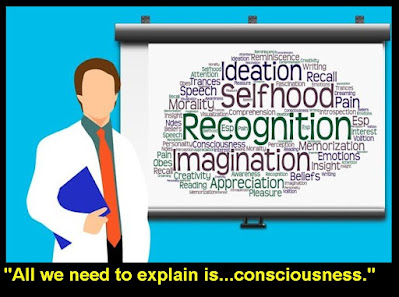
silly reductionism

Generically, we should be extremely suspicious of any philosopher who attempts to explain the human mind by using language centered around the term "consciousness." Let's look at one example of such a thing. In his 2017 paper "An Ontological Solution to the Mind-Body Problem," a paper with too boastful a title, independent scholar Bernardo Kastrup advances an offbeat theory of mind which he summarizes like this in the paper's abstract:

"It can be summarized as follows: spatially unbound consciousness is posited to be nature’s sole ontological primitive. We, as well as all other living organisms, are dissociated alters of this unbound consciousness. The universe we see around us is the extrinsic appearance of phenomenality surrounding—but dissociated from—our alter. The living organisms we share the world with are the extrinsic appearances of other dissociated alters. As such, the challenge to artificially create individualized consciousness becomes synonymous with the challenge to artificially induce abiogenesis."

Right off the bat, we should be extremely skeptical of such talk. The first reason is that we have right at the beginning a reference to "spatially unbound consciousness" as an "ontological primitive." What we need to explain are human minds, and human minds are a very complex and diverse reality, not at all anything like a "primitive." There is no reason to think that we could explain the extremely complex and diverse reality of the human mind by referencing some thing that is called a "primitive."  But if you made the huge mistake of using shrink-speaking language that wrongly describes the great complex and diverse reality of the human mind by using the diminutive term "consciousness," then you might think that you had got a good idea by postulating that such a reality can be explained by appealing to a "primitive."  Similarly, if you made the great mistake of using shrink-speaking language that wrongly describes the enormously organized and functionally complex and hierarchically organized human body as "carbon stuff," then you might think that you had a good idea of the origin of such a thing by merely postulating a "carbon stuff source." 

The last sentence of the paragraph quoted above is an extremely odd statement: "As such, the challenge to artificially create individualized consciousness becomes synonymous with the challenge to artificially induce abiogenesis." Abiogenesis is the creation of one-celled life from non-life, something that has never been achieved. It is very strange to equate that with creating an artificial consciousness. 

Kastrup's paper takes an approach in which he describes some things he calls the Basic Facts of Reality, and then attempts to deduce things from such facts. This approach goes wrong at the very beginning, for the first of these claimed "basic facts of reality" is no such thing. Kastrup lists as his first "basic fact of reality" the claim that "There are tight correlations between a person’s reported private experiences and the observed brain activity of the person."  This is not correct. Contrary to the unfounded boasts of neuroscientists  scanned brains don't look different when people are thinking, learning or remembering.  For a review of the failure of attempts to provide evidence for "neural correlates of consciousness," see my posts here and here.  The results typically reported in studies looking for "neural correlates of consciousness" are fluctuations of about 1 part in 200. We would expect to find fluctuations of that size even if the brain does not produce the mind, and memories are not stored in brains.  


The next four of Kastrup's "four basic facts of reality" are pretty uncontroversial. Kastrup then proceeds to make some metaphysical deductions, which he strangely lists as "five other facts." The first of these he states as "
 Fact 5: irrespective of the ontological status of what we call ‘a person’, there is that which experiences."  This is not a fact at all. Strangely, Kastrup attempts to justify this assertion by stating this, using "TWE" to mean "that which experiences":

"This is self-evident and, as colorfully put by Strawson [1] (p. 26), not even a sensible Buddhist rejects such a claim. For clarity, notice that I am not necessarily making an ontological distinction between experience and experiencer here; in fact, soon I will claim precisely that there isn’t such a distinction. I am simply recognizing that experience necessarily entails a subjective field of potential or actualized qualities. TWE is this field."

At this point Kastrup just leaps from a list of mostly truthful facts to some strange metaphysical assertion that is not at all self-evident, and is not justified by the claim that it is self-evident.  Alas, a thousand metaphysicians have appealed to things they called "self-evident" but which were not at all self-evident. A good rule is: never trust a metaphysician claiming something is self-evident. "Field" is a physics term, and seems out of place in the type of discussion here, since nothing physical is being talked about.  

Kastrup then lists another assertion as a "fact," by stating this: "Fact 6: A person has private experiences that can only be known by others if the person reports them, for other people do not have direct access to these private experiences."  This is not a fact at all.  We have very good evidence for extrasensory perception or telepathy. A first person may have a private experience of thinking about something, which a second person is able to identify even though the first person did not report it.  I have personally experienced this effect quite a few times in my life, and the effect has been reported by innumerable witnesses. Experiments attempting to reproduce such an ESP effect have been massively successful for decades. 

Also extremely dubious is what Kastrup claims as "Fact 9" which he states as "A brain has the same essential nature—that is, it belongs to the same ontological class—as the rest of the universe," a claim that he justifies by stating, "After all, brains are made of the same kind of ‘stuff’ that makes up the universe as a whole." All cellular matter in human bodies is matter in an extremely high state of organization, and therefore different from 99.9999999999% of the ordinary matter in the universe, which is no such high state of organization. 

After listing nine things claimed as facts, three of which are not actually facts, Kastrup attempts to derive what he calls "inferences." His first inference he states like this (using TWE to mean "that which experiences"):

"Inference 1The most parsimonious and least problematic ontological underpinning for Fact 5 is that TWE and experience are of the same essential nature. More specifically, experience is a pattern of excitation of TWE."

This doesn't seem to actually be any inference, but simply an arbitrary and very dubious metaphysical assertion. We can only wonder: why is Kastrup claiming that experience is "a pattern of excitation"? When I'm calmly lying in bed with my eyes closed, that is an example of experience. But it seems to be nothing at all like some state of excitation. 

Kastrup's next inference states, "TWE is an ontological primitive, uncaused and irreducible." Something has gone very wrong here.  A leap has been made to a claim about some uncaused reality, without any argumentative justification. Soon after making this claim, Kastrup says, "Substantial literature supports this view," referring us to three books which sound like metaphysical books. 

Very strangely, Kastrup keeps using the words "dissociated" and "dissociation," using such terms 77 times in his article. He seems to imagine some "ontological primitive" he calls "universal consciousness," and seems to claim that you and I are "dissociated alters" of such universal consciousness. Constantly using the term "dissociated" to describe humans, he ends up sounding very strange. A central reality of a human mind is its unity. So it sounds very strange for Kastrup to keep talking about humans as being "dissociated."   Kastrup evokes the term "alter" saying that it means one of the personalities of a split personality. He then attempts to use claims about split-personalities as a metaphysical springboard, claiming that each of us is an "alter" of "universal consciousness," with each of us being like one of the personalities of a split personality. This leaves his "universal consciousness" as rather sounding like some psychiatric case, like Sally Field's Sybil character, but infinitely more mind-fragmented.  Such reasoning is bizarre, and it ends up making each human sound like a psychiatric symptom. 

At the conclusion of his paper, Kastrup states this:

"I have argued for a coherent idealist ontology that explains reality in a more parsimonious and empirically rigorous manner than mainstream physicalism and bottom-up panpsychism. This idealist ontology also offers more explanatory power than both physicalism and bottom-up panpsychism, in that it does not fall prey to either the ‘hard problem of consciousness’ or the ‘subject combination problem’, respectively. It can be summarized as follows: there is only universal consciousness. We, as well as all other living organisms, are but dissociated alters of universal consciousness, surrounded like islands by the ocean of its thoughts. The inanimate universe we see around us is the extrinsic appearance of these thoughts. The living organisms that we share the world with are the extrinsic appearances of other dissociated alters of universal consciousness. As such, the quest for artificial consciousness boils down to the quest for abiogenesis. The currently prevailing concept of a physical world independent of consciousness is an unnecessary and problematic intellectual abstraction." 

This may sound somewhat impressive until we remember the very great folly of trying to reduce human minds and human mental experience to some bloodless abstraction called "consciousness." What we have to explain is not some mere abstraction called "consciousness" but the extremely complex and diverse reality of human minds, things such as imagination, selfhood, ideation, appreciation, memorization, morality, recognition, consciousness, emotions, speech, comprehension, creativity, recall, insight, beliefs, reminiscence, trances, introspection, pleasure, pain, reading, writing, awareness, perception, knowledge,  attention, personality, fascination, interest, visualization, ESP, dreaming, volition, out-of-body experiences, near-death experiences and apparition sightings. 

Idealism is the philosophical position that matter has no independent existence outside of minds that perceive matter. An idealist is someone who believes that the universe is just a collection of minds. An idealist is someone who thinks that instead of our minds existing inside the solar system, it's the other way around: the solar system is merely something that exists as a perceptual regularity inside of minds such as ours.


idealism

To someone who is not used to thinking as an idealist, idealism may initially seem absurd. But the case for idealism was advanced in a surprisingly forceful way in the eighteenth century, by British philosopher George Berkeley. In his classic philosophical work The Principles of Human Knowledge (which can be read here), Berkeley argued for immaterialism, the idea that matter has no existence outside of minds that perceive matter. 

Being a person who denies the reality of matter, an idealist needs to have a credible answer  to the question of why people report identical experiences of observing physical things that don't really exist according to the idealist.  For example, why do you and me and all of our relatives always have the same experience seeing a bright yellow thing in the sky during the day, and a bright white thing in the sky during the night? For a materialist or a dualist the answer is easy: because the sun really physically exists, and the moon really physically exists. But for the idealist who does not believe in the physical existence of the sun or the moon, this uniformity of observations is a problem. 

Berkeley got around this problem by imagining a divine reality (God) that causes such uniformity of perceptual experiences. So, according to Berkeley, when we look up at the sky and see the sun fairly often, it is not because there exists a physical sun independent of minds; it is instead because a divine mind is causing such perceptual regularities in our mind.  We know that movie directors cause people to have certain uniform perceptual experiences. So, for example, all of the people who saw Saving Private Ryan in the movie theater had the same perceptual experience.  So it's not too implausible that a divine power could cause humans to have certain types of uniform perceptual experiences. 

But it would seem that thinkers such as Kastrup have no good answer to the question of why humans would have uniform perceptual experiences of matter if matter does not exist. It seems rather implausible that some mere "universal consciousness" would cause you and I to have identical experiences of perceiving the sun and the moon if the sun and the moon did not materially exist.  The problem is that Kastrup has hitched his wagon to the bloodless, abstract, shrink-speaking term "consciousness,"  and imagined some "universal consciousness" which he describes as a mere "ontological primitive." Having done that, he is left with a "primitive" bloodless abstract "universal consciousness" that seems to lack any will or intention, and would therefore be incapable of intentional effects such as making sure that you and I have uniform experiences of observing the sky.  So it seems the idealism of Kastrup is not as credible as the idealism of Berkeley. 

I must emphasize that we should be extremely suspicious of any philosopher who attempts to explain the human mind by using language centered around the diminutive and minimalist term "consciousness." Similarly, we should be extremely suspicious of any philosopher who attempts to explain the human mind by using language centered around the minimalist term "Being." You should doubt that the armchair reasoning of ontology will yield an explanation of humans. 

Postscript: In a Scientific American article, Kastrup made the incorrect claim below about "dissociative identity disorder" (DID):

"Modern neuroimaging techniques have demonstrated that DID is real: in a 2014 study, doctors performed functional brain scans on both DID patients and actors simulating DID. The scans of the actual patients displayed clear differences when compared to those of the actors, showing that dissociation has an identifiable neural activity fingerprint."

To the contrary, the 2014 study failed to show any such thing.  It was a Questionable Research Practices study that involved a far-too-small sample size of only 11 subjects identified as having "dissociative identity disorder."  The subject was not a pre-registered study, failed to follow any blinding protocol, and failed to do any sample size calculation. Anyone searching for differences in brain scans can always find differences in one random group of about a dozen people and some other random group of about a dozen people.  Study group sizes far greater than 11 are needed for robust results. 

The way to get a reliable result would have been to first state (before gathering data) a specific hypothesis to be tested (such as a description of some specific difference in brains), and then to test for that exact hypothesis using an adequate study group size (determined by a sample size calculation), in an analysis done by analysts blind as to whether the brain scans come from the control group or the study group. 

Contrary to Kastrup's claims, split-personality cases are of no value in helping to establish the credibility of some claim that humans are "but dissociated alters of universal consciousness" (to use a phrase of Kastrup I quoted above).   The "alters" of people diagnosed as split personalities are not personalities existing at the same time, but personalities that may appear sequentially. An analogy is the channel dial on an old TV of the 1960's, which would only allow you to choose one channel at a time. The "alters" of the person with split personality are like "personality channels," and only one appears at any instant. As suggested in the diagram below, someone with a split personality may switch from Personality 1 to some different Personality 2, but such personalities do not appear at the same time. Such cases do nothing to help establish the claim that some "universal consciousness" has split up into billions of human minds that simultaneously exist at the same instant.  

split personality
Schematic diagram of a split personality

Post-postscript: In a recent post Kastrup confesses this:

"Rupert highlights that Analytic Idealism is still naturalist and reductionist. That is entirely correct. I think the world unfolds spontaneously, according to its own inherent dispositions (i.e., the observed regularities we call the 'laws of nature'), and without supernatural intervention from an outside agent beyond the boundaries of nature itself."

Kastrup denounces materialism, and uses language different from that of a materialist. But when it comes to the key questions thar really matter, such as whether the human race is a mere accident of nature, it seems that Kastrup's ideology at its core is pretty much the same as that of materialists. And his "analytic idealism" fails for the same type of reasons that materialism fails, in that it fails all over the place to credibly explain the organization marvels of human bodies and the wonders of human minds. "Atheistic idealism" would be a more honest name for his philosophy. 

Kastrup can be a very careless reasoner. In one post he states this: 

"There is nothing you can pin down about the infant, the child, the teenager or the young adult you once were that has remained intact in you today. Everything about them has changed: their bodies, appearance, feelings, dreams, thoughts, opinions, everything."

This is not true at all. An old person like me has many memories of his youth, and such memories have not changed. I still have many of the opinions and feelings I had when I was a young man, and my feelings  towards my mother and siblings have not changed in 50 years

The same poorly-reasoned post gives me further suspicions that there is no great difference between the thinking of Kastrup and that of a materialist, despite the superficial differences and differences in language. Kastrup's concept of death seems to be essentially identical to that of a materialist not believing in life after death. He seems to imagine a person's death as a "you will no longer be a separated alter of mind-at-large or universal consciousness" deal which is for all practical purposes the same as death without an afterlife.  Observational reality tells us a different tale, and near-death experiences and out-of-body experiences are part of the huge amount of evidence in favor of the survival of persons and souls after death.