Showing posts with label science journalism. Show all posts

Sunday, April 27, 2025

The BBC's Science News Coverage Is Often Third-Rate

 The term “filter bubble” is used for a situation in which someone receives only a stream of information that agrees with his beliefs. The term was originally used to describe computer algorithms that give you only a stream of stories, news items or posts that match your interests (such a flow of items also having a tendency to match your own beliefs about things). But the term “filter bubble” is also used in a wider sense, to mean any stream of information or opinion that was designed (by computers or humans) to conform to the beliefs and expectations of a particular type of person.

On our TV sets we have particular American TV channels that are examples of filter bubbles. On the Fox News channel, we are given only stories and information that conform to the opinions and expectations of Republican voters. On the MSNBC channel, it often seems we are given only stories and information that conform to the opinions and expectations of Democratic voters. 

There are similar web sites that are designed to give news items and opinion pieces that conform to the beliefs of some particular type of voter. Between 2001 and 2025 all US presidents and congresses have recklessly piled up sky-high budget deficits that have caused the US national debt to skyrocket to nearly 36 trillion dollars.  During  eight years of George W. Bush and two years of Donald Trump, we heard hardly a word about such a problem on Fox News; and during eight years of Barack Obama and four years of Joe Biden we heard scarcely a word about such a problem on MSNBC. 

If you're a scientist or a typical consumer of scientist dogma, you may think to yourself: “You often have that kind of filter bubble in politics, but not in science,” or “When I get my science news, it doesn't involve any kind of filter bubble.” But such opinions are very wrong. The favorite web sites of scientists and scientist fans are actually some of the clearest examples of filter bubbles anywhere on the Internet.


Some of the favorite web sites of scientists and materialists are these:
  1.  The New York Times.
  2.  Quanta Magazine
  3. Scientific American
  4. The web site of the journal Nature
  5. LiveScience
  6. The web site of the journal Science
  7. Nautilus Magazine
  8. BBC.com
  9. National Geographic
  10. Wikipedia.com

Below are some of the reasons such sites are filter bubbles:
  1. No coverage of the paranormal, or only biased or untruthful coverage. Human experience with paranormal phenomena is extremely vast, consisting of a huge variety of anomalies experienced by a large fraction of the population. Such experiences include things like ESP experiences, apparition sightings, near-death experiences, precognitive dreams, visions of the terminally ill, anomalous experiences with mediums, and UFO sightings. Besides the vast amount of experiences that have occurred outside of laboratory settings, there is a gigantic amount of evidence for paranormal phenomena gathered under laboratory conditions, including abundant laboratory evidence for both ESP and unexplained physical disturbances and manifestations. But in the filter bubbles of the favorite web sites of scientists, there is virtually no reference to such important realities. If any reference is made, it is likely to be jaundiced or untruthful.
  2. Very little coverage or discussion of facts inconsistent with the beliefs favored by those inside the filter bubble. The person in the materialist filter bubble believes that the human mind is purely a product of the brain, or perhaps just an aspect of the brain. He also believes that the brain is a machine for storing and retrieving memories. There are many observational facts that conflict with such dogmas, typically facts that are not even contested. For example, there have been quite a few persons with normal, near-normal or above average intelligence despite having little functional brain tissue or only half a brain (discussed in this series of posts); synapses (claimed to be the storage sites of memory) are made up of proteins that have average lifetimes of only a few weeks; and autistic savants with brain damage can show memory recall abilities far beyond that of a normal person. But within the filter bubbles of the favorite web sites of scientists, you will get very little or no discussion of these and very many other facts that conflict with the claims of materialist orthodoxy. A similar situation might have occurred in the 1970's if a pro-Nixon newspaper were to have only a few lines in its paper (buried in the back pages) referring to the Watergate affair.
  3. Uncritical regurgitation of extremely dubious experimental results or theoretical speculations. Besides a replication crisis in modern science, there is a vast problem of hype, triumphalist overconfidence and exaggeration, in which extremely dubious speculations, flimsy explanations or weak experimental results are constantly being trumpeted as momentous science breakthroughs or "facts." In the favorite web sites of scientists, such dubious results and weak intellectual products are typically reported without criticism, and often hyped even further, often in a way that seems designed to bolster prevailing dogmas and prejudices.  The result is typically a kind of "pom-pom journalism" in which pushover fanboys tend to fall for authority pronouncements  and professorial party lines "hook, line and sinker." 
Notice that I include the British Broadcasting Company or BBC in the list above of filter bubble sites favored by scientists. The BBC has a reputation as a reliable source of journalism.  In regard to coverage of science topics, the BBC surely does not deserve such a reputation  Over many years the BBC has been guilty of very bad coverage on science topics. The BBC's science coverage is often Bunk, Baloney and Crap, like the Fake News we read in the headline below. 

Fake News, BBC-Style

The web site of the British Broadcasting Company is very much a materialist filter-bubble site. An example of its strong bias was a long article it published on mediums. There was no discussion at all of any of the many years of studies in which scientists had dramatic successes in testing mediums under controlled conditions, including repeated spectacular successes with mental mediums such as Leonora Piper and Gladys Osborne Leonard, and equally dramatic successes with physical mediums who produced dramatic physical paranormal phenomena (see here and here for two examples). Instead, the only mention of scientific tests of mediums was a quote by someone who misspoke by saying mediums have never produced paranormal results when tested under controlled conditions. So the article was roughly equivalent to an article giving no evidence for rocket successes, and quoting someone claiming that rocket launches have never succeeded.  An example of the BBC's appalling gaslighting of paranormal witnesses is discussed here

Below are some examples of cases in which the BBC gave us extremely low-quality science coverage:
  • A story on the BBC Science Focus site had this utterly bogus Fake News headline: "We finally know how life on Earth started, staggering new asteroid discovery suggests."  The study discussed provided not the slightest warrant for such a claim, and none of the study's authors made such a claim.  The study merely claimed to have found the tiniest trace amounts (roughly 1 part in a billion) of some chemicals used by living things, in a sample taken from an asteroid. As I discuss at length in my post here, the claims made in the study are not reliable, because the amounts reported are such negligible trace amounts that  we can have no confidence that the reported chemicals came from the asteroid, rather than from earthly contamination. The BBC article on this study has quite a few statements as bogus and untrue as the article's headline. 
  • About the same time there was an equally bogus headline on BBC Science Focus, a headline of "Alien life on Mars: Ancient beach discovery may offer clearest proof yet."  No evidence of life on Mars has been discovered.  No one has found the building components of life on Mars (protein molecules), nor has anyone ever found on Mars the building components of the building components of life  (amino acids). 
  • A laughable BBC article attempting to persuade us that Charles Darwin was some brilliant origin-of-life theorist.  Entitled "Darwin's hunch about early life was probably right," the piece is laughable partially because Darwin's published works contain no deep thoughts about the origin of life.  The only thing Darwin wrote having any relevance to the origin of life was a mere sentence he wrote in some letter on February 1, 1871. All he said was this: "But if (& oh what a big if) we could conceive in some warm little pond with all sorts of ammonia & phosphoric salts,—light, heat, electricity &c present, that a protein compound was chemically formed, ready to undergo still more complex changes, at the present day such matter will be instantly devoured, or absorbed, which would not have been the case before living creatures were formed." Far from being a great insight, we now know that functional protein molecules require hundreds of well-arranged parts that have to be as carefully arranged as the letters in a useful instruction paragraph, making their accidental origin unthinkable, and also that life requires hundreds of different types of protein molecules, making the origin of life exponentially more difficult than what is described in Darwin's sentence (and by exponentially more difficult I mean like 10 to the hundredth power more difficult). 
  • In 2018 the BBC reported on a science experiment by using the false headline “'Memory transplant' achieved in snails.” But you need not think very hard to realize that there's something very fishy about such a story. How could someone possibly get decent evidence about a memory in a snail?  The study was an example of junk neuroscience.  Judging from the paper, the effect described involved a way-too-small study group size of  only 7 snails (the number listed on lines 571 -572 of the paper). There is no mention of trying the test more than once on such snails. Such a result is completely unimpressive, and could easily have been achieved by pure chance, without any real “memory transfer” going on. Whether the snail does or does not withdraw into its shell is like a coin flip. It could easily be that by pure chance you might see some number of “into the shell withdrawals” that you interpret as “memory transfer.”
  • A BBC "Science Focus" story  gave us this very false "almost finished" narrative about research  into the origin of life: "While we don’t know exactly how life began, we have a lot of clues. Let’s start with the easiest bits: what is life made of and where did those components come from? Living organisms contain thousands of chemicals: like proteins and nucleic acids that carry our genetic information. These chemicals are complex, but we now know that their constituent parts form quite readily." No, we do not have "a lot of clues" about life's origin. The constituent parts of proteins (amino acids) do not "form quite readily," and the evidence the article cited for such an opinion (the Miller-Urey experiment) did nothing to show that such amino acids "form quite readily," because it was not a realistic simulation of the early Earth, as I discuss here.
  • A BBC article told us this utterly false claim about parallel universes: "Physics has found all sorts of reasons why they should exist.”  This claim was Fake News, for reasons I discuss here. Physicists have not provided any actual justifications for believing in parallel universes. 

  • An article at the BBC Science Focus sight tried to persuade us that "do it home" brain zapping device may be good for treating depression. The article referred us to a study run by people being paid by a corporation selling such a device. We were incorrectly told that this was like a double-blind study: "It was a double-blind, placebo-controlled, randomised study – something close to a gold standard in research." The study was not actually a double-blind study, because when the device is producing real brain stimulation, you can tell it is running. So the people getting the real brain stimulation would have been more likely to have reported improvement (due to a placebo effect) than people using "sham" devices that did not provide brain stimulation.  A double-blind study is like a study in which people get  a pill, and they have no way of knowing whether the pill is real medicine or merely a do-nothing placebo pill. 

  • An article at the BBC Sky at Night magazine has the incorrect title "NASA’s new SPHEREx telescope set to reveal what happened just a fraction of a second after the Big Bang." The claim was total baloney. No telescope could ever do any such thing.  According to what cosmologists tell us, the first 250,000 years of the universe's history, matter and energy were so densely packed that all light or energy signals from before that time must have been hopelessly scattered a billion trillion times, making it physically impossible to ever devise a telescope looking back to get signals from the universe's first 100,000 years. The BBC story was a bad example of a misleading news story. It began with this baloney claim: "NASA’s new SPHEREx space telescope will soon launch on its mission to answer some of humanity’s most fundamental questions around how life, and even the Universe itself, came to exist." That telescope won't do anything to tell us how life began or how the universe began. 

  • A bbc.com story announced, “Researchers have released the most accurate map ever produced of the dark matter in our Universe.” But how can someone have a map of dark matter locations when dark matter has never been observed? All attempts thus far to make direct observations of dark matter have failed. Dark matter doesn't even have a place in the Standard Model of Physics, and no evidence for it has turned up at the Large Hadron Collider.  The BBC claim was false. No real "map" had been produced. 

  •  A recent BBC news article had a bogus headline of "Fly brain breakthrough 'huge leap' to unlock human mind." Here is an excerpt from the story: "Now for the first time scientists researching the brain of a fly have identified the position, shape and connections of every single one of its 130,000 cells and 50 million connections. It's the most detailed analysis of the brain of an adult animal ever produced. One leading brain specialist independent of the new research described the breakthrough as a 'huge leap' in our understanding of our own brains. One of the research leaders said it would shed new light into 'the mechanism of thought'."  The claim at the end of the quote is obviously very absurd.  Fruit flies don't think. So there is no conceivable study of the brain of the fruit fly that could shed light on what allows humans to think. 

  • The recent case of scientist Nikku Madhusudhan making groundless claims about detecting dimethyl sulfide at planet K2-18 b was a good litmus test of whether a science news source will fall "hook, line and sinker" for very untrustworthy scientist boasts.  For reasons I give in my post here, the claims were groundless. There is zero robust evidence that such a gas was detected at planet K2-18 b, and zero evidence of any biomarkers at this planet.  Most of the mainstream science news sources flunked the test, although we got some good science journalism at The Atlantic and Ars Technica, which presented reasons for being very skeptical about Madhusudhan's gloryhound boasts (I quote them in my post).  The BBC flunked this litmus test very badly. One of its stories falsely claimed that dimethyl sulfide had been detected, at planet K2-18 b ignoring very many reasons for disbelieving Madhusudhan's boasts. The BBC article was entitled, "Scientists find 'strongest evidence yet' of life on distant planet." No such evidence had been found. On the day  Madhusudhan's paper was published, I published a post saying that his claims were groundless, and that "nothing reliable has been done in this paper to show any likelihood of the existence of dimethyl sulfide on this planet K2-18 b," and that "nothing reliable has been done in this paper to show any likelihood of the existence of any biomarker on this planet K2-18 b."  In the following days we had articles in mainstream publications quoting scientists saying they were very skeptical about Madhusudhan's paper, such as the Gizmodo.com article here and and the National Geographic article here

Wednesday, December 20, 2023

How to Interview an Overconfident Biologist

These days biologists routinely display enormous overconfidence. They routinely claim to understand very deep things they do not understand, and that are a hundred miles over their heads. Biologists also have the very bad habit of repeating groundless triumphal legends claiming that scientists have developed explanations for wonders of biology that are actually vastly beyond the understanding of our biologists. 

Science journalists should act as a check inhibiting the extreme overconfidence of biologists, just as speed bumps are checks that limit the speeding of reckless drivers. But alas, today's science journalists act like cheerleaders. Science journalists act like they are afraid to ask scientists the tough questions such scientists should be asked. This is only one of many very bad failures or very poor habits of today's science journalists. 

bad science journalism

But we may hope that one day we see more science journalists acting like real journalists rather than North Korean journalists who reverently accept everything told them by authorities. Below is a sketch of how a science journalist could interview an overconfident biologist.  The interview follows a general strategy:

(1) First, the journalist asks a few "softball questions" that will typically result in the overconfident biologist making his most overconfident claims. 
(2) Instead of immediately disputing the overconfident answers, the journalist asks about very many smaller issues related to the overconfident claims. 
(3) Finally, the journalist points out the discrepancy between the overconfident claims made by the scientist at the beginning of the interview, and the answers given in the main part of the interview, pointing out the contradiction between the two.  

Below is a sketch of how this might occur. 

Reporter: I am here with the distinguished biologist Professor Doe. Thanks for giving us some time, Professor. 
Scientist: It's a pleasure to be here. 
Reporter: So I know that authorities such as you are very big on the insights of Charles Darwin, and the idea of natural selection and evolution, isn't that right?
Scientist: It certainly is. In fact, we're fond of quoting the geneticist who said that nothing in biology makes sense except in the light of evolution. 
Reporter: So does Darwinism and evolutionary theory explain the history of life on Earth?
Scientist: Yes, absolutely. Darwin rules! As someone once said, "In the final analysis, the answer must always be Darwin."
Reporter: I'm sure it's great to have that kind of sweeping insight. And speaking of simple ideas that explain a huge amount of things, would you say that the human mind and human behavior can all be explained as aspects of brain activity or results caused by brain activity? 
Scientist: Yes, everything that we call the mind is really just the brain, or effects produced by the brain. 
ReporterI know that neuroscientists like to say things such as,  "We're all just brains and the brain's activity." 
Scientist: Yes, exactly. That is correct. 
Reporter: So everything that goes on in the mind can be explained by something happening in the brain, correct?
Scientist: Yes, exactly. The brain explains everything in psychology. 
Reporter: So can you list some unsolved problems of biology?
Scientist: Well, there's the origin of life. We don't understand that.
Reporter: You mean the origin of prokaryotic cells. But what about the origin of the vastly more complex eukaryotic cells?
Scientist: We have a theory that covers that, a theory of a huge leap in organization by endosymbiosis, kind of like a house suddenly converting into a high office tower.
Reporter: Is that a Darwinian theory, involving nothing but very gradual steps over a very long time, a "nature makes no leaps" kind of thing?
Scientist: No, it actually involves a gigantic sudden leap.
Reporter: And so what about the Cambrian Explosion, when all or almost all the animal phyla seemed to have originated rather suddenly within maybe something like ten million years or twenty million years? What caused that?
Scientist:  That's quite a mystery. We're still working on trying to explain how that happened. Some say it had something to do with a change in the oxygen levels on planet Earth. 
Reporter: Oxygen? So can oxygen design incredibly complicated new blueprints for making many new types of organisms, unlike any that have existed?
Scientist: No, I didn't say that. But oxygen is very important. We couldn't live without it.  
Reporter:  Each of us has more than 20,000 types of protein molecules in our bodies, and almost all of these types contain hundreds or thousands of well-arranged amino acid parts. How did Darwin explain the origin of all those molecule types?
Scientist: Well, that kind of complexity was not discovered until the 20th century, so it's not fair to expect he explained that. 
Reporter: Do you understand the origin of language?
Scientist: Little progress has been made on that.
Reporter: What about morphogenesis, the problem how a speck-sized zygote progresses to become the vast organization of an adult human body?
Scientist: That's one of the biggest unsolved problems of biology. The people called developmental biologists are working on that. 
Reporter: Do you understand how a single human cell is able to reproduce?
Scientist: Well, we can describe the stages. But the "how" is very puzzling. We don't really understand the how. 
Reporter: And how does a human being instantly remember a complex answer upon hearing a single name or short question?
Scientist: I don't know. That's a puzzle the neuroscientists are working on. 
Reporter: How can people remember things for fifty years, when the proteins that make up neurons and synapses have lifetimes of only a few weeks?
Scientist:  Memory is quite the mystery. 
Reporter: People can remember very many types of things, can't they? They can remember images, school lessons, music, facts, emotions they've experienced, life experiences they have had, and how to do physical things such as ride a bike or type or play an instrument.  How could all of those different types of learning and memory be stored as brain states?
Scientist:  Well, when you learn something called encoding goes on. That means translating your experiences and learning into brain states. Then when you remember such things, there's an opposite process called decoding. 
Reporter:  Does anyone understand how such encoding could occur? Has anyone ever found a "brain code" that works in some very specific way, kind of like how the genetic code works?
Scientist:  Not actually. But we're looking for that. Give us time. Rome wasn't built in a day. 
Reporter:  But microscopes today are very many thousands of times more powerful than when the genetic code was discovered in the 1950's, so wouldn't scientists have found such a "brain code" for storing memories if it existed? 
Scientist:  We haven't found it yet, so I guess the answer must be "no."
Reporter:  Has anyone ever read a memory from a dead person, so that you could tell what they learned? Has anyone ever done something like looking at some brain tissue using a microscope, and then said, "I know this dead guy must have learned about Spanish medieval history, because I see facts of Spanish medieval history stored in his brain?" 
Scientist:  No, I've never heard of that happening. But you know science is moving so fast, we may see that some day. 
Reporter:  But given the power of today's microscopes, wouldn't you have found such memories in the brains of dead people, if brains store memories?
Scientist:  Apparently not, because no one has ever done that. 
Reporter:  So how could some brain chemical reactions ever add up so that you get the reality of a person with a unified sense of a single self having experiences?
Scientist:  They sometimes call that "the hard problem of consciousness." It is generally thought that it hasn't been solved yet. But there are some interesting theories I could discuss, such as the integrated information theory and the global workspace theory. 
Reporter: Can you describe what goes on in a brain when a person starts to have a belief or an opinion? Do you know of some  kind of chemical reaction that corresponds to that, or some neural restructuring?
Scientist:  No, but it's not really fair to ask that, because most of experimental neuroscience has been done on mice and rats, and they don't really have opinions or beliefs. 
Reporter:  I can't help noticing that what you said at the beginning of this interview very much seems to contradict what you've been saying after the beginning of the interview.  
Scientist:  What do you mean?
Reporter: At the beginning of the interview, you said that  evolutionary theory explains the history of life. But based on your answers after that, it seems like evolution theory and Darwin's ideas do not explain most of the biggest things that occurred in that history.  It seems that you don't have evolutionary explanations for most of the biggest things happening in the history of life. And it sounds like you don't really have much of any explanation for some of the biggest things happening in the history of life, such as the Cambrian Explosion, the origin of protein molecules, the reproduction of cells, the origin of language, the origin of consciousness and the origin of creatures that can remember for as long and as quickly as humans remember. 
Scientist:  Not so. I was taught in graduate school that in biology "ultimately the answer is always Darwin."
Reporter: Also I can't help noticing how your statement at the beginning of this interview (saying that the brain completely explains the mind) is contradicted by your statements after the beginning of this interview. For you have repeatedly confessed that you don't have an explanation for most of the things going on in the mind, things like consciousness and self-hood and instant recall and memory storage and remembering things for fifty years. Based on your statements after the beginning of the interview, it sounds like you don't have any detailed or credible brain explanation for such things that constitute the core of what goes on in the mind. 
Scientist:  Not so. I was taught in school many times that everything in the mind is explained by the brain. 
Reporter: Would  it make sense to claim that you understand the physical origin of some species when you don't understand the origin of any of the adult organisms of that species? 
Scientist:  No, that would probably be kind of like saying you were very rich when you couldn't even pay your modest rent. 
Reporter: So why do you claim that you understand the origin of the human species when you don't seem to understand the origin of any adult human, because you don't understand morphogenesis (how a speck-sized zygote progresses to become a full adult human), and you don't understand how minds like ours and memories like ours arise? 
Scientist:  So why are you casting such doubt about what people like me say? Don't be so "anti-science."  
Reporter: I'm not "anti-science" at all. I'm pro-science. I just want better science, in which scientists don't claim so often to know things they don't know. 
Scientist:  In my department we all agree: whenever someone doubts certain things, that means they're enemies of science.
Reporter: Thank you for your time, Professor Doe.

Were we to get an interview like this with a biologist, it would really help to "pull back the wizard's curtain" and show how groundless are the biggest explanatory boasts of biologists. But you should not expect any science journalist to ask questions this challenging when interviewing a biologist.  Science journalists act like rock star fans when dealing with scientists, and they treat scientists as reverently as North Korean journalists treat North Korean officials.  The rule of the science journalist doing an interview seems to be, "Only gently pitch softballs that are easy to hit." 

Asking the right questions and getting confessions about lack of knowledge about smaller matters is one way to help show that overconfident biologists do not actually know many of the grand things they claim to know. Another technique is to diligently collect statements by scientists in which they confess they do not know the type of smaller things they would know if their claims about knowing larger things were true. A very large collection of such statements is found in my long post "Candid Confessions of the Scientists" which you can read here

Sunday, July 9, 2023

The Two Years of MSNBC's Mueller Hype Was Like the Science Media's Poor Journalism

 During most of 2020 and 2021, the COVID-19 pandemic and the 2020 US election were the two big stories in the US press.  But in 2017 and 2018 in some places in the media it was like there was a different story that had been crowned as the Big Story: the Mueller Investigation. We can look back now at the coverage of that investigation, and realize that much of the coverage was a bad example of junk journalism. 

Triggered by the firing of FBI director James Comey by Donald Trump (then president of the United States), the Mueller Investigation was launched in May 2017 to investigate claims of Russian interference into the 2016 United States election. Before it completed  in March of 2019, the investigation was a secret government inquiry. But this did not stop television networks such as MSNBC from reporting on it almost every day for two years.  The stories about the investigation that we got on MSNBC shows such as the Rachel Maddow show were in general a case of junk journalism. 

For almost two years on her primetime show, Rachel Maddow had a steady stream of talking heads speculating about what the Mueller Investigation was doing and what its end result would be. It was a very long stream of guesswork and kind of wishful longing in which people seemed to fondly imagine how the Mueller Investigation would end up spelling Trump's doom. Guest after guest on Maddow's show would leave hints suggesting that once the investigation was finished, it would spell political doom for the US president at that time, Donald Trump. During this period between May 2017 and March 2019, there was little in the way of substantive facts to back up such speculation, because the Mueller Investigation had not yet released its report. For almost two years MSNBC led us to believe that the Mueller Investigation was pretty much the most important story of its time. A Guardian article says this:

"The Mueller investigation was covered more on MSBNC than any other television network, and was mentioned virtually every day in 2018. No twist was too minuscule or outlandish for Maddow; every night, seemingly, brought another nail in the coffin of the soon-to-be-dead Trump presidency...In more sober times, this brand of analysis would barely cut it on a far-right podcast. In the Trump era, it was ratings gold."

The Mueller Investigation resulted in the indictment of 34 individuals,  eight of whom were convicted or pleaded guilty. None of the charges were charges of colluding with Russians to alter the 2016 election. Donald Trump was not indicted. Finally in May 2019 the Mueller Investigation released its report. The results were anticlimactic. The report said that substantial Russian interference in the 2016 US election had occurred, but such a thing was already known before the Mueller Investigation began in 2017. 

BBC article summarized the rather dull and muted findings of the Mueller Investigation:

"Mr Mueller's 448-page report said it had not established that the Trump campaign criminally conspired with Russia to influence the [2016] election. However, it did detail 10 instances where Mr Trump had possibly attempted to impede the investigation and stated the report did not exonerate Mr Trump. Mr Mueller reiterated that in a rare statement following the end of the inquiry and said legal guidelines prevent the indictment of a sitting president. He said if his team had had confidence that Mr Trump 'clearly did not commit a crime, we would have said so.' "

The Mueller Investigation seemed to have no great effect on the opinions of US voters, and there was little change in the polls.  By April 2020 people began focusing on the COVID-19 pandemic, and the Mueller Investigation was almost forgotten by the public. After losing the 2020 US presidential election Donald Trump now finds himself indicted on other charges and in serious legal trouble for various other reasons; but the idea that the Mueller Investigation would be his downfall was not at all correct. 

There is a strong resemblance between two years of MSNBC's "Mueller mania" junk journalism and the junk journalism that continues to pervade the reporting of science news. Some of the similarities are as follows:

(1) Just as MSNBC gave us two years of softball-question interviews with speculating authorities who did not really know what they were talking about when they droned on about the Mueller Investigation (because the investigation was secret), science journalists give us year after year of softball-question interviews with speculating scientists who do not know what they are talking about when they speculate on topics such as dark energy and dark matter (which have never been observed), human memory (which is not credibly explained by anything known about the brain),  and macroevolution (which has never been observed by humans, unlike small-scale microevolution that has been observed). 

(2) Just as MSNBC hosts such as Rachel Maddow for two years tried to give us the impression that they had some deep insight into some matter they did not understand (the secret Mueller Investigation), science journalists year after year write articles trying to give us the impression that have some great insight into baffling mysteries of nature that are vastly beyond their understanding (such as the mystery of how an enormously organized human body is able to form from a speck-sized zygote, the mystery of how any human is able to think, imagine or remember, or the mystery of how the human species originated). 

(3)  Just as the great majority of the Mueller Investigation talk we got for two years (2017 and 2018) on MSNBC shows such as the Rachel Maddow Show was pretty worthless hype and speculation, a large fraction of the content of today's science news is almost-worthless hype and speculation, including lots of poor and uncritical hype-heavy discussion of badly designed science research guilty of Questionable Research Practices, in which weak and unimportant papers are hailed as giant breakthroughs.

(4) Just as the endless Mueller Investigation talk we got for two years (2017 and 2018) on MSNBC was ideology-heavy content designed to influence worldviews and voting behavior, a great deal of the content in our science news feeds and science web sites is ideology-heavy content designed to influence worldviews, and make you think a particular way about yourself and the universe you live in: that your species is an accident of nature that arose in an accidental universe.  

(5) Just as the endless Mueller Investigation talk we got for two years (2017 and 2018) on MSNBC distracted us from things we should have been paying attention to (such as the risk of a global pandemic like the one starting in 2020, the danger of hazardous gene-splicing in biomedical labs with insufficient safeguards, and the danger of inflation which rather suddenly got so bad around 2021), the speculation and clickbait journalism that litters science news sites have been a very bad distraction reducing the amount of time people spend on pondering the really important developments related to science and nature. Such developments include the gradual discovery that we live in a very precisely fine-tuned universe that had to be just right in dozens of ways for us to exist; the accelerating discovery of stratospheric levels of organization. coordinated complexity and purposeful fine-tuning in the human body and in the bodies of all mammals; the worsening failure of explanations such as Darwinism and genetics to account for such wonders of nature; the failure of neuroscientists to provide robust evidence backing up their  claims of a neural basis of mind and memory; increasing evidence suggesting brains have many physical shortfalls ruling out claims that they explain mind and memory; a replication crisis shaking the public's confidence in various types of experimental science such as neuroscience; and the growing evidence for psychic phenomena such as out-of-body experiences that are inconsistent with the claims about minds and brains typically made by today's scientists.  

bad detective
See here for a long discussion of the six clues shown above

Tuesday, March 29, 2022

Why the Academia Cyberspace Profit Complex Keeps Giving Misleading Brain Research Reports

Why do so many untrue and misleading stories about brains and minds appear in the press? The answer is largely a financial one: because various parties profit from such misleading stories. Using the famous "follow the money" slogan in the main movie about the Watergate affair (All the President's Men), let us "follow the money" and see how various parties profit from misleading stories about brains and minds in the press. 

The interesting diagram below illustrates a profit complex that links academia and cyberspace (a word that means the same as the Internet). 

Bad Science Is Profitable

To understand this profit complex, you must first understand how modern scientists are judged by their peers and superiors in academia. There are two numbers by which scientists are judged: (1) the number of scientific articles that the scientist has written or co-written, called the paper count; (2) the number of other papers that have mentioned or cited one of the papers the scientist has written or co-written, called the citation count. If you are a scientist hoping for a promotion such as tenure or a higher salary, you very much want these numbers to be as high as possible. 

The desire to raise such numbers (for the benefit of a scientist) is very much a factor when a scientist designs an experiment. Given the choice between some "quick and dirty" experimental design that will be likely to produce some result that is either a quick and easy result or a positive result or a result that can be claimed as some important result, and some other design that involves some more stringent research method that is longer, harder, or less likely to result in a positive result or a result that can be claimed as important, a scientist who is very interested in increasing his paper count and his citation count will be more likely to choose the "quick and dirty" design.  Such "quick and dirty" designs will very often involve way-too-small sample sizes, in which fewer than 15 subjects are studied (often for studies in which many dozens, hundreds or thousands of subjects would be needed if you wanted to get a reliable result).  A scientific study found that research papers that failed to replicate were on average 153 times more likely to be cited than papers describing research that replicated, stating this: "papers that replicate are cited 153 times less, on average, than papers that do not." Such failing-to-replicate studies typically involve shoddy "quick and dirty" experimental designs. 

Nowadays science journals have a tendency called "publication bias," which is a tendency to publish papers reporting positive results and reject papers reporting null or negative results.  When a scientist does an experiment that produces a null or negative result, and is not able to get a journal to publish the paper, the scientist's paper count is not increased, and the effort does nothing to advance the scientist's career. So scientists will avoid very careful and stringent designs less likely to result in a paper reporting a positive result, and will be more likely to create "quick and dirty" designs more likely to result in a positive result and more likely to result in a positive result that can be produced more quickly.  The quicker the experiment can be done, the more quickly can the scientist's paper count be increased. 

After creating this design, some observations are produced. Desiring to report some positive result and ideally some important-sounding result, scientists will tend to filter or segregate the observations to produce some subset that is more favorable to the reporting of a positive and interesting-sounding result. Sometimes this process can be described as cherry-picking, and other times this process is something rather along the lines of "keep slicing and dicing the data until it gives what is wanted" or "keep torturing the data until it confesses."  There are 101 reasons that can be given for excluding some data points and keeping other data points. There are also hundreds of statistical methods that can be used to massage and filter data until you are left with more favorable results.  In this analysis of data, scientists will have a motivation not to use blind analysis techniques that minimize the chance of biased analysis in which scientists report seeing what they want to see. 

After such analysis is completed, there comes the writing of a scientific paper.  When writing up a scientific paper, scientists are very motivated to describe the research as showing some positive result, even if the research has mainly or entirely produced a negative or null result. This is because scientists want to increase their paper count (the number of published papers they have authored or co-authored); and given publication bias in which journals tend to reject papers reporting only negative results, a paper reporting a negative result may be unlikely to be published. Scientists will also be very motivated to report getting some important result. The more that a scientist tends to claim that some important result was produced by the research, the more likely will be the publication of the paper. Also, the more important the result that is claimed, the more likely the paper will be to be cited by other papers. Such citations are extremely important to scientists, as scientists are judged not just by their paper count (the number of papers they have written), but also by their citation count (the number of times such papers have been cited). 

It very often happens that in writing up papers describing their research, scientists make claims that are misleading, exaggerated or just plain false. At a blog entitled "Survival Blog for Scientists" and subtitled "How to Become a Leading Scientist," a blog that tells us  "contributors are scientists in various stages of their career," we have an explanation of why so many science papers have inaccurate titles:

"Scientists need citations for their papers....If the content of your paper is a dull, solid investigation and your title announces this heavy reading, it is clear you will not reach your citation target, as your department head will tell you in your evaluation interview. So to survive – and to impress editors and reviewers of high-impact journals,  you will have to hype up your title. And embellish your abstract. And perhaps deliberately confuse the reader about the content."

scientist citation counts
Is this how scientists are trained?

A neuroscientist makes this confession:

"This system comes with big problems. Chief among them is the issue of publication bias: reviewers and editors are more likely to give a scientific paper a good write-up and publish it in their journal if it reports positive or exciting results. So scientists go to great lengths to hype up their studies, lean on their analyses so they produce 'better' results, and sometimes even commit fraud in order to impress those all-important gatekeepers."

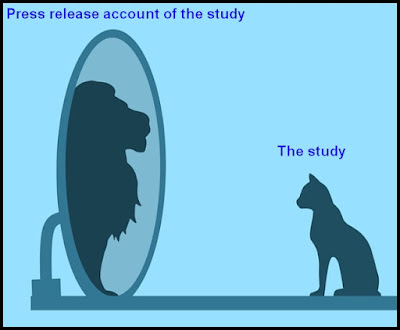
After a scientific paper has been written up and published, it is announced with a press release issued by the main academic institution involved in the research. Nowadays the press releases of universities and colleges are notorious for making sensationalized claims that are not warranted by anything discovered in the research being discovered. Often a tentative claim made in a scientific paper (basically a "perhaps" or a "maybe") will be stated as if it is was simply a discovery of a definite fact.  Other times a university press release will make some important-sounding claim that was never made in the scientific paper writing up the research.  An example was that when  there appeared a scientific paper merely claiming that "Regional synapse gain and loss accompany memory formation in larval zebrafish," there appeared a great number of press stories repeating the headline of a press release claiming that the formation of a memory had been observed (a claim not made in the paper).  We have every reason to believe that synapse gains and losses occur  continually in the human body, regardless of whether some new memory is forming. 

Authorship anonymity is a large factor that facilitates the appearance of misleading university and college press releases.  Nowadays university and college press releases typically appear without any person listed as the author. So when a lie occurs (as it very often does), you can never point the figure and identify one particular person who was lying.  When PR men at universities are thinking to themselves "no one will blame me specifically if the press release has an error," they will feel more free to say misleading and untrue things that make unimpressive research sound important.  We should always hold every single scientist involved in a scientific paper responsible and accountable for every untruth that appears in a scientific paper they co-authored and also ever untruth that appears in the university press release announcing the paper, unless that scientist has publicly protested the misstatement. 
 
Misleading press releases produce an indirect financial benefit for the colleges and universities that release them.  When there occurs untrue announcements of important research results, such press releases make the college and university sound like some place where important research is being done. The more such press releases appear, the more people will think that the college or university is worth the very high tuition fees it charges. 

Judging from the quote below, it seems that science journalists often look down on the writers of university and college press releases, even though such science journalists very often uncritically parrot the claims of such people.  In an Undark.org article we read this:

"Still, there are young science journalists who say they would rather be poor than write a press release. Kristin Hugo, for example, a 26-year-old graduate of Boston University’s science journalism program, refuses to step into a communications role with an institution, nonprofit or government agency.  'I’ve been lucky enough that I haven’t had to compromise my integrity. I really believe in being non-biased and non-partisan,' she says. 'I really, really, really want to continue that. I wouldn’t necessarily begrudge someone for going into [public relations] because there’s money in that, but I’d really like to stay out of it.' "

Misleading press releases also help to sustain cyberspace profit systems outside of a college or university. Such press releases are repeated (often with further exaggerations and misstatements) by a host of web sites offering clickbait headlines leading to web pages containing ads. The more people click on these clickbait headlines, the more page views there are for pages containing ads. The more people view those pages, the more advertising revenue the web sites get. 

So web sites giving science news stories have a very large financial incentive to produce exaggerated or untrue headlines that users will be more likely to click on.  If the headline on a web page truthfully says, "Another Junk Science Brain-Scanning Result," almost no one will click on the headline to go to the page with the story containing ads. But if the headline untruthfully says, "Breakthrough Study Reveals the Secret of Memory," then thousands of people may click on the headline, producing many pages views of the story the link leads to, and much more advertising revenue. 

The web sites are one profit center benefiting from poor and misleading science journalism that exaggerates or misrepresents unimpressive research. Another profit center is the science journalists themselves. Most science journalist do not work on some salary basis in which they are paid the same annual salary regardless of what they write. Instead most science journalists work on a per-article basis, earning about $1 per word for an article in a print magazine such as Discover Magazine, or about $300 per article for an online article. Such journalists tend to pitch their stories to editors. The more sensational sounding the story, and the more exciting the claims made, the more likely the story will be to get published.  An article that applies critical scrutiny to some impressive-sounding press release claim will be unlikely to be published.  By uncritically parroting unfounded but exciting-sounding claims in university and college press releases,  science journalists help to fatten their own wallets.  Often science journalists will imaginatively add their own unwarranted claims and unjustified spin about some research, hoping to further increase their chances of receiving fees for writing exciting-sounding news stories.  In general, science journalists getting paid by word or by article are often very unreliable sources of information.  

To "follow the money" all the way, we must go back to the scientists who originally chose "quick and dirty" designs, and who may have misstated the implications and findings coming from their research. What is the result when "quick and dirty" experiment designs are chosen? The result is that the paper count (the number of published papers) of a scientist will increase more quickly. What is the result when scientists misstate or exaggerate what their observations show or imply, making their research sound important when it is not? The result is a greater number of citations of their papers by other scientists. The very important "citation count" of a scientist will increase.  What is the financial result when a scientist has piled up a high paper count and a high citation count? That scientist will be more likely to get promoted, more likely to get the tenure that gives him a lifetime job, more likely to get a higher salary, more likely to get a lucrative book deal with a major publisher, and so forth. 

What we have is an infrastructure that all over the place incentivizes bad agents who mislead and misinform, as long as such persons mislead and misinform in some way that produces exciting-sounding results that fit in with popular academia belief systems.  Given such an infrastructure, you should not be surprised to hear that today's cognitive neuroscience is a house of cards that mostly rests on an illusory foundation. Most of the things that neuroscientists claim have been established by cognitive neuroscientists have not actually been established by them at all. Most of the more important-sounding claims made in the neuroscience news stories of recent years are claims lacking any solid foundation in observations. Junk science flourishes, because there are so many people in so many different places who profit from junk science. 

Thursday, February 24, 2022

The Press Often Gives Us Fake News About Brains

A significant fraction of the neuroscience news these days contains exaggerations, extremely dubious interpretations or downright falsehoods. Sometimes these falsehoods are so brazen that they must be branded as fake news. An outrageous example of fake news was a recent story in the British new source The Independent, a story with the phony headline, "Brain scan reveals patient’s ‘last thoughts’ just before they died in landmark study." Below are some of the reasons the headline and the story are as phony as a three-dollar bill: 

  • The scientific study made no claim to have revealed the thoughts of the dying 87-year-old patient, nor did it even make any guess about such a thing. 
  • No one is quoted in the article referring to last thoughts.
  • The headline uses the phrase "just before they died," suggesting there were multiple patients involved in the new study; but there was only one patient. 
  • The patient did not actually have his brain scanned as he died. Brain scans are done with MRI machines, and the patient was not being scanned in an MRI machine or any similar machine when he died.  Instead, there was a merely a reading of electrical activity by means of EEG electrodes. 
  • There was nothing "landmark" about the study, as there have been electrode readings of the brain activity of numerous previous patients as they died.  The subtitle of the story makes the untrue claim that there were "first-of-a-kind brain scans," when nothing "first-of-a-kind" was done, and no brain scan was done.  
  • As discussed below, there are very strong reasons for assuming that the patient in question was unconscious in the moments before death, and that he therefore was not thinking about anything just before dying. 

We don't need to read very far to find out how phony the story is. The headline claims "brain scan reveals patients 'last thoughts,'" but the subtitle states this: "First-of-a-kind brain scans of dying person indicate they may have been making ‘last recall of life’, scientists say." So the headline and the subtitle contradict each other. If scientists were merely speculating that the patient may have been recalling his life, then nothing has been actually revealed about what the patient was thinking.  Of course, the idea that you can figure out  someone's thoughts by looking at EEG readings is as nonsensical as the claim that you can find out someone's future life events by reading lines on his palms.  EEG readings are mere squiggly lines without any semantic content. 

The untrue "first-of-a-kind" claim is partially the fault of the Frontiers press release, which made this untrue claim: "This unexpected event allowed the scientists to record the activity of a dying human brain for the first time ever." You can very easily find out how untrue this claim is by using a Google search phrase of "EEG reading of dying patient," and using the Tools option to restrict the search results to be from 1/1/1990 to 1/1/2021.  In your search results you will get papers such as the 2017 paper "Electroencephalographic Recordings During Withdrawal of Life-Sustaining Therapy Until 30 Minutes After Declaration of Death," and this 2017 press article about the study (which shows some of the EEG readings from four dying patients). 

Besides making the untrue claim above, the Frontiers press release is guilty of getting the ball rolling on this fake news story, by suggesting the utterly groundless idea that the EEG readings from a seizure-wracked dying patient in a coma did something to suggest the patient was recalling events in his life.  Here is a quote from the press release:

" 'We measured 900 seconds of brain activity around the time of death and set a specific focus to investigate what happened in the 30 seconds before and after the heart stopped beating,' said Dr Ajmal Zemmar, a neurosurgeon at the University of Louisville, US, who organised the study. 'Just before and after the heart stopped working, we saw changes in a specific band of neural oscillations, so-called gamma oscillations, but also in others such as delta, theta, alpha and beta oscillations.' Brain oscillations (more commonly known as ‘brain waves’) are patterns of rhythmic brain activity normally present in living human brains. The different types of oscillations, including gamma, are involved in high-cognitive functions, such as concentrating, dreaming, meditation, memory retrieval, information processing, and conscious perception, just like those associated with memory flashbacks. 'Through generating oscillations involved in memory retrieval, the brain may be playing a last recall of important life events just before we die, similar to the ones reported in near-death experiences,'  Zemmar speculated. "

Notice the nonsense reasoning here. It's basically this:

(1) People have different types of brain waves, which occur when they do various things like thinking, recalling, meditating (which does not involve recall), and perceiving. 

(2) Some brain waves were measured in a person who died. 

(3) So maybe he was recalling important life events. 

This is nonsensical logic. The study has not provided the slightest reason for thinking that the dying person was remembering past events in his life. To the contrary, we can think of the strongest reason why a person would not be recalling important life events after having a sudden heart attack. The sudden heart attack would produce great pain and great distress, and under such conditions if you were conscious you would be no more likely to be recalling past life events than you would be if someone suddenly stabbed you in the chest. In fact, sudden fatal heart attacks instantly produce unconsciousness which should prevent anyone from engaging in thinking about past events.  

The scientific paper describes the patient's condition before death, and we learn of a state so dire that any speculation about the patient reliving past memories seems supremely absurd. We are told the patient was a 87-year-old who had suffered a fall, and who was in a coma (rating 10 on the Glascow Coma Scale, meaning a moderate coma). Here is how the paper describes the patient's death. 

"An electroencephalography (EEG) was obtained, which showed non-convulsive status epilepticus in the left hemisphere. There were at least 12 identified electrographic seizures, after which a burst suppression pattern spontaneously developed over the left hemisphere (Figure 2A).  Shortly thereafter, electrographic activity over both hemispheres demonstrated a burst suppression pattern, which was followed by development of ventricular tachycardia with apneustic respirations and clinical cardiorespiratory arrest. After discussion with the patient’s family and in consideration of the 'Do-Not-Resiscitate (DNR)' status of the patient, no further treatment was administered and the patient passed away."

Given such a patient state, it is obvious folly to be speculating  that such a patient was reliving past memories just before death. Status epilepticus is a life-threatening seizure of particularly long length. Apneustic respirations are a kind of gasping suggesting death is very near.  Twelve seizures would have produced a "witch's brew" of brain signals showing up on EEG readings, and from such a thunderstorm of brain signals nothing reliable can be inferred about what a patient was thinking or recalling. Since the patient was in a coma and plagued by a dozen seizures that disrupt mental processes such as recollection if it is occurring, it makes no sense at all to speculate that the patient was thinking about or recollecting anything.

Giving us a headline as phony as the headline quoted above from the Independent, the Daily Mail gives us this fake news headline about this patient: "Our lives really DO flash before us: Scientists record the brain activity of an 87-year-old man at the moment he died, revealing a rapid 'memory retrieval' process."  This headline is as phony as a three-dollar bill.  Zero evidence has been provided in the scientific paper of any memory retrieval around the time of death,  and the patient's condition gives the strongest reason for disbelieving that any such thing was occurring. A similar fake news headline occurs on www.bbc.com, showing that once an expert lights a fake news match, the fake news fire will spread even to sources the average person regards as having high journalistic standards. 

There is an abundance of reliable evidence that people have extraordinary near-death experiences after their hearts have stopped.  Such experiences often include what are called life-review experiences, in which a person may recall important moments from his life.  Neuroscience has done nothing to explain such near-death experiences. 

The fact of such experiences is a major reason for rejecting all claims that human consciousness is a product of the brain, and that memories are stored in brains.  According to such claims, no one should have any mental experiences at all  other than unconsciousness after his heart stops. Within a few seconds after a heart stops, a brain shuts down its electrical activity. This was shown by the 2017 paper I previously mentioned, "Electroencephalographic Recordings During Withdrawal of Life-Sustaining Therapy Until 30 Minutes After Declaration of Death," Figure 1 of that paper shows EEG readings of four patients for thirty minutes after their hearts stopped.  The readings are flat lines, except for three or four little blips that can be compared to momentary muscle twitches of a corpse a few minutes after death.  The Zemmar study does nothing to challenge ideas that brains promptly shut down as soon as a heart stops. 

On the same day that we had the fake news headlines quoted above,  we had another fake news headline, one that declared, "New project creates digital clones of human brains to help treat neurological disorders." No one has created any such thing as a digital clone of the human brain. We can also be quite confident that no one ever will do such a thing, because the act of measuring all of the synapse states and neuron states of a brain would inevitably kill a person, or require the cutting away of so much tissue that you would never be left with a clone of the person's original brain state.  In the text of the story we read that the work being done is merely the creation of some "virtual model," something not at all a clone of the brain. 

fake science news

Postscript
: Vice.com tries to squeeze some more juice out of the fake news story about the dying 87-year-old. It gives us an article with the misleading title "The Search for Meaning in a Mysterious Brain Signal at Death." There was nothing mysterious about the brains signals recorded.  There are some good aspects of the Vice.com story. The story quotes a doctor named Chalwa:

“ 'They have no idea what that guy is experiencing,' Chawla said. It’d be different if the man survived, and reported that he experienced a recall of memories. But since he died, we have no idea what happened. To say otherwise, 'is frankly appalling,' Chawla said."

Correct  -- the behavior of so many people in this matter is truly appalling and unprofessional.