Claims by neuroscientists that they have found "representations" in the brain (other than genetic representations) are examples of what very abundantly exists in biology: groundless achievement legends. There is no robust evidence for any such representations.
Excluding the genetic information stored in DNA and its genes, there are simply no physical signs of learned information stored in a brain in any kind of organized format that resembles some kind of system of representation. If learned information were stored in a brain, it would tend to have an easily detected hallmark: the hallmark of token repetition. There would be some system of tokens, each of which would represent something, perhaps a sound or a color pixel or a letter. There would be very many repetitions of different types of symbolic tokens. Some examples of tokens are given below. Other examples of tokens include nucleotide base pairs (which in particular combinations of 3 base pairs represent particular amino acids), and also coins and bills (some particular combination of coins and bills can represent some particular amount of wealth).
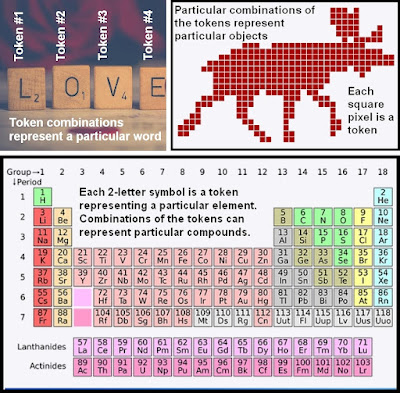
Other than the nucleotide base pair triple combinations that represent mere low-level chemical information such as amino acids, something found in neurons and many other types of cells outside of the brain, there is no sign at all of any repetition of symbolic tokens in the brain. Except for genetic information which is merely low-level chemical information, we can find none of the hallmarks of symbolic information (the repetition of symbolic tokens) inside the brain. No one has ever found anything that looks like traces or remnants of learned information by studying brain tissue. If you cut off some piece of brain tissue when someone dies, and place it under the most powerful electron microscope, you will never find any evidence that such tissue stored information learned during a lifetime, and you will never be able to figure out what a person learned from studying such tissue. This is one reason why scientists and law enforcement officials never bother to preserve the brains of dead people in hopes of learning something about what such people experienced during their lives, or what they thought or believed, or what deeds they committed.
But despite their complete failure to find any robust evidence of non-genetic representations in the brain, neuroscientists often make groundless boasts of having discovered representations in the brain. What is going on is pareidolia, people reporting seeing something that is not there, after wishfully analyzing large amounts of ambiguous and hazy and ever-changing data. It's like someone eagerly analyzing his toast every day for years, looking for something that looks like the face of Jesus, and eventually reporting he saw something that looked to him like the face of Jesus. It's also like someone studying endless photos of clouds, looking for a shape that looks like an animal shape, to try and back up his belief that the ghosts of dead animals live in the sky.

Claims that there are non-genetic representations in the brain often appeal to the existence of "place cells." Nature does not tell us that there is any such thing as "place cells." We merely know that there are cells, and that neuroscientists started to use the term "place cells" for some small set of cells, to try to spread ideas that cells help to represent some place where an organism has been in.
What would a convincing experiment showing representations in a brain look like? It might work like this. You might have some "blinded" analysts who had no idea of what claims were being made about representations, and no idea of what the goals, procedures or suspicions of the neuroscientists were. Such analysts might be shown some data such as EEG data or brain scan data, and the analysts might be told, "We think that in this data may be representations of something an organism observed or experienced -- can you guess what that was?" If most of the analysts gave the same answer (such as describing the layout of a particular type of maze that a rat ran through), that might be good evidence that neural representations had been found; for there would be very many thousands of possible answers, so we would not expect most of the answers to coincidentally agree.
Nothing like that has occurred in any of these experiments claiming evidence for brain representations. Instead, we typically have some procedure vastly less convincing, in which a scientist (who knows that some rodents observed some particular thing) attempts to sift through lots of data, looking for something that he can claim is evidence for a representation of that thing, rather like some person walking through a forest of 1000 trees, eagerly looking for some tree that has a face shape on it.
There is no robust evidence for any spatial representations in the brain. "Place cells" are a social construct of neuroscientists, not something with an objective reality in nature. What would we expect to find if such claims of representations in the brain are not well-founded? One thing we might expect to find is that there would be great inconsistency in the descriptions of such claimed representations, with little replication of the same results. That is just what seems to have happened. Neuroscientists have invented an inaccurate phrase to describe such inconsistencies. The phrase they are now using is "representational drift." The phrase is an inaccurate one, because there are no actual representations that are drifting. It is simply claims of such representations that are varying, or failures to replicate the original claims of representations.
The science journal Nature just published an article on so-called "representational drift." We have this title and subtitle:
Below is the text (for those reading this post in a non-English translation:"The brain’s code seems to be in constant flux. Neuroscientists are baffled
Neurons fire much more erratically than researchers thought. What does that mean for how the brain works?"
We read this in the article:
"Over a single day, neurons in the parietal cortex, a hub for processing sensory information, fired predictably in response to specific things, such as the position of the mouse in a virtual maze. But over the course of a few weeks, even though the task of navigating the maze remained the same, these activity patterns underwent major reorganization1. Some of the neurons stopped firing in response to stimuli that had previously activated them; others did the reverse....Since then, many more researchers have reported evidence for neurons changing how they respond to certain stimuli or behaviours over time, a phenomenon that neuroscientists have dubbed representational drift (see ‘How neuronal activity drifts over time’). Evidence has been found for it in various brain regions and when using several different techniques....Drift kept turning up in more areas, including some unlikely places, such as the visual cortex and the olfactory cortex. For instance, finding representational drift in the piriform cortex6, a key region for processing olfactory information, was 'completely contrary to how we and all of our colleagues had thought about that cortex', says Fink. Scientists had thought that activity in the neurons in this region would have to be fixed to enable animals to identify smells, but Fink and his colleagues discovered that such activity patterns were almost completely unrecognizable one month after the original recordings." We have in the Nature article this schematic depiction of this "representational drift." A set of brain cells are tracked on different days when some animal is undergoing the same stimulus or having the same experience. There is no consistency in the responses, with the recorded brain waves varying from day to day.
We have in the Nature article some goofy-sounding groundless speculations about imagined deep significance of these claimed "representational drifts":
"One hypothesis is that representational drift, at least in the hippocampus, helps the brain to keep track of time. In fact, years before the word ‘drift’ was widely used, Jill Leutgeb, a neuroscientist at the University of California, San Diego, and her colleagues observed shifts in the activity of groups of neurons in the hippocampus over time and suggested that they might encode the passing of time between events7.
Other have posed similar ideas: Yaniv Ziv, a neuroscientist at the Weizmann Institute of Science in Rehovot, Israel, suggests that drift is required for the 'time stamping' of events for long-term memories. And Denise Cai, a neuroscientist at the Icahn School of Medicine at Mount Sinai in New York City, says that drift might enable the brain to link memories that are formed close together in time."
The most likely explanation of what is going on with these claimed "representational drifts" is something much simpler. It is not that these claimed representations are drifting -- it is that they never existed. What happened is that neuroscientists very eager to find some evidence of non-genetic representations in a brain published claims of representations that were not well-founded, and were mere examples of pareidolia, like someone claiming to find an image of Jesus in his toast. Since there never was any sound basis for the original reports of representation, it is no surprise that they fail to be well-replicated.
Neurons in the brain fire very frequently (between about 1 and 200 times per second), with the firing occurring at unpredictable intervals. Anyone analyzing the firing rates of 500 neurons in some brain location will be able to find some neurons that fired more frequently when the organism having those neurons had some experience. It is a mistake to ever claim that such higher firing rates are representations of the experience the organism is having, or any part of such an experience. The next time such an experiment is tried, there will be some different set of neurons that have higher firing rates. This is exactly what we would expect under the assumption that the original report of "representations" was groundless, and that all that was going on was noise-mining of random, frequently fluctuating data. Noise mining is when someone analyzes random, rapidly varying data, and tries to suggest it has some deep significance that it does not actually have.
The visual below is a schematic giving some idea about the variation in the number of times per second that neurons fire in some part of the brain.
The infographic below also discusses variations in the firing rates of neurons. When it refers to 1 Hertz or 1 Hz , it means a firing rate of 1 time per second. When it refers to 200 Hertz or 200 Hz , it means a firing rate of 200 times per second. The infographic below shows some of the factors that cause random variations in the firing rates of neurons.
When firing rates in the brain are varying so often and so randomly because of factors like those depicted above, there are endless opportunities for people wishing to eagerly seek out correlations between firing rates somewhere and what an organism has experienced, someone who then wrongly calls this evidence of representations. But when such correlations are claimed, we should not regard them as something unexpected, even if brains have no representations of anything someone has learned or anything someone is experiencing.
A paper on so-called "representational drift" states this:
"Cells whose activity was previously correlated with environmental and behavioral variables are most frequently no longer active in response to the same variables weeks later. At the same time, a mostly new pool of neurons develops activity patterns correlated with these variables. Less commonly, cells previously correlated with certain variables become correlated with new variables. In one example of these findings, as mice move through an environment, a subpopulation of hippocampal place cells are informative about the animal's spatial position. Over time, the pool of place cells that make up this spatial code changes, despite the environment staying the same."
There is a simple and plausible explanation for such results:
(1) Brains do not actually contain representations of anything learned or experienced by humans or animals, and no neuroscientist has ever produced a credible theory of how learned information could be stored as brain states or neural states.
(2) Experimental claims that the brain contains such representation were never robust science, but involved experiments guilty of Questionable Research Practices such as way-too-small study group sizes, a lack of a blinding protocol, a lack of pre-registration, and subjective "see whatever you want to see" cherry-picking analysis by overeager correlation fishers guilty of pareidolia.
(3) The reported "representational drift" is the kind of random variation and vanishing of reported correlations we would expect given a scientific result that was never robust, but was always based on dubious subjective analysis of randomly varying ambiguous data. and mere pareidolia (people seeing patterns in random data that they were hoping to see).
Neuroscientists are using extremely misleading language when they claim to see something they call "superior activations" or "higher activations" or "activation patterns," and then pass off such claimed observations as evidence for representations. The concept of a "cell activation" is not even a solid one, and the term "higher cell activation" or "activation pattern" has no precise meaning. Letting us know exactly when they are active, light switches have an "on" position and an "off" position; but cells have no such things. Representations involve tokens or symbols in which one thing stands for another. If there were to exist some mere "higher activation" of a cell, that would not be a representation. If I see a naked woman on the street, there may be some higher activation of my eyes, with my eyes widening. Such a thing is not a representation of a naked woman.
When the genetic code was discovered in DNA, that was not some thing merely involving fleeting "higher cellular activations." That was a discovery of a massive storehouse of symbolic tokens in DNA -- particular combinations of nucleotide base pairs which represented particular amino acids. Other than such a genetic code, there simply is no evidence of representations in the brain. There is zero robust evidence that brains store representations of any learned knowledge or any place where an organism has visited or any experience an organism is having.
The latest example of a low-quality science paper making a false claim of observing representations in the brain is the paper here, entitled "Neural representation of action symbols in primate frontal cortex." We have an experiment in which monkeys had electrodes implanted into their brains, to record brain activity while monkeys were drawing. The authors claim some correlation between brain firing spikes and what the monkeys were drawing, incorrectly claiming this as a "representation of action symbols." What is going on seems to be mainly noise mining, eager correlation-fishing and pareidolia, the mining of correlations that you would inevitably be able to get even if no such symbols or representations existed in a brain. A halfway-reliable result in an experiment like this would require 15 or 20 animals per study group. The authors used only two monkeys. A sample size calculation would have revealed how very inadequate such a study group size was, but the authors do not report doing any sample size calculation. Much or all of the claimed correlation can be explained as mere EEG spikes caused by muscle movements, which are known to create spikes in EEG readings. Probably a good fraction of the claimed correlations are artifacts of the fancy data-juggling statistical rigmarole that was going on. We don't have here any decent evidence of neural representations, but we do probably have evidence of needless harm to primates being caused by scientists doing poorly-designed experiments.


No comments:
Post a Comment