Thursday, January 9, 2025

Neuroscientists Cannot Credibly Explain Any of These 11 Features of Out-of-Body Experiences

The most popular strategy used by those trying to explain accounts of the paranormal is the strategy of shrunken description. Given accounts that are utterly beyond the power of some skeptic to explain, the skeptic will try the technique of describing the type of observation so that only some strange little fraction of the whole phenomenon is reported. 

An example of following such a strategy was Michael Faraday's feeble attempt to explain the mysterious events involving tables that were massively reported by a host of observers in the middle of the nineteenth century. Each of these phenomena was massively reported by very many witnesses at very many different times and very many different places (as described in my posts herehereherehereherehereherehere, here, here & here):

(1) Mysterious raps coming from untouched tables, and from many other places in a room. 

(2) Strange sudden movements of a table when a group of people merely put their finger tips on the table's top. 

(3) Tables moving around a room "by themselves," both when people touched the tables with their finger tips, and when no one touched the table. 

(4) Tables rising up on two legs, when no one was touching the table. 

(5) Tables levitating up into the air, when no one was touching the table. 

Faraday used the method of shrunken description to try to discredit such reports. He described the phenomenon as only involving item 2 above (table movements while hands were on a table), and attempted to account for it by involuntary muscle movement. He simply ignored all of the other phenomenon. Faraday's explanation is a joke to any serious scholar of these observation reports, because his explanation fails completely to account for items (1), (3), (4) and (5) above. 

A similar strategy is typically used by a person trying to give explanations for out-of-body experiences while sticking to the dogma that the brain is the source of the mind. The person will describe an out-of-body experience in some shrunken way, without mentioning most aspects of the experience. He will then make some attempt at a neural explanation. For example, he may describe an out-of-body experience as a mere "feeling of floating," and may then try to explain why your brain might give you a "feeling of floating." 

To rebut such sins of shrunken description, let me discuss all of the features that are often reported when out-of-body experiences are described. Not every account of an out-of-body experience will involve all of these features. But each of these features is something that is often reported when people report out-of-body experiences. Since I am trying to document many examples of particular features of out-of-body experiences, I may duplicate a quotation a few times, in cases when a quotation involves more than one of these features. 

Each of the features is beyond any credible neural explanation. About most of these features we can say: no one would report such a thing if the mind is a product of the brain. The examples I will give of such features are only a tiny fraction of the reports of out-of-body experiences that have reported such features, and I could easily give ten examples for every example I will give. 

Feature #1: observing one's own body from outside it, typically from a horizontal position, at a distance of about two meters above it, or from a location near the ceiling.

Below are some relevant examples:

(1) On page 288 of the July, 1894 edition of the Journal of the Society for Psychical Research, which can be read here, a witness reported being an observer above his own body, with an "elastic force" preventing him from floating too far away from his body. He reported he could not rise higher than "two yards" above his body. 

(2) On page 34 of the January 17, 1903 edition of the periodical Light, which can be read here, George Wyld MD describes having an out-of-body experience in which his "soul-form" was "six or seven feet" above his body. 

(3) On page 46 of the February 8, 1919 edition of the periodical Light, which can be read herewe hear an account by Captain Gilbert Nobbs of getting a severe head injury during World War I. He says, "I seemed for a moment somewhere in the emptiness looking down at my body lying in the shell-hole."

(4) On pages 57-58 of an Italian book (the text of which can be easily translated using Google Translate), we read that Mrs. Nathalie Annenkof reported an out-of-body experience, saying "suddenly I found myself above and next to my body, which I saw sitting on the edge of the grave... And I had the sensation of hovering above my body in complete bliss."

(5) On page 23 of the periodical here we read this:

" 'On one occasion at a dentist’s office.' says Arthur J. Wills, Ph.D., C.E., of 224 Herrick Road, Riverside, Illinois, 'the dentist was drilling in my tooth. Suddenly I found myself outside of myself looking over the dentist’s shoulder into my own mouth!' "

(6)  On the same page of that periodical, we read an account by a Mr. Hyman who says, "I found myself high up in the room, from where, to my terror, I saw my body on the bed, eyes closed. " 

(7) Barbara Lambert said that during a difficult labor she floated out of her body to the ceiling, and saw her body from above, temporarily thinking that the body below her was her twin sister (link). 

(8) A woman (W.H. Westley) said that at her son's funeral her heart fluttered, and she found herself high above the funeral attendees, addressed by the very son who had died (link).

(9) Ami Greenstead suffered from a rare illness causing many fainting experiences, but reported to her mother that she had out-of-body experiences during such events, going up to the ceiling and observing her body from above (link). 

(10) Bryce Bond reports that when hospitalized from an allergic reaction, he rose up out of his body to the ceiling, before traveling through a dark tunnel, and meeting a dead relative he recognized (link).

(11) Dick Battista reported floating above the operating table during a transplant operation and watching the surgeons do their work (link).

(12) Marjorie Hall reported that she had an out-of-body experience during childbirth. She says, "I felt myself lift out of my body and float upward." She reported seeing from above her body giving birth, at a height about 15 feet (about five meters) above the scene (link). 

(13) On page 95  of a book we read this account by Cromwell Anderson:

"One night I awoke to find myself floating over my body, a few feet from the ceiling and could see my physical body on the bed beneath me. 

(14) Below is an account of a man who was in an armored car hit by an an anti-tank shell:

 "I was conscious of being two persons -- one, lying on the ground in a field where I had fallen from the blast, my clothes, etc., on fire ...The other 'me' was floating up in the air, about twenty feet from my body, from which position I could see not only my other self on the ground, but also the hedge, the road, and the car, which was surrounded by smoke and burning fiercely."

The person reported telling himself to roll to put out the fire, and then once he did,  his perception returned to normal. The account appeared on page 207 of the March-April 1948 edition of the Journal of the Society for Psychical Research, which can be read here

On page 123 of the 1954 Proceedings of the American Society for Psychical Research (Volume 48), which you can read here, we read of a poll done of 42 students who were asked: "Have you ever actually seen your physical body from a viewpoint completely outside that body, like standing beside the bed and looking at yourself lying in the bed, or like floating in the air near your body?” 33% answered "Yes." 

In 1968 there appeared the book Out-of-the-Body Experiences by Celia Green, the Director of the Institute of Psychophysical Research at Oxford University. Registered users at www.archive.org can read the book here. In 1966 an appeal had been made by radio for accounts of people who had such experiences. About 400 responses were received. Two questionnaires were sent to these people, and 326 replied to the first, with 251 to the second. On pages 42 to 43 she stated this:
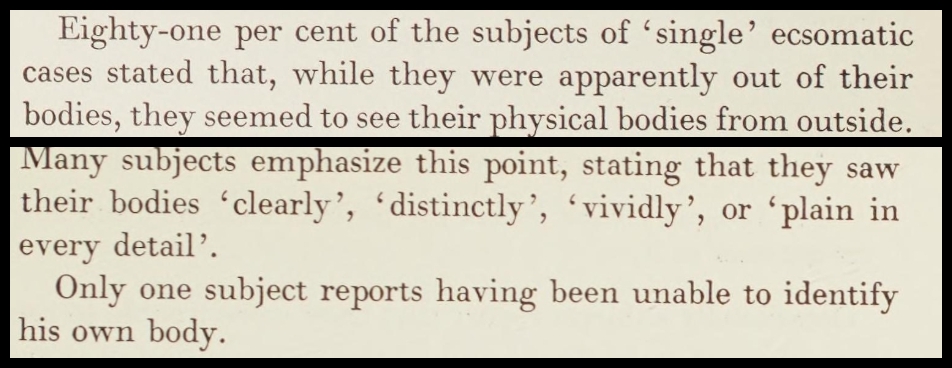
On page 46 Green says this:

 "The great majority of subjects describe themselves as looking down on their physical bodies. The subject frequently refers to his ecsomatic position as being near the ceiling -- e.g 'suspended against the ceiling.' Again, the corner of the ceiling is often specified."

On page 107 of Green's book we have this account:

"I remember nothing whatsoever of the process of leaving my body, but 'awoke' early next morning being fully conscious of the real me floating near the ceiling in a prone position. The sensation was of total weightlessness and freedom, and was altogether most delightful. I observed my physical body lying on the bed sleeping peacefully, on my left side as usual, but was struck by the extreme pallor the skin of my face which looked as if it would have been stone-cold to the touch."

Robert Crookall noted quite a few observers who reported floating horizontally above their bodies at a distance of about one or two meters:

"A number described their newly released 'doubles' as occupying a remarkable position, namely horizontal, just above the vacated body. They were J. McCormack (who noted 'this rather odd position'), Miss Bazett (about three feet above), Mrs. C. H. Smith (about a foot above), Mulvey (about three feet above), Dennis, Mr. 'H,' Mrs. Boorman, Dr. Gilbert, Mrs. Hibberd, Miss Douglas, Nurse Normanby, Mrs. 'Horam,' Miss Dean, G. Lester, and Mrs. Folson ( when she was a child of five or six years). More than a score of others, who did not describe the horizontal position, did note that their 'doubles' were above their bodies."

Below are some cases from one of the books of Robert Crookall:

  • Case #161. A Mrs. J. Douglas Newton reported this: "My son, then 8 years of age, who had never heard of any¬ thing of this sort, had gone to bed one night and was lying reading. Suddenly he called rather urgently for me. I found him sitting up, rather scared. He said, 'Such a funny thing has happened. I was just lying reading when I felt I was rising into the air. I seemed to go up, near the ceiling. Then I looked down and could see myself lying in bed. I came slowly down.' "
  • Case #162. A B. Barrett reported this: "I was in perfect health when one night I found myself looking down at my earthly body and could not make out why it was not lying there dead as I thought."
  • Case 165. A Mrs. Lambert reported this: "Suddenly I shot out of my body. I lay about six feet up, looking down at myself."
  • Case 170. A Peter Urquhart stated this: "I went outside and found myself out of the body again. This time the sensation was like being in a balloon, attached by a cord somewhere in the region of the navel, like the umbilical cord."
  • Case 172. A Mrs. Argles reported this: "I found myself standing on the top of the steps, looking down on my body, lying on the floor. There was a cord connecting me to the body on the floor."
  • Case 173. Vera Oates stated this: "In the early hours of the morning I was suddenly wide awake, but, to my amazement, I was hovering between the railing and the bed. I looked down and saw myself on the bed."
  • Case 175. A Mrs. Harris stated this: "I have left my body many times, walking round the room and looking at my body which is joined by a cord." Reports of such a cord connecting body to soul are not very rare.
  • Case 183. A Mrs. M. F. Hemeon stated this: "Suddenly I felt myself  ‘swimming’ up out of my body...I was very startled, and by an effort of will... returned to my body."
  • Case 194. A woman states, " Suddenly I was floating with my nose almost touching the ceiling—I saw all the little imperfections in the distemper."
  • Case 201: An R. J. Carlson states, " I suddenly found myself out of and above myself—and yet I could either sense or see my body in bed."
  • Case 204: A Rebecca Schreiber stated "I suddenly felt I had left my body and was flying over the ocean until I came to the ship" (the Queen Mary) that her daughter was on. After asking her daughter what was wrong, and being told she was sea-sick, she told her daughter she would soon feel better. Her daughter later said she had an experience matching this visitation account, while on the ship, at about the same time. 
  • Case 236. Oscar Mockler stated, "The next thing I was aware of was standing on the floor of the cabin and looking down at my body lying asleep in the bunk."
  • Case 241.  Mrs. N. Matile stated this: "I found myself floating above my bed (about three feet above). I then quickly passed out of the window to the middle of the Mews where we were living. It was a starry night and it was a lovely feeling, floating in the air. "
  • Case 243. An M.E. Fearn stated this: "I felt myself arise and float off the bed and ... was at the foot of our bed, looking at myself asleep, facing my husband’s back. Then I floated towards the window."
  • Case 246.  A Mrs. Eyres stated, "I had a feeling that the real Me came out of my body through the head and I had the sensation of flying.” She claimed to have visited other countries in out-of-body experiences. 
  • Case 247. A Mrs. Watkin claimed to be visited by two figures who took on a visit to some spirit world. She states this: "I was brought back to my bedroom and there the three of us again stood looking at my lifeless-looking body. Suddenly I slipped easily and swiftly into it."   
  • Case 259. A Miss Douglas stated this: "“One night I awoke from sleep to find that I was in a horizontal position and suspended in mid-air. In this position I travelled at moderate speed through the bedroom windows out into the night. It was moonlight and I could see the houses very clearly. I felt thrilled as I travelled along ...It was so real. I drifted across the roof-tops and identified the neighbours’ gardens. ... On the return journey I seemed to be losing height but not speed. ... Finally, I arrived in the garden at home, still remaining in a horizontal position and suspended in mid-air."
  • Case 267. A Mr. Hall stated this: "Presently a most strange sensation passed through my body. Next I floated out through the window and across the town. I seemed to be several hundred feet above the ground."
  • Case 269. A Mrs. Flint stated, "One afternoon, while resting on my bed, I felt myself floating, or rather suspended in the air, and I was actually looking down at my body on the bed."
  • Case 285. A Mrs. Mansergh stated this: "In February, 1939, my husband and I retired to bed as usual and I awoke to find myself standing by the side of the bed looking down on the sleeping forms of my husband and myself. I moved away from the bed to the window. As I moved, I noticed a glistening cord trailing from me." 
  • Case 309. A G. Bradley stated this: " I awoke about 7 a.m., and had the sensation of leaving the body. All I could see was the frame of myself left in the bed. I was floating around the room feeling peaceful. Suddenly I had the urge to get back into the shell of my body. What a struggle I had to do it!"
  • Case 310. A Mrs. Shakespeare stated this: "During the night I seemed to float down the ward and then returned and hovered over my bed, looking down at myself. I felt calm and peaceful.”
  • Case 313: A Mrs. Fyal stated this:  "Suddenly I felt myself leaving my body and looking around my bedroom... I saw my own body...Suddenly I found myself wandering again and floated to my body where, in the morning, I was astounded that I was in it."
  • Case 314: A Mrs. Langridge stated this: "I was outside my body, suspended in air, and looking down upon my body. Three or four people were reviving me. I was in a pleasant state of freedom and thought, ‘I wish these people would leave me alone!' "
  • Case 327. Dr G. B. Kirkland stated this: "To my surprise, I found myself looking at myself lying on the bed. The thought; just flashed through me that I didn't think much of me —in fact, I didn’t approve of me at all. Then I was hurried off at great speed. Have you ever looked through a very long tunnel and seen the tiny speck of light at the far end ? It seems an incredible distance off. Well, I found myself with others vaguely discernible hurrying along just such a tunnel or passage—smoky or cloudy, colourless, grey and very cold."
  • Case 336: An F. W. Talbot stated this: "The next  moment I was suspended in mid-air, horizontal, and looking down at my body on the bed. I could see myself lying in bed quite clearly. I watched an attendant go to my body, lift my arm and plunge in a needle. This was extremely interesting; I was suspended over his head and my feeling was that of detached curiosity."
  • Case 337: A Mrs Rowbotham stated, "I remember being on the ceiling of the room looking down at the two doctors and two nurses—just floating and watching."
  • Case 339: A Kathleen Snowdon stated this: "Suddenly I realized a feeling of great excitement, wonder and delight surpassing anything I had ever experienced as I felt my body [‘double’] completely weightless and floating upwards in a golden glow towards a wonderful light around hazy welcoming figures and the whole air was filled with beautiful singing. I floated joyfully towards the light and then I heard my mother’s voice calling me. My whole being revolted against going back."
  • Case 343: An S. H. Kelly stated this: "As I lost consciousness, certain things in my life came in front of me. This was followed by a queer sound of music and the next thing I was suspended in mid-air and looking at them bringing my body out of the water and trying artificial respiration. I was very happy and free and wondered why they were doing that when I was here! At that moment I was transported to my mother’s room. I stood beside her as she was by the fire in an easy chair, trying to tell her I was all right and happy. Afterwards, I was back, looking at my body, when a brilliant light shone around me and a voice said, ‘It is not your time yet—you must go back. You have work to do!' "
  • Case 346:  A Mrs. Maries stated this: "Meanwhile I  had left my body and felt myself floating in what seemed like a dark tunnel (with a glimpse, at the end, of a lovely countryside). I had no pain, only a wonderful feeling of happiness. I felt I had somebody with me, but saw nobody. Only I heard a voice which said, ‘You must go back! That child needs you!’ I returned to my body and heard the doctor say, ‘No, by Jove, I can still feel her heart!’ "

A year 2025 scientific paper on out-of-body experiences involved interviews with ten subjects. We read this:

"Participants 1 and 4 saw their bodies from the ceiling, while participant 7 saw theirs from another part of the room. Participant 8 had the experience while sitting on a street bench and viewed their body from the sky, approximately at the height of a second floor. ...Participant 9 saw his body from behind while walking."

The number and consistency of these accounts I have quoted is very high, ruling out any explanation of hallucination. Hallucinations produce random content, not accounts that would appear with such consistency as we find in the accounts above.  

Feature #2:  a strong feeling of euphoria or exaltation during an out-of-body experience

I have already quoted several cases above of people reporting an exhilaration or euphoria during an out-of-body experience, including a mention of "a wonderful feeling of happiness" by Mrs. Maries. a feeling by S. H. Kelley that she was "very happy," a feeling of "great excitement, wonder and delight surpassing anything I have ever experienced" by Kathleen Snowdon, and  a statement by Miss Douglas that she "felt thrilled," Below are some more relevant examples:

(1) On page 40 of the January 22, 1932 edition of the periodical Light, which you can read here, a doctor describes an out-of-body experience, saying, "I cannot describe the sensation of peace and happiness." 

(2) On page 46 of the February 8, 1919 edition of the periodical Light, which can be read here,  we hear an account by Captain Gilbert Nobbs of getting a severe head injury during World War I. Just before saying, "I seemed for a moment somewhere in the emptiness looking down at my body lying in the shell-hole," Nobbs says, "There was a peacefulness... a happiness indescribable."

(3) On pages 57-58 of an Italian book (the text of which can be easily translated using Google Translate), we read that Mrs. Nathalie Annenkof reported an out-of-body experience, says this:

"I had the sensation of hovering above my body in complete bliss. I had the sensation of a great and luminous joy of living, as if I were living a thousand lives at once, and of complete tranquility." 

(4) On page 63 of a book, we read an account by Joseph Costa of an out-of-body experience. He says, "If I said that I felt free, light, ethereal, I would only be expressing from afar the sensation that I felt in this moment of infinite liberation...I never had such a vivid sensation of really existing as in the moment when I felt separated from my body."

(5)  On page 59 of the November - December 1945 edition of the Journal of the Society for Psychical Research, which you can read here, we have this account of bliss during an out-of-body experience:

"Then, I can only describe this my own way, I was given psychic vision, for my Spirit left my body which I saw by my wife's in bed. I seemed to resemble the shape of a flame with a long silver thread attached to my earth body. I enjoyed, what I can only liken to, the Peace of God which passeth all understanding, I have never enjoyed such mental exhilaration before or since." 

(6) A man having an out-of-body experience said that he felt more alive than ever before (link).

(7)  Case 346 mentioned above mentioned "a wonderful feeling of happiness" during an out-of-body experience.  

On page 39 in her book about out-of-body experiences, based on a survey of hundreds who had such experiences,  Green says, "Many subjects comment on their feelings of well-being and reality in their new position apart from their physical body, and there are no counter-instances, that is to say, no subjects remark on having felt incomplete, unsubstantial or unreal in their new position." On page 86 she quotes someone who had an out-of-body experience saying that she felt "the utmost joy and happiness." On page 87 she quotes someone having an out-of-body experience as saying, "The escaped me felt absolutely wonderful, very light and full of the most wonderful vitality, in fact more well than I have ever felt before or since."

The author of a 2023 PhD dissertation ("Investigating the Nature and Psychological Impact of Out-of-Body Experiences") performed an online survey of 213 people who claimed to have had an out-of-body experience (page 156).  He states that 47% reported "a feeling of bliss or happiness" (page 451). 

Feature #3:  an experience of being able to pass-through matter while having an out-of-body experience.

(1) In the article "Astral Excursions" by Franz Hartmann MD, which appears on page 159 of the March 1908 Occult Review, which can be read here, Hartmann describes an out-of-body experience. He says that during this experience "when I tried to lift one of the instruments on a little table next to the chair, I could not do so, as my fingers passed through it."  

(2) A report of an out-of-body experience can be read in the 1936 book 'Twixt Earth and Heaven by Annie Britain, which you can read here. On page 50 she states this:

"I tried to grasp and move some cups and saucers in the room, but my fingers passed through them as if they were shadows. On the same occasion I tried to slap and pinch the faces of the people in the room but could make no impression on them, and they did not take the least notice of me. I walked through a table as though it were an optical illusion. I remember feeling amused to think that I was so superior to flesh and blood, which usually comes off second best in encounter with wood, stone or steel. Tables, chairs, walls, the bodies of humans, seem as unsubstantial as shadows when one is out of the body."

On page 56 the author states this:

"I woke to find myself standing outside my body, gazing at the sleeping form in the chair. My cousin was by my side, a young man who had died some years before, and to whom I had been deeply attached. I was not greatly surprised to see him, as he had often escorted me on my spirit travels. Now he offered to take me out for the afternoon and see some of the spirit people. We passed out through the walls of the room, seeming to glide rather than to walk, with no more sense of motion than if we had been in a balloon."

(3) On page 69 of Green's book we read this account of someone able to pass his hand through solid matter while having an out-of-body experience:

ghostly hand during out-of-body experience

(4) On page 124 of the October, 1954 edition of the Journal of the American Society for Psychical Research, we read this:

"Of the students who reported having seen their physical bodies from outside positions, more than one-fourth said that during such experiences they seemed to be occupying another body, which seemed to be real, tangible, and capable of voluntary movement. More than two out of five reported that, during their out-of-the-body experiences they seemed to be able to pass through seemingly solid objects—like closed doors, or blank walls."

(5) On page 47 of the study here, we have one person's account of an out-of-body experience, one that has Feature #1, Feature #3, and Feature #4.

"I was very awake standing at the bathroom sink getting ready to shave. With no warning I soon found myself looking at my physical body from about 3 feet in front of me and slightly elevated. After assessing my facial expression which did not change I moved towards the other side of the bathroom noticing how incredibly vivid the wall paper appeared. I then was confronted with the shower wall and decided to continue realizing that I could go right through the wall."

(6) On pages 254 to 255 of the 1895 book Brown Studies by George H. Hepworth, we have a description of an out-of-body experience, one that includes an account of being able to pass through matter. We read this:

"While sitting with my right hand resting on the arm of the chair I seemed to step out of my body, and stand beside it, looking upon it with mingled curiosity and astonishment. I felt as light as air, and said to myself, 'This must be what St. Paul calls the spiritual body.' It is true that I looked on what sat in the chair with a kind of tenderness, but the sense of freedom which I soon became conscious of was almost ecstatic, and it seemed as though I would not go back into those narrow quarters again for worlds. The body was so clumsy, so heavy, so un comely, so uncouth and ungraceful, while this other body, on the contrary, was a delight, a dream, a poem....I moved away from my body toward the door, thinking to open it and go out into the starlight ; but to my surprise I found that the door was no obstruction whatever. I simply passed through it as the sun's rays pass through a pane of glass."

The author of a 2023 PhD dissertation ("Investigating the Nature and Psychological Impact of Out-of-Body Experiences") performed an online survey of 213 people who claimed to have had an out-of-body experience (page 156).  He states that 40% reported "the ability to pass through physical matter" (page 451). 

Feature #4:  an experience of having enhanced senses during an out-of-body experience, which may include the ability to see through walls or look inside the body as if you had x-ray eyes, or the ability to see a 360 degree view.

(1) On page 70 of a book an author quotes Eugenie Garcia as having an out-of-body experience, apparently while being hypnotized:

"  I cast my eyes on myself: 'Look! I am luminous, transparent, light as a feather.'  Suddenly, I saw my body lying motionless in an armchair. Three or four people surrounded me, watching me attentively. What are they looking at me like that? Let's see. I come closer and look at myself too. doing like everyone else. I could clearly see the inside of my body, I could see the heart beating, the blood circulating, the networks.."

(2) On page 63 of a book, we read an account by Joseph Costa an out-of-body experience. Speaking as if he had X-ray vision, he says, "I saw my body perfectly recognizable by its particularities, its profile, my figure, but also bundles of veins and nerves vibrating with a luminous tingling."

(3) On page 62 of his book Lessons From the Light, Kenneth Ring quotes an account received by him in a letter, in which a woman described an out-of-body experience (when she says "three hundred degree" she apparently means "three-hundred-sixty degree"):

"I was hovering over a stretcher in one of the emergency rooms
at the hospital. I glanced down at the stretcher, knew the body
wrapped in blankets was mine, and really didn't care...I could see
the tiles on the ceiling and the tiles on the floor, simultaneously:
three hundred degree spherical vision. And not just spherical. Detailed! I could see every single hair and the follicle out of which it grew on the head of the nurse standing beside the stretcher."

(4) On page 37 of the same book, Ring quotes a male witness who claimed to see a womanly figure of light during his out-of-body experience. He recalls this when looking at his body:

"I could see the vascular system and the chambers emptying and filling with blood. I could see the vascular system and the life-sustaining materials working their way through the entire body. "

(5) On page 60 of the same book, a nearsighted woman recalls "the next I was aware of was floating on the ceiling" and that at this time "it was so vivid" and that "I could read the numbers on the machine behind my head." 

(6) On pages 254 to 255 of the 1895 book Brown Studies by George H. Hepworth, we have a description of an out-of-body experience. On page 255 he seems to describe enhanced vision during such an experience:

"I shall never be able to tell you how the stars looked that night. The heavens were an astonishing revelation to me. Not only did I see with perfectly clear vision, but there seemed to be a penetrating, a far-reaching quality to my sight which doubled the number of glistening lights above me, and the spectacle was so marvelous, so beautiful, that I stood entranced."

On page 256 the author compares his enhanced vision during his out-of-body experience to an account he heard of a very nearsighted boy who was given glasses and who could suddenly see the world clearly for the first time. 

(7) In the account below (from page 393 of the paper here) a person having an out-of-body experience reports having enhanced hearing (the account has both Feature #1 and Feature #4):

enhanced hearing during out-of-body experience

(8) One person having an out-of-body experience said this: "I was suddenly not in my body but above it...I could see, but all around, as
if my mind ...had eye-facets all over."

(9) At around the 4:39 mark in the video here, scientist Anna Stone says that during an out-of-body experience she had 360 degree vision. 

On page 72 of Green's book on out-of-body experiences, we read this:

superior vision in out-of-body experience

On page 79 of Green's book she quotes someone who claims to have seen through a wall during an out-of-body experience

Around page 59 of his book Lessons From the Light, Kenneth Ring begins discussing cases that seemed to show superior vision during out-of-body experiences. He mentions some cases of people who reported being able to see very clearly the dust that was in some high spot above their bodies, such as the dust on a hanging lamp. On page 60 he estimates that he encountered about six cases of what he calls the "dust on the light fixture" type. On the same page he quotes someone as saying that she could see in vivid detail during her our-of-body experience, even though she is very nearsighted, and at time was not wearing her glasses. On page 61 he quotes a first-person account of someone else who claimed he could see very clearly during an out-of-body experience, even though he was very myopic and not wearing glasses. 

On page 76 of Green's book, she quotes someone who claims to have seen clearly in the dark during an out-of-body experience outdoors. On page 78 she quotes someone who claims to have been able to see "in a full circle of 360" degrees during an out-of-body experience. 

The study "Differences and Commonalities Among Various Types of Perceived Out-of-Body Experiences (OBEs) (Phase II)" analyzed 252 reports of out-of-body experiences, received by those who filled out questionnaires after responding to advertising asking for responses from people who had out-of-body experiences.  On page 24 we read this: "Some of the participants reported they were able to see a much wider area than before. This even included a visual perception spanning up to 360° in some cases. Although there was a question about the clarity of sight asked during both phases, the question did not mention anything about the field of their vision, so their comments about a broader form of sight were not directly solicited and their descriptions contain self-chosen terms (e.g., 360°, etc.)." There then follows several quotes from survey respondents talking about 360 degree vision or "fish-eye lens" vision, and two respondents talking about a binocular or zoom ability. Page 26 quotes a person as saying "everything seemed very vivid, a higher definition," and quotes another person as saying, "I could see very clear and it looked crystal clear like it was the best high definition ever." The same page quotes another person as saying, "I could see everything perfectly clearly, which is odd because my glasses had fallen off my face in the accident." 

The author of a 2023 PhD dissertation ("Investigating the Nature and Psychological Impact of Out-of-Body Experiences") performed an online survey of 213 people who claimed to have had an out-of-body experience (page 156).  He states that 16% reported "the ability to see through physical objects" (page 450), that 23% reported "the ability to see at an abnormal distance" (page 450), that 45% reported "the ability to see in the dark" (page 450), and that 22% reported "the ability to see 360 degrees" (page 451). 

In an article in Reader's Digest, we read this:

"After a four-year battle with lymphatic cancer, Anita Moorjani slipped into a coma in 2006. Doctors were sure it was the end, not realizing that in her near-death state, she was still conscious. Initially, she felt like she was floating above her body with '360-degree peripheral vision' of the hospital room and beyond, she told Today."

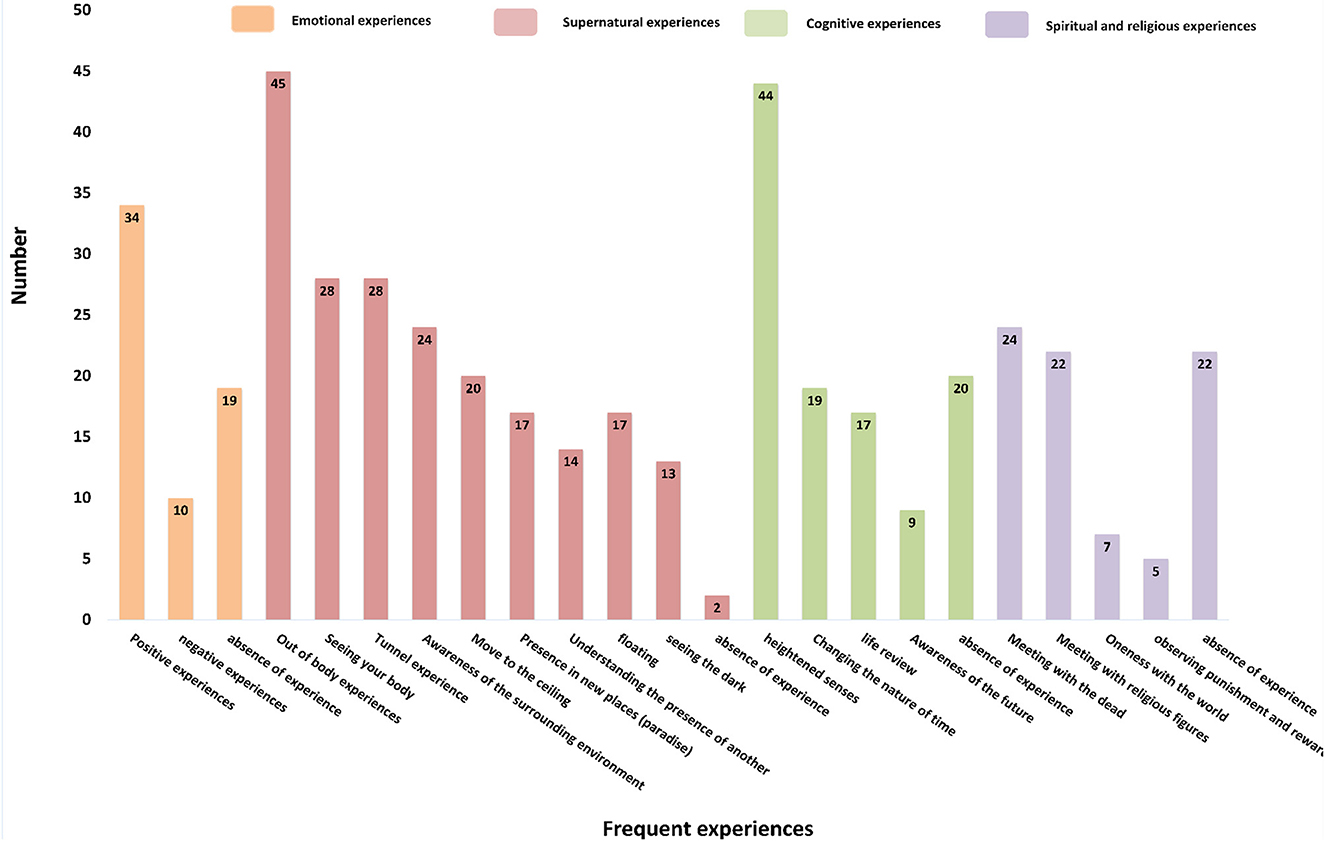
The 2023 paper "Explanation of near-death experiences: a systematic analysis of case reports and qualitative research" has a chart listing common aspects of near-death experiences, and their frequency. The most common aspect was an out-of-body experience, and the second most common was "heightened senses," reported by 44 people.   

Feature #5: an experience of being connected to the body while outside of it, sometimes with there being a cord-like or elastic structure between the observer outside of the body and his own body.

I have already cited above several cases in which Feature #5 was reported. Here are some more:

(1) On page 59 of the November - December 1945 edition of the Journal of the Society for Psychical Research, which you can read herewe have this account of a "long silver thread" between someone's spirit (outside of his body) and the body. 

"Then, I can only describe this my own way, I was given psychic vision, for my Spirit left my body which I saw by my wife's in bed. I seemed to resemble the shape of a flame with a long silver thread attached to my earth body." 

(2) On page 103 we read of a novelist named William Gerhardi who had an out-of-body experience, one in which he seemed to experience the "silver cord" often reported in out-of-body experiences:

"At the back of me was a coil of light, like a luminous garden hose resembling the strong broad ray of dusty light at the back of a dark cinema projecting on the screen in front. To my utter astonishment, that broad cable of light at the back of me illuminated the very face on the pillows I recognized as my own, as if attached to the brow of the sleeper."

(3) On pages 116-117 of a book he author, Sylvan Muldoon describes his first out-of-body experience:

"Slowly ...I was moving toward the ceiling, all the while lying horizontal and powerless. Naturally I believed that this was my physical body as I had always known it, but that it had mysteriously begun to defy gravity...Involuntarily, at about six feet above the bed, as if the movement had been conducted by an invisible intelligent force, present in the very air, I was uprighted from the horizontal position, to the perpendicular, and placed standing upon the floor of the room... where I remained for two or three minutes, still unable to move of my own accord... I managed to turn around. There were two of me! In the name of common sense — there were two of me! There was another 'me' lying quietly upon the bed. It was difficult to conceive of this being real — but there I was, fully conscious, fully able to reason and know what I saw was actual. The next thing which caught my eye, explained the curious sensation in the back of my head — for my two identical bodies were joined by means of an elastic-like cord, one end of which was fastened to the medulla oblongata region of my phantom counterpart, while the other end centered between the eyes of my physical counterpart. This cord extended across the space of probably six feet which separated us."

(4) In his 1864 biography Incidents in My Life, Daniel Dunglas Home related an out-of-body experience. After hearing a mysterious voice that seemed to be that of his late wife, he had an experience he described below:

"I was at this instant brought to a consciousness of light, by seeing the whole of my nervous system, as it were, composed of thousands of electrical scintillations, which here and there, as in the created nerve, took the form of currents, darting their rayons over the whole body in a manner most marvellous ; still this was but a cold electrical light and besides, it was external. Gradually, however, I saw that the extremities were less luminous, and the finer membranes' surrounding the brain became as it were glowing, and I felt that thought and action were no longer connected with the earthly tenement, but that they were in a spirit-body in every respect similar to the body which I knew to have been mine, and which I now saw lying motionless before me on the bed. The only link which held the two forms together seemed to be a silvery-like light, which proceeded from the brain ; and, as if it were a response to my earlier waking thoughts, the same voice, only that it was now more musical than before, said,  'Death is but a second birth, corresponding in every respect to the natural birth, and should the uniting link now be severed, you could never again enter the body.' "

(5) In Case 170 quoted above someone stated "the sensation was like being in a balloon, attached by a cord somewhere in the region of the navel, like the umbilical cord."

(6) In Case 172 quoted above a Mrs. Argles reported this: "I found myself standing on the top of the steps, looking down on my body, lying on the floor. There was a cord connecting me to the body on the floor."

(7) In Case 175 quoted above a Mrs. Harris stated this: "I have left my body many times, walking round the room and looking at my body which is joined by a cord." 

(8) In Case 285 quoted above a Mrs. Mansergh stated that during her out-of-body experience, "As I moved, I noticed a glistening cord trailing from me."

(9) On page 62 of the January 26, 1934 edition of the periodical Light, which you can read here, we have an account of an out-of-body experience in which the witness describes a cord between her regular body and herself out of the body.

(10) In an 1892 edition of the Proceedings of the Society for Psychical Research (Volume VIII, page 196), we have an account by L. J. Bertrand of an out-of-body experience he had 30 years earlier. He states this:

" 'Well,'  thought I, 'at last I am what they call a dead man, and here I am, a ball of air in the air, a captive balloon still attached to earth by a kind of elastic string and going up and always up. How strange ! I see better than ever, and I am dead—only a small space in the space without a body ! . . . Where is my last body ?  Looking down, I was astounded to recognise my own envelope. ' Strange ! ' said I to myself. 'There is the corpse in which I lived and which I called me, as if the coat were the body, as if the body were the soul ! What a horrid thing is that body ! —deadly pale, with a yellowish-blue colour, holding a cigar in its mouth and a match in its two burned fingers ! Well, I hope that you shall never smoke again, dirty rag ! Ah ! if only I had a hand and scissors to cut the thread which ties me still to it."

Although an account of what happened decades earlier, the credibility of this account comes from the fact that at the time it was made an account like this was almost totally unheard of, and some of the strange details would be corroborated by many later witnesses citing similar details involving their own experiences.  

(11) On page 36 of his 1936 book Forty Years of Psychic Research Hamlin Garland asks a medium he is about to test a good question, and gets a response that will "ring a bell" with any serious scholar of out-of-body experiences. We read this:


early report of out-of-body experience

At the end of his book More Astral Projections, Robert Crookall has some interesting summary statistics regarding how often such accounts had recurring characteristics. He used the term "the double" for a kind of spirit body that was a double of the human body. For what he called "single-type cases" the statistics included the following:
  • "The fact that, the newly-released ‘double’, often took up a horizontal position (usually not far above its physical counterpart), was noted in 50 natural and 7 enforced cases (i.e. 23.3 per cent and 18.9 per cent respectively)."
  • The percentage of people reporting a "silver cord" or "shining cord" connecting the human body and a spirit body (or something like that) was "43 (20.0 per cent) natural cases, 6 (16.2 per cent) enforced cases." 

On page 100 of Green's book, she reports a smaller incidence of such a "cord" effect. She reports that only about 30% of those having a single out-of-body experience felt any connection to their body, and that only 3.5% reported a visible connection to the body, such as a visible cord leading back to it. 

The author of a 2023 PhD dissertation ("Investigating the Nature and Psychological Impact of Out-of-Body Experiences") performed an online survey of 213 people who claimed to have had an out-of-body experience (page 156).  He states that 11% reported "seeing a ray of light, cord, ribbon, or rope connecting the nonphysical self to the physical self" (page 450).

Feature #6:  an experience of encountering one or more spiritual or non-physical entities (or deceased people) while having an out-of-body experience.

I have already mentioned in this post several accounts which have this feature. Below are some more:

(1) On page 5 of a 1944 periodical (the May 10, 1944 Psychic Observer which can be read here) George B. Bronwell MD gives a narrative of a near-death experience and out-of-body experience.  He reported seeing his wife's sister, who had passed away several years earlier. He also reported being transported to some mystical realm. 

(2) A report of out-of-body experiences can be read in the 1936 book 'Twixt Earth and Heaven by Annie Britain, which you can read here. On page 56 she states this:

"I woke to find myself standing outside my body, gazing at the sleeping form in the chair. My cousin was by my side, a young man who had died some years before, and to whom I had been deeply attached."

(3) Olivia Robertson reported having an out-of-body experience that included a "long, long tunnel" and an encounter with her deceased mother (link). 

(4) Young Kanta Smith reported an out-of-body experience while "dead" for 15 minutes before being revived. She described meeting a grandfather she had never even seen in a photo, and a parent says the description matched that of the grandfather (link).

(5) On page 67 of a book we read of a New Jersey woman who reported an out-of-body experience during an operation. She recalls meeting a deceased grandmother who took her on a little flying tour that ended with the woman returning to her body. 

The author of a 2023 PhD dissertation ("Investigating the Nature and Psychological Impact of Out-of-Body Experiences") performed an online survey of 213 people who claimed to have had an out-of-body experience (page 156).  He states that 25% reported "seeing spiritual entities or beings" (page 450), and that 42% reported "feeling the presence of an unknown non-physical being."

Feature #7:  an experience of completely leaving the location of the body, while traveling to other earthly locations or unearthly locations.

I have already reported above several cases that reported Feature #7. Below are some more.

(1) Marcel Picard reported having an out-of-body experience in which he floated above his body, eventually reaching other apartments below his (link). 

(2) Below is a May 20, 1935 account of a young boy's out-of-body experience, from page 342 of the periodical Light. The account includes a report of the observer transporting around mysteriously to other earthly locations. 

early out-of-body experience

(3) Below is an account of a man claiming to have out-of-body experiences in which he traveled to the 1905 World's Fair in St. Louis. 

early out-of-body experience

You can read the full account here:

https://chroniclingamerica.loc.gov/lccn/sn85058130/1905-02-05/ed-1/seq-18/

(4) Below is a 1903 account of a dying boy (Walter Smith) who reports a trip to Heaven during a close brush with death that was soon followed by actual death. We have elements of a near-death experience, an out-of-body experience and perhaps what is called terminal lucidity.  Click on the image to read it better. 

early near-death experience

You can read the account below:


(5) A person being viciously beaten by the Nazis reportedly had an out-of-body experience in which he returned to his home, only to see his wife cavorting there with another man (link)

(6) A nurse claimed that three different times she had an out-of-body experience when one of her patients was dying, saying that she kind of mystically traveled with them towards some otherworldly destination, before being told she must go back (link).

(7) A student claiming out-of-body experiences reportedly described correctly the home of her professor, which she had never physically seen, but claimed to have visited in an out-of-body experience (link). 

(8) At around the 3:20 mark in the video here, scientist Anna Stone says that during an out-of-body experience she "was instantly taken to"  the site of where her daughter was, more than a hundred miles away. 

In the very interesting 1907 book The Psychic Riddle by Isaac Funk (the same Funk of the famous Funk and Wagnall's dictionary), we read an account on pages 179 to 184 by a person who Funk tells is a " well-known gentleman in New York, a man whose veracity would be questioned by no one who knows him, a physician of standing, also an editor and publisher of reputation."  We read this account of an out-of-body experience involving travel to a distant location:

"As the movement continued upward, all at once there came a flashing of lights in my eyes and a ringing in my ears, and it seemed for an instant as tho I had become unconscious. When I came out of this state, I seemed to be walking in the air. No words can describe the exhilaration and freedom that I experienced. No words can describe the clearness of mental vision. At no time in my life had my mind been so clear or so free. Just then I thought of a friend who was more than a thousand miles distant. Then I seemed to be traveling with great rapidity through the atmosphere about me. Everything was light, and yet it was not the light of the day or the sun, but, I might say, a peculiar light of its own, such as I had never known. It could not have been a minute after I thought of my friend before I was conscious of standing in a room where the gas-jets were turned up, and my friend was standing with his back toward me, but suddenly turning and seeing me, said, 'What in the world are you doing here? I thought you were in Florida,' and he started to come toward me. While I heard the words distinctly, I was unable to answer. An instant later I was gone, and the consciousness of the things that transpired that memorable night will never be forgotten. I seemed to leave the earth, and everything pertaining to it, and enter a condition of life of which it is absolutely impossible to give here any thought I had concerning it, because there was no correspondence to anything I had ever seen or heard or known of in any way. The wonder and the joy of it was unspeakable, and I can readily understand now what Paul meant when he said, 'I knew a man, whether in the body or out of it I know not, who was caught up to the third heaven, and there saw things which it is not possible (lawful) to utter.'...I may add here that the friend referred to having been seen by me that night was also distinctly conscious of my presence and made the exclamation mentioned. We both wrote the next day and relating the experiences of the night, and the letters corroborating the incident crossed in the post....If the whole world was to rise up and say that there was no life after one left the physical organism, it would not make one particle of difference in my mind, as I am absolutely certain that I have been as free from my physical body as l ever will be, and that my life apart from it was far more wonderful than any life I have ever experienced in it."

A year 2025 study ("Out-of-body experiences: interpretations through the eyes of those who live them") gives us two cases similar to those above. We read, "Participants 5 and 10 reported traveling to very distant places, such as other cities or countries."

The author of a 2023 PhD dissertation ("Investigating the Nature and Psychological Impact of Out-of-Body Experiences") performed an online survey of 213 people who claimed to have had an out-of-body experience (page 156).  He states that 56% reported they "travelled to a different room or location away from the physical body " (page 449).

In the paper "The Near-Death Experience Content (NDE-C) scale: Development and psychometric validation" we get some good data from a survey of 403 people who claimed to have had a near-death experience. There is  a scale mentioning features of near-death experiences, in which people can give a number between 0 and 4, with 0 meaning "not at all, none," 1 meaning "slightly," 2 meaning "moderately," 3 meaning "strongly" and 4 meaning "extremely, more than any other time in my life, and stronger than 3."
  • 62% give the "extremely" answer (4) for "you had the impression of being outside of, or separated from your own body."
  • 58% give the "extremely" answer (4) for "you had the sensation of leaving the earthly world or of entering a new dimension and/or environment."

Feature #8:  an out-of-body experience experience that includes observations of things that should have been impossible for a person to observe, giving his physical position.

A patient who had an out-of-body experience during a dental operation reported seeing two pennies on top of a high shelf while the patient floated above her body. The dentist got a ladder, and found that the two pennies were really there (link). 

Many people have heard of one or two of these veridical near-death experiences, perhaps the Pam Reynolds case or the often-told story about “Maria's shoe.” But judging from the book The Self Does Not Die: Verified Paranormal Phenomena from Near-Death Experiences, these veridical near-death experiences may not be so rare. Below are some of the cases documented in that book.

Case 2.1: A dying cancer patient remarked to Ricardo Ojeda-Vera (a doctor's assistant) that he had written a beautiful letter to his mother. Ojeda-Vera had written such a letter. The patient “described in detail exactly what he had written,” and accurately recounted that he had worn a green bathrobe while writing the letter. The patient claimed to have seen Ojeda-Vera writing the letter while she had “looked down on him from the ceiling.” Three days later the patient died.

Case 2.2: A patient reported having an out-of-body experience (OBE) during a cardiac arrest, and reported seeing a penny on the top of a cabinet. The cabinet was checked, and a penny was found there.

Case 2.3: In this well-known case, a woman named Maria reported floating out of her body during a cardiac arrest, and that during such an experience she saw a dark blue tennis shoe on a ledge near a window on the third floor. A search found such a shoe in such a location.

Case 2.5: At a hospital a woman who had a cardiac arrest reported having an out-of-body experience during which she floated out of her body, and saw a 12-digit serial number on the top of a six-foot tall respirator. The respirator was later checked and found to have exactly that number on its top.

Case 2.6: A man reported having an out-of-body experience during which he observed a 1985 quarter atop an 8-foot-high cardiac monitor. The top of the monitor was checked, and a 1985 quarter was found on its top.

Case 2.8: A man reported having an out-of-body experience during which he observed medical workers putting defibrillation paddles on him and gel. This matched his actual medical experience during his cardiac resuscitation.

Case 2.11: a woman reported floating out of her body during a cardiac arrest, and that during such an experience she rose up through the hospital's floors, rising up above the roof, where she saw the skyline and a red shoe. A search of the hospital's roof found a red shoe on the roof.

Case 2.12: A man reported that during his cardiac operation he floated out of his body and returned to his home, where he saw a caretaker having sex there with his girlfriend. The caretaker admitted this had happened.

Case 2.13: A woman reported that during her operation she floated out of her body and saw doctors telling her family (incorrectly) that she had died. It was later confirmed that the family had been told that.

Case 2.14: A woman reported having a near-death experience in which she looked down at her body from a corner of a hospital room during her operation. She then reported seeing in a paranormal way two of her grandmothers saying in a cafeteria that they were going to have a cigarette, even though neither smoked. It was confirmed that this improbable thing had happened.

Case 2.15: A patient in the intensive care unit of the hospital had a near-death experience in which he was reportedly able to hear the conversations of relatives elsewhere in the hospital, such as a waiting room conversation about a green toy tractor knocking down a wall of toy bricks. The conversations had occurred far away from his location in the hospital.

Case 3.1: A woman put under general anesthesia during her operation reported details of her operations from an “on the ceiling” perspective, and also correctly reported details of an operation in the adjacent operating room, such as the amputation of a leg and its placement in a yellow bag. She made the report as soon as she woke up, and had no way of knowing such information.

Case 3.7: A man missing his dentures correctly reported a nurse putting them in the drawer of a cart during his cardiac resuscitation, when he should have been completely unconscious.

Case 3.8 A man reported a near-death experience during cardiac arrest. He reported that during the medical efforts to revive him, he saw that a nurse dropped a tray and was scolded about it by a doctor. The account was confirmed.

Case 3.9 A woman had a near-death experience during cardiac arrest. She reported hovering in a corner of the room near the ceiling, and noticed a rose-shaped hair clip and a bottle breaking, details she should have been unaware of. The details were accurate.

Case 3.10 A patient unconscious during his operation reported floating above his body, and accurately described details of his operation.

Case 3.11 This dramatic near-death experience account is told in the youtube.com interview here. A patient was written off for dead, and had no vital signs for "close to 20 minutes." During that time he had "no heart beat, no blood pressure, no respiratory function."  But then in a seemingly miraculous manner the patient's vital signs reappeared, and he eventually "recovered fully." The patient described a near-death experience in which he observed post-it notes in the operating room that he should have been unable to observe because his eyes were taped and he was unconscious. The details were accurate.
 
Case 3.12 A patient whose heart was stopped reported a near-death experience in which he heard some paramedic say something to the effect that the patient would never revive, but a rookie paramedic could use the patient to practice CPR. After undergoing an amazing recovery, the patient told what he had heard to one of the paramedics, who was amazed that the man had apparently heard what the paramedic had said.

Case 3.16 Medical staff tried to save a patient who had undergone cardiac arrest, and they decided to stop the resuscitation efforts. They later found a faint pulse, and resumed the revival efforts. The man survived, and described the medical efforts trying to revive him. He “got all the details right, which was impossible” because he had no pulse during such efforts.

Case 3.18 A man who had a cardiac arrest during an operation reported to his doctor that he had seen a brown leather key fob fall out of the doctor's pocket during the operation. The doctor confirmed that such a thing had happened, at a time when the patient should have been unconscious.

Case 3.29: This case is the famous Pam Reynolds case, which I discuss here (while also discussing an equally astonishing case more recent).  While having her senses blocked and her temperature dramatically lowered during an operation that should have guaranteed unconsciousness, Reynolds reported a near-death that included very specific details of her operation she should have been unaware of. 

Case 3.30: A boy who underwent cardiac arrest recalled that during the medical efforts to revive him he "had been up in a corner of the room and had looked down on his body." He correctly recalled several details of the procedure. 

Case 3.33: A man who underwent cardiac arrest reported an out-of-body experience in which he felt himself "rising up through the ceiling" and then seeing some hospital area  in which there were mannequins. Above the ICU he was in was a CPR training area in which there were dummies (resembling mannequins) used for CPR training. 

Sylvan Muldoon claimed to have willfully experienced many out-of-body experiences, at a time when the term was little-known. In his 1929 book The Projection of the Astral Body, Sylvan Muldoon uses the phrase "in the astral" to mean "while having an out-of-body experience." He states this:

"You have asked me, too, if I have ever seen anything while in the astral which I did not know existed, and later verified by seeing it in the physical. Certainly ! This is nothing unusual to do, while consciously projected. I have often gone into houses, and noted the things — later going there in the physical, and seeing everything exactly as I saw it in the astral."

A year 2025 study ("Out-of-body experiences: interpretations through the eyes of those who live them") gives us two cases similar to those above. We read this:

"Participant 5 described an out-of-body experience where she visited the hospital to see her aunt in the Intensive Care Unit (ICU). The following day, upon visiting the hospital in reality, she was deeply surprised to find that the hallway, the door, and the ICU where her aunt was located were exactly as she had seen during the OBE. Participant 10 reported that during her OBE, she visited a village in Scotland. As she flew in, she observed a bridge and a specific landscape, and upon 'landing' in the village, she noticed the village's name. Later, she confirmed on a map that both the river and the village existed."

Feature #9:  an experience of having an exalted intellect or speeded-up mind during an out-of-body experience

On page 81 of Green's book, she states, "Subjects usually report that their intellectual faculties were unimpaired in the 
ecsomatic [out-of-body] state; indeed, their reports often suggest a greater than usual degree of mental clarity, and some subjects assert explicitly that their intellectual functions often improved in the ecsomatic [out-of-body] state."  On page 69 of Green's book we read an account by someone who says his intelligence seemed sharper during his out-of-body experience. 

On page 71 of the 1918 book Man Is a Spirit by J. Arthur Hill (a very interesting collection of spontaneous paranormal experiences) we have an account by John Huntley of an out-of-body experience, an account in which he claims to have a greatly enhanced mind during his out-of-body experience:

"About five years ago I woke from sleep to find 'myself' clean out of the body, as the kernel of a nut comes out of its shell. I was conscious in two places — in a feeble degree, in the body which was lying in bed on its left side; and to a far greater degree, away from the body (far away, it seemed), surrounded by white opaque light, and in a state of absolute happiness and security (a curious expression, but one which best conveys the feeling). The whole of my personality lay 'out there,' even to the replica of the body — which, like the body, lay also on its left side. I was not conscious of leaving the body, but woke up out of it. It was not a dream, for the consciousness was an enhanced one, as superior to the ordinary waking state as that is to the dream state."

In 1983 Bruce Greyson MD created a 16-item Greyson Scale questionnaire  listing features often reported in near-death experiences. The scale is used to judge whether an experience should be classified as a near-death experience, with people reporting 7 or more of its items being classified as having had a near-death experience. Because reports of speeded-up thinking were fairly common in near-death experiences, one of the 16 items on the 16-item Greyson Scale questionnaire  is a question asking, "Were your thoughts speeded up?" In the 1983 paper that introduced the Greyson Scale, Greyson reported data on 74 people who reported something like a near-death experience. Of those, 53% reported an out-of-body experience, 46% reported "thoughts unusually vivid," 30% reported "sudden understanding," 23% reported extrasensory perception, and 19% reported "thinking unusually fast." 0% reported "thinking blurred or dull." Near-death experiences often include a "life review" experience, with 22% of the 74 in Greyson's paper reporting such a thing. During such a life review experience, thinking or mental experience is typically reported as occurring super-fast, with people describing the life review by saying things such as "my whole life flashed before me in an instant."

In a 2014 paper about near-death experiences, which often involve out-of-body experiences, the author states this about near-death experiences (NDE):

"The NDERF survey asked, 'How did your highest level of consciousness and alertness during the experience compare to your normal, everyday consciousness and alertness?' Of 1,122 NDErs surveyed, 835 (74.4%) indicated they had 'More consciousness and alertness than normal'; 229 (20.4%) experienced 'Normal consciousness and alertness'; and only 58 (5.2%) had 'Less consciousness and alertness than normal.'

In table 2 of the 2003 paper here, 44% of 27 people having near-death experiences reported "accelerated thought processes" and 70% reported a "sense of being out of the physical body." 

A very long post related to this long post is my post "Prevailing Brain Dogmas Cannot Explain Hypnotic Phenomena" which you can read here. In that post I describe 13 phenomena reported during hypnosis, none of which are explicable under prevailing dogmas about the brain. Item #10 in that list was "Exaltation of thinking and speaking abilities under hypnosis." I quote cases of people who seemed to think much  faster and much better under hypnosis than in normal consciousness. Although not involving out-of-body experiences, such cases tend to lend credence to reports that the mind can be sped up during an out-of-body experience. 

The author of a 2023 PhD dissertation ("Investigating the Nature and Psychological Impact of Out-of-Body Experiences") performed an online survey of 213 people who claimed to have had an out-of-body experience (page 156).  He states that 40% reported "a feeling of an expansion of their consciousness or non-physical body to a larger than normal size" (page 451), and that 35% reported "a feeling of all knowing or understanding" (page 451).

In the paper "The Near-Death Experience Content (NDE-C) scale: Development and psychometric validation" we get some good data from a survey of 403 people who claimed to have had a near-death experience. There is  a scale mentioning features of near-death experiences, in which people can give a number between 0 and 4, with 0 meaning "not at all, none," 1 meaning "slightly," 2 meaning "moderately," 3 meaning "strongly" and 4 meaning "extremely, more than any other time in my life, and stronger than 3."
  • 62% give the "extremely" answer (4) for "you had the impression of being outside of, or separated from your own body."
  • 35% give the "extremely" answer (4) for "your thoughts speeded up."
Feature #10:  an ability to mentally move around by merely willing it.

On page 86 of Green's book she says that some people having out-of-body experiences report the ability to change their viewing position by merely willing it. She quotes one person as saying, "I experimented by moving about my room with a kind of floating or
drifting movement, some feet above the ground, and learned that
direction was quite easily controlled by will."

On page 691 of the research paper here, we read of a person reporting many out-of-body experiences. We read that "he reported that every time his Self separated from his physical body, it was able to inspect
different remote places including settings which didn't seem to be of Earthly origin. Moreover, he was able to do so at the speed of thought and independently of distance involved between his physical body and the place his Self tried to reach."

On page 260 of George H. Hepworth's 1895 account of an out-of-body experience, which begins here, he seems to report moving great  distances by an act of will or desire:

"The most intense desire to see her seized me. It was a longing so poignant, so sharp, that it was painful. This ardor seemed to be an impelling force, and I new with incredible speed through the darkness. The camp, the lake, the mountains, were lost to view almost instantly, while other mountains and lakes came within range of my astonished vision."

Recalling an out-of-body experience, a Mr. Brown states this:

"I became conscious to find myself apparently floating over my 
Physical Body at a height of five to six feet...I willed myself
to move forward in the air, in a horizontal position, feet first until
I was quite clear of the house."

Feature #11:  an experience of seeming to re-enter the body after having been separated from it.

(1) On pages 57-58 of an Italian book (the text of which can be easily translated using Google Translate), we read that Mrs. Nathalie Annenkof reported an out-of-body experience, and said this about the end of an out-of-body experience:

"I approached my lying body and tried to enter it. I immediately felt that it absorbed me, like a sheet of blotting paper, or like a sponge absorbs water."

(2) A report of out-of-body experiences can be read in the 1936 book 'Twixt Earth and Heaven by Annie Britain, which you can read here. On page 53 she states this:

"I should mention in passing that I am seldom conscious of leaving the body. I simply find myself standing beside my sleeping form. The sensation on returning is always distinct; it is a sort of shock-the kind · of physical shock one experiences when one wakes from sleep with a  start. How I really enter I cannot explain; we seem to fuse into each other with a sort of snap."

(3) German government official Annamarie Renger reported leaving her body, and said that when she returned, it was like passing through a small tube (link). 

(4) The account below is from page 62 of the January 26, 1934 edition of the periodical Light, which you can read here. We read of someone re-entering his body after an out-of-body experience, saying, "I seemed to dissolve into a quick-silver-like fluid and slipped into my body by the toes":

early out-of-body experience

On page 18 of the study here, we have some comments by four people reporting out-of-body experiences:

  • "Getting back into my physical body was like a gentle lowering of my dissociated self into my body except for the back of my head which felt like it wouldn't go back in, but as I persisted it suddenly went back in with a sort of thud."
  • "It felt like my dissociated self slammed back into my body."
  • "I returned to my body as though I was abruptly falling from a certain height."
  • "The return ....felt like a suction, or that I was shot back into my physical body in one quick motion."
Table 7 of the same paper (on page 16) tells us that 50+ people reported that at the end of their out-of-body experience they "felt a sensation of movement toward and/or reintegrating with the physical body." At the 55 minute mark in the interview here, aerospace executive Robert Bigelow states he heard an account from a person in the US air force who had an out-of-body experience after being in a centrifuge machine designed to test the high accelerations during space flight.  According to Bigelow, the man found himself out of his body, observed it from outside, passed through a solid wall, and eventually experienced a kind of slamming back into his human body. 

Hallucinations produce random output, and when you get reports that follow an extremely characteristic pattern, then hallucination is not a credible explanation. Did all four people in your house report seeing at different times a man with a red hat and a green cape walking by your house? Then you could not have all been hallucinating this. 

The similarities in out-of-body experiences are far too great to be explained by any hypothesis of hallucination. We have too much of a repetition of extremely distinctive features to be explained under any theory of hallucination. The probability of random hallucinations producing so many out-of-body experience accounts so similar seems as small as the probability that many people all over the world in many different countries would all report (purely because of coincidentally similar random hallucinations) that they all saw a pink elephant smoking a cigar.

There is no substance in any neuroscientist attempt to explain out-of-body experiences or near-death experiences.  The attempts that have been made by neuroscientists to explain such phenomena have been largely characterized by dishonesty, misstatements and irrelevance. For a critical discussion of some of the attempts that have been made, see my post "There Is No Evidence of a Neural Explanation for Out-of-Body Experiences" which you can read here, and my post "Misleading Claims in Attempts to Naturally Explain Near-Death Experiences and Out-of-Body Experiences," which you can read here, and also my post "The Guardian's Misleading Story on Near-Death Experiences" which you can read here

After making a very thorough study of reports of out-of-body experiences, an objective scholar will be led to the conclusion that they are among the most decisive items of evidence against the claim that the mind is a product of the brain. Along with brain physical shortfalls that show your brain cannot be the cause of the main ordinary aspects of human mentality, out-of-body experiences prove that you are a soul, not a brain. 

If the topic of this post interested you, check out my free 160-page book "Near-Death Experiences and Out-of-Body Experiences," now available on www.archive.org using the link here. Using the native www.archive.org file viewer in single-page mode,  which you can get by clicking the [] icon at the bottom of the file viewer, you can conveniently read the whole book by finger swiping. Scholars who are interested in following the links may prefer to download the book as a PDF file, which will allow opening links by right-clicking on a link. 

Thursday, January 2, 2025

Most Subjects in Neuroscience Research Do Not Understand the Risks They Are Taking

Neuroscience research often involves risks to human subjects involved in that research. Different types of research involve different types of risk.

fMRI Risks

Many patients undergo medically unnecessary scanning in fMRI machines, purely for the sake of neuroscience research. Such scans involve substantial risks, which are discussed in my post "Poorly Designed Brain Scan Experiments Needlessly Put the Needy at Risk." One danger of fMRI scans is well-known: the risk of the very strong magnets used by such machines causing some metal object to be hurled at a high speed, causing injury or death.  In 2001 a six-year-old boy was killed in the US during an fMRI scan, when the machine turned an oxygen canister into a flying projectile.  There is always a risk of lingering psychological trauma when certain people are put in some noisy high-tech machine and told they must be silent and not move for a long time such as an hour. There is also the risk that the more powerful fMRI scans (and longer fMRI scans) may raise the risk of cancer in the person getting getting the scan.

The 2009 study here ("Genotoxic effects of 3 T magnetic resonance imaging in cultured human lymphocytes") cautions about the use of a high-intensity ("3T and above") fMRI, and states that "potential health risks are implied in the MRI and especially HF MRI environment due to high-static magnetic fields, fast gradient magnetic fields, and strong radiofrequency electromagnetic fields," also noting that "these results suggest that exposure to 3 T MRI induces  genotoxic effects in human  lymphocytes," referring to effects  that may cause cancer. There are very few studies comparing cancer rates in those who have had fMRI scans and those who have not had such scans. Now neuroscientists are starting to do neuroscience experiments on humans with more powerful fMRI scanners such as 7T scanners, which have potentially higher risks.  So claims by scientists that "fMRI scans are safe" are not candid about risks. It is entirely possible that every time someone has a long fMRI scan (as often done for neuroscience research) that he is increasing his lifetime risk of getting cancer. 

Claims that "fMRI scans are safe" are typically claims made based on short scans (such as 10 minutes) with 1.5T and 3T scanners, not claims based on hour-long scans often done in neuroscience research, and not claims based on scans with the higher-intensity 7T scanners. Neuroscience researchers often ask subjects to engage in multiple long scans, with the total scanning time as high as 3 hours or more. See here for an example in which subjects were unnecessarily scanned for almost 3 hours, and here for a poor-quality study in which subjects were unnecessarily scanned for 16 hours in a 3T MRI scanner.  See here for a discussion of how subjects were  scanned unnecessarily for 38 hours each in a 7T scanner (described as "ultra-high magnetic strength") to create an unnecessary database (of very dubious usefulness) tracking nothing other than how brains look when people were looking at different natural scenes. 

Scientists do not track the long-term health of subjects they have subjected to long fMRI scans. Their rule is "scan them and forget them." It often happens that things that were once not thought to be carcinogenic are later shown to be carcinogenic. For example, today I read that the US surgeon general is saying alcohol uses causes 20,000 deaths a year in the US. In the high school I attended students were forced to dissect cats, and the dead cats were stored in a vat of formaldehyde, which often got on the students' skin. We now know formaldehyde is a carcinogen. 

When we examine the history of fMRI scans, we see a history of overconfidence, and authorities dogmatically asserting that "fMRI scans are perfectly safe," when they did not actually know whether they were perfectly safe.  Not many years ago there arose the great "contrast agent" scandal.  Scientists began to learn that what are called "contrast agent" fMRI scans may not be so safe. In such "contrast agent" scans, a subject is given an injection that increases the visual contrast of the fMRI scan.  For a long time, the main substance in such an injection was gadolinium.  A mainstream cancer web site states, "Tissue and autopsy reports have also confirmed that gadolinium can accumulate in the brain and other organs." The results can be a health disaster, as described here. A 2019 Science Daily story says, "New contrast agent could make MRIs safer," letting us know that many of them previously were not so safe. On the same Science Daily web site, we read a 2017 news story with the title "MRI contrast agents accumulate in the brain."  A 2020 paper ("Side Effect of Gadolinium MRI Contrast Agents") says this:

"Until recently, it was believed that gadolinium is effectively cleared within 24 hours after intravenous injection, and that it does not have any harmful effects on the human body. However, recent studies on animals and analyses of clinical data have indicated that gadolinium is retained in the body for many years post-administration, and may cause various diseases."

Neuroscientists extensively used such contrast agents (as described here), very often putting human subjects at risk. typically for the sake of junk poorly designed studies falling far short of the best experimental practices. You can do a Google search for "gadolinium deposition" to learn more about this issue. 

The University of North Carolina publishes a template for an "Adult Consent Form" informed consent form, and the template has the selection below. I will boldface and underline two lines:

"As part of the MRl procedure you may receive a dye called gadolinium. Gadolinium makes it easier to see details on the MRI pictures. If you have any problems with your kidneys, you may be at risk for a condition called Nephrogenic Systemic Fibrosis or Nephrogenic Fibrosing Dermopathy (NSF). NSF has been reported to occur between 2 days and 18 months following injection of gadolinium. There is no known treatment for NSF. Some people have even died from this. Signs and symptoms of NSF may include:  burning, swelling, hardening or tightening of the skin, blood vessels and internal organs (heart, lungs, live; yellow spots on the white part of the eyes; joint swelling and stiffness; pain in the hip bones or ribs; muscle weakness."

Probably the great majority of people who underwent fMRI scans for neuroscience research and who ingested gadolinium were not informed so candidly about the risks, and only in later years did language so candid tend to commonly appear in such forms. 

Invasive Electrode Implantation Risks

Electrodes may be implanted in the brains of epilepsy patients to help determine the best way to do surgery for epilepsy. But the same person involved in doing such surgery may be doing neuroscience research, and may try to take advantage of the opportunity offered by implanting electrodes in a patient's brain.  That person may cause additional electrodes to be implanted in the patient's brain, electrodes that were not necessary for surgery evaluation. All electrode implantation comes with risks. 

A paper tells us the following:

"A meta-analysis of 2542 patients implanted with subdural grids for extraoperative monitoring prior to epilepsy resection, both with and without depth electrodes, the estimated pooled prevalence of pyogenic central nervous system infection was 2.3%, of intracranial hemorrhage was 4.0%, and of transient new neurological deficits was 4.6%, with 3.5% of patients requiring additional surgical procedures to manage adverse events. Similar complication rates were reported from a national hospital database in addition to an estimated 11.7% rate of cerebrospinal fluid leakage, a complication that often is unreported in published case series."

The paper also tells us that implanting electrodes may cause seizures, stating this:

"The primary risk of electrical stimulation mapping is provoking a seizure. This risk may depend significantly on technique; in a review of risks in intraoperative mapping for epilepsy surgery, the risk of seizure was 1.2% with the train-of-5 technique and 9.5% with the 60-Hz technique."

Transcranial Magnetic Stimulation Risks

Transcranial Magnetic Stimulation is a noninvasive technique in which the brain is bombarded by magnetism.  The technique is sometimes used in neuroscience research. A wikipedia.org article on the technique states the following:

 "Although TMS is generally regarded as safe, risks are increased for therapeutic rTMS compared to single or paired diagnostic TMS. Adverse effects generally increase with higher frequency stimulation. The greatest immediate risk from TMS is fainting, though this is uncommon. Seizures have been reported, but are rare. Other adverse effects include short term discomfort, pain, brief episodes of hypomania, cognitive change, hearing loss, impaired working memory, and the induction of electrical currents in implanted devices such as cardiac pacemakers."

The technique of Transcranial Magnetic Stimulation is a fairly new one, and no one has done has long-term studies on the topic of whether such TMS increases a person's risk of brain cancer, Alzheimer's disease or dementia.  If you accept the typical assumptions of neuroscientists about memory, you should tend to suspect that such stimulation might increase a person's risk of dementia. Zapping computers with magnetism is known to incur a severe risk of data loss. 

Transcranial Direct Current Stimulation Risks

Transcranial Direct Current Stimulation (tDCS) is a noninvasive technique in which the brain is bombarded by electricity. A scientific paper tells us this:

" Nevertheless, several papers have reported that, in tDCS, some adverse events persist even after stimulation. The persistent events consist of skin lesions similar to burns, which can arise even in healthy subjects, and mania or hypomania in patients with depression. Recently, one paper reported a pediatric patient presenting with seizure after tDCS, although the causal relationship between stimulation and seizure is not clear." 

The technique of Transcranial Direct Current Stimulation is a fairly new one, and no one has done long-term studies on the topic of whether such tDCS increases a person's risk of brain cancer, Alzheimer's disease or dementia.  If you accept the typical assumptions of neuroscientists about memory, you should tend to suspect that such stimulation might increase a person's risk of dementia.  Zapping computers with electricity is known to incur a severe risk of data loss.

The Charade and Farce of "Informed Consent"

Neuroscientists claim that the human subjects used for neuroscience research have given what they call "informed consent." However, there are very strong reasons for believing that a large fraction or most of the subjects in neuroscience experiments do not understand the risks they are taking.  Below are some of the reasons:

(1) Unclear "informed consent" documents.  A person participating in a neuroscience research study will be asked to sign a document called an Informed Consent document. Such documents are typically long, filled with jargon, and hard for the layman to understand. 

(2) "Informed consent" documents failing to candidly discuss all the risks.  A person participating in a neuroscience research study will typically be asked to sign a document that is not candid about all the risks involved, a document that fails to adequately inform the person about all the risks involved. The document may give the person false ideas about the risks involved. Some technique such as fMRI scanning may be described as "safe," which gives the impression that there is no risk; but as I discuss above, there are actually very substantial risks involved in fMRI scanning, particularly when it occurs for longer periods, with repeated scans, and higher-intensity scans such as 3T scans and 7T scans. So-called "informed consent" documents are full of "spin" designed to reassure the subject about the safety of the procedures he will be exposed to. Such "spin" often fails to adequately inform the subject of the risks he is taking. 

(3) "Informed consent" documents are frequently presented under situations in which the reader is discouraged from taking his time to read the document.  Anyone who has gone to a hospital emergency room or a very busy hospital may have experienced a situation under which "informed consent" documents are rather a charade or farce, because of a high degree of time pressure to sign the long documents as quickly as possible.  Lengthy fine-print forms are given to someone, with the clear impression given that he is expected to sign them very rapidly, rather than taking minutes to study and properly understand them.  For example, a doctor may come to a hospital room and give three pages of fine-print forms for a patient to sign, while impatiently waiting for an immediate signature. I don't know how often such dynamics occur in neuroscience research studies, but I would imagine that the same "hurry up and sign" dynamics frequently occurs. 

(4) No one ever verifies that the person reading the "informed consent" document is capable of reading and understanding a document of that type. So-called "informed consent" documents are typically written in college-level language. But studies indicate that roughly half of the US population cannot read well-enough to understand documents written in such language. A very sizable fraction of Americans have a native-language other than English, and a very large fraction of people whose native language is English never learned to read well-enough to understand language written like "informed consent" documents. It would be an easy task to verify that a subject can read and understand an "informed consent" document. You could ask them to read aloud a crucial part of the document, and then to summarize that part in his own words.  Scientists never do that. 

(5) Rarely does anyone ever verify that a subject spent adequate time reading an "informed consent" document. So-called "informed consent" documents are typically given to people, with some pressure for them to rapidly sign. Almost never does anyone verify that the person spent adequate time studying the document, a very easy thing to do. 

(6) Rarely does anyone ever verify that a subject properly understood the risks explained in an "informed consent" document. It would be very easy to verify that someone properly understood the risks explained in an "informed consent" document. You could simply give the person a one-page multiple-choice test, asking him about the contents of the document. Anyone failing to answer all of the answers correctly would be assumed to not understand the risks involved. Such tests are virtually never done. 

At the link here, we have a University of Michigan template for an "informed consent" document for a research study. It is ten pages of fine print, written at a reading level that most  or a large fraction of Americans will not be able to understand well.  The documents mentions an unusually long fMRI scan time of 1 to 3 hours, much longer than the average MRI scan (between 15 and 30 minutes). No mention is made of how strong the fMRI scanner will be (whether it will be 1.5 T, 3T or 7T).  The document fails to make any mention of the very real possibility of an increased cancer risk or dementia risk caused by the long scanning, which is small but real and significant in that long a scan. We have a document that will fail to cause most of its readers to understand the risk in the experimentation involved. The document has a profoundly misleading clause claiming "it is anticipated that at least 10,000 subjects will participate," tending to create a reassuring impression of very high numbers of people participating. The truth is that the vast majority of neuroscience experiments involve fewer than 20 human subjects, and a brain-scanning study of more than 50 people almost never occurs.

For all of these reasons and others, the "informed consent" procedures of neuroscience experiments are a charade and a farce.  We should assume that the majority of subjects in neuroscience experiments do not understand the risks they are taking. The very idea of a mere "informed consent" is a profoundly defective one. A more stringent standard would have to be followed in order for good morality to be practiced in neuroscience experiments on humans. You might call such a standard the standard of "risk-cognizant consent."

The idea of risk-cognizant consent would be to verify that a subject understood all of the risks involved in an experiment, not merely that he had been informed of such risks in a way that might well have failed to cause a good understanding of the risks. Here is how such a protocol of risk-cognizant consent might work. 

(1)  Consent documents would be carefully written according to a "plain English" standard.
(2) All risks would be candidly discussed, including known risks, and unknown risks that it might be reasonable to suspect the subject was incurring. 
(3) Before any subject was asked to sign such a document, his or her reading skills would be verified (for example, he might be asked to read the first paragraph aloud). 
(4) Anyone lacking very good reading skills would be offered the consent document in an audio form or video form, or would have the consent document read to him.
(5) It would be made clear that a test would be given on the content of the consent document, and that therefore it should be studied very carefully. 
(6) It would always be verified that the person had spent adequate time studying the written consent document or listening to the audio form of the document, without any of the nonsense going on in emergency rooms, where people are routinely given long documents and pressured to quickly sign them, with medical personnel routinely accepting signatures when people obviously had not taken adequate time to sign what they had written. 
(7) All persons signing such a document would then be given a ten-question multiple-choice test trying to determine how well they understood the information in the consent document. 
(8) Any persons failing to score very highly on such a test (such as scoring 9 out of 10 or higher) would be excluded from participation in the experimental study.

Following such a protocol would make it likely that the great majority of subjects in neuroscience research understood well the risks they were taking by participating in such research. It is not practical to follow this type of protocol in a rushed hurry-up environment such as a hospital emergency room.  But neuroscience experiments never have such a time factor. With neuroscience experiments, there is abundant available time to follow a morally responsible protocol such as the risk-cognizant standard I have described. A mere "informed consent" protocol is not an adequate standard for neuroscience experiments. 

Much of today's neuroscience research is morally questionable.  The research techniques followed are typically bad, with a very high occurrence of Questionable Research Practices such as way-too-small study group sizes, a lack of a detailed blinding protocol, a lack of pre-registration, and "make it up as go along" analytics following a "keep torturing the data until it confesses" approach.  Very often the most dubious and arbitrary computer programming post-processing is occurring, in which scientists senselessly contort the data in any way they please in order to twist the data into some desired form so that a discovery or "statistical significance" can be claimed. There is no benefit to society from such junk research, which causes much suffering and death to animals. 

The people who benefit from such neuroscientist busy work are  neuroscientists, who get to add to their count of published papers.  Serious risks are incurred in such experiments by the human subjects, who are often paid only "chump change" payments such as $20 an hour for the risks they endure. The people lured by such tiny payments are typically some of society's neediest, people in need of every little payment they can earn. Most of the subjects do not understand the risks they are taking, because of the problems like those discussed above. Most neuroscience research these days is of low quality, for reasons such as too-small study group sizes, lack of pre-registration, lack of control groups, and lack of a good blinding protocol. What we have here is mainly activity that is for the benefit of the few (neuroscience professors and their colleagues) at the expense of the many (tax payers who fund the junk research, readers who are misled by misleading claims flowing from the bad research, and research subjects undergoing substantial health risks). 

I advise all participants in neuroscience research to keep a permanent record of any document they signed, to collect the names of all participating scientists and the name or identifier of the research study, and to keep a careful record of any health complaints such participants have at any time in the future, whether physical or psychological. Such information may be useful in filing a law suit or claim trying to collect payment for damages inflicted. 

immoral neuroscience experiments

 Postscript: A paper tells us the following about the newer twice-as-
powerful 3T MRI machines that have been replacing the older 1.5T MRI
machines, suggesting their magnetic fields are much stronger than
the strength needed to lift a car:

"The main magnetic field of a 3T system is 60,000 times
 the earth's magnet field. The strength of electromagnets
 used to pick up cars in junk yards is about the field strength 
of MRI systems with field strengths from 1.5-2.0T.
 It is strong enough to pull fork-lift tires off of machinery,
 pull heavy-duty floor buffers and mop buckets into
 the bore of the magnet, pull stretchers across the room
 and turn oxygen bottles into flying projectiles reaching
 speeds in excess of 40 miles per hour."   

According to the paper here ("The effects of repeated brain MRI on
chromosomal damage") which 
judged genetic damage from 3T MRI scans, "While we do not report any change after a single MRI session, repeated exposure was associated with an increase in the frequency of chromosomal deletions." The paper "Genotoxic effects of 3 T magnetic resonance imaging in cultured human lymphocytes" found that chromosomal aberrations (CA) increased in proportion to the length of time someone had a 3T MRI scan. It says, "the frequencies of CAs in lymphocytes exposed for 0, 45, 67, and 89 min were 1.33, 2.33, 3.67, and 4.67 per 200 cells, respectively." Such chromosomal deletions and aberrations probably increase cancer risk, or the risk of equally devastating problems.

At the Courtois NeuroMod site here we have a page detailing frivolous-seeming datasets gathered by what seems like excessive and potentially hazardous brain scanning of subjects. For example, one of the datasets consists of "About ten hours of fMRI data per subject (N=6) while watching the following movies: Bourne Supremacy, The Wolf of Wall Street, Life documentary (twice), Hidden Figures ((twice)."  We see nine other datasets that sound just as frivolous, such as one that describes "About ten hours of fMRI data per subject (N=5) while watching the 6th season of the Friends TV show." One of the scientists involved in this project has announced the morally reckless idea of brain-scanning individual subjects for 600 hours. We read this in a paper by him: "The Courtois NeuroMod team will scan six subjects for about 100 hours per year in functional MRI, as well as 20 hours per year in MEG, for a duration of five years, totaling about 600 hours."  This is for some medically unnecessary project involving video games. 

An October 2024 article published by the US Department of Veteran Affairs  is entitled "Metal in MRI contrast agents may cause serious health problems."  We learn some shocking details suggesting neuroscience researchers may have been massively endangering their research volunteers:

"New Mexico VA Healthcare System researchers were part of a team of experts who revealed potential chronic health problems linked to magnetic resonance imaging (MRI) contrast agents.

Their review article compiled evidence that the metal gadolinium can remain in the body and lead to multiple conditions, such as kidney injury, debilitating joint and skin problems, and even fatal brain damage....A peculiar, devastating condition, systemic fibrosis, was first identified in 1997 in end-stage renal disease patients. Patients were afflicted with severe pain and a woody or cobblestone-like texture to the skin, as well as joint problems. Nephrologists identified gadolinium as the most significant risk factor in 2006. ...
Now it seems the gadolinium contrast agents have the potential for harm in other patients, not just those with impaired kidney function, based on evidence gathered by Wagner and his team. They said their findings have profound implications for patients experiencing symptoms associated with gadolinium exposure, such as brain fog, skin disorders, joint pain, and permanent disability.

The researchers also discovered gadolinium can stay in the body for a long time, possibly permanently, meaning patients may experience symptoms immediately after as little as one MRI contrast agent exposure or many years after exposure."

The article is discussing the 2024 paper "The safety of magnetic resonance imaging contrast agents," which you can read here. Below are some excerpts:

"Safety concerns with magnetic resonance imaging contrast agents arose when gadolinium was linked to the blight systemic fibrosis, a grievous infirmity (Grobner, 2006).... In addition to severe pain, the skin has been characterized as having a woody induration and cobblestoned. The disease is also associated with severely debilitating joint contractures....Gadolinium-based contrast agents are increasingly associated with cutaneous and systemic abnormalities in patients with normal renal function...Data mining of the United States Food & Drug Administration Adverse Event Reporting System corroborates that skin complications relate to most brands of magnetic resonance imaging contrast agents (Wang et al., 2023). As of 30 September 2023, 31,868 reactions were reported to the United States Food & Drug Administration Adverse Event Reporting System (Figure 2). The leading reaction group for all magnetic resonance imaging contrast agents is skin and subcutaneous tissue disorders (including nephrogenic systemic fibrosis)....Symptoms were skin thickening, 'like hard rubber,' hair loss, skin biopsy with fibrosis, and abnormal calcification on mammograms and x-rays....Acute kidney injury has also been temporally linked to gadolinium-based contrast administration....Neurotoxicity has been linked to magnetic resonance imaging contrast agents in rodent models and case reports (Rogosnitzky and Branch, 2016)....Known complications of gadolinium-based contrast agent administration include kidney damage (Leander et al., 1992Prince et al., 1996Sam et al., 2003Thomsen, 2004Akgun et al., 2006Briguori et al., 2006Ergun et al., 2006Elmstahl et al., 2007), nephrogenic systemic fibrosis, skin disorders, and sometimes permanent neurologic sequelae (including coma and death). Each dose of gadolinium is fraught with unanticipated risks.. .In humans, a single magnetic resonance imaging contrast agent exposure can trigger nephrogenic systemic fibrosis (Broome et al., 2007Thomsen et al., 2007Abraham et al., 2008Shabana et al., 2008Leyba and Wagner, 2019). When Dr. Sean Cowper (Professor of Dermatology, Yale School of Medicine) maintained a registry of nephrogenic systemic fibrosis cases, he noted that 46% of cases had just a single exposure....There are many reports of neurotoxicity induced by gadolinium (Table 2). Many case reports detail acute, subacute, and chronic complications (summarized in Supplementary Material). Invariably, these cases required escalation of care for life-threatening scenarios...The doses of magnetic resonance imaging contrast agent needed to induce severe neurologic manifestations (and sometimes death) are minute...Disinherited by the medical establishment, patients spend an eternal time in chronic symptomatic purgatory....Magnetic resonance imaging contrast agents cause kidney injury and gadolinium encephalopathy (sometimes fatal) and may lead to permanent gadolinium retention. Provider education regarding these known adverse events is critical, and informing patients of these risks and outcomes is essential."

Postscriptyear 2024 study ("Evaluation of the Biological Effects of Exposures to Magnetic Resonance Imaging on Single-Strand DNA: An In-vivo Study") found similar results, finding that MRI scanners only half as powerful as 3T scanners can produce genotoxic effects.  It reported this:

"The DNA single-strand breaks were significant for all tested parameters in both MRI 1.5 T (p<0.01) and 3.0 T (p<0.001)....The percentage of cells destroyed in the group exposed to 3.0 T MRI was increased to 12.65 ± 1.0 after 10 minutes of exposure."

As shown in its Table 1, the study found that with a 3.0T MRI scanner, the longer you scan, the more DNA damage is done. The reported damage after 40 minutes of 3.0T MRI scanning is given a numerical value of 57, which is nearly twice as high as the damage done after only 10 minutes of scanning (damage given a numerical rating of 32). A similar relation is reported in Table 4, using a different measure of damage.  Using that measure, 10 minutes of 3.0T MRI produces DNA damage given a numerical value of 12.66, but 40  minutes of 3.0T MRI produces almost twice-as-bad DNA damage given a numerical value of 22.38.  Any DNA damage tends to increase cancer risk. 

The 2022 paper here ("The effects of repeated brain MRI on
chromosomal damage") reports, "The total number of damaged cells increased by 3.2% (95% CI 1.5–4.8%) per MRI (Fig. 2d–h) (p < 0.001); this increase being higher during the first ten MRI sessions than during the last ten ones (p for interaction = 0.016)."